An education loan is one that can incur significant repayment debt, especially when a foreign degree is financed. Under Section 80E tax benefit, the taxable income of eligible taxpayers may be reduced by permitting the interest on qualifying education loans to be deductible. The deduction applies to interest paid, rather than the amount of the principal repayment, and the interest law does not provide a dollar limit for the qualifying interest deduction.
The eligibility, however, hinges on factors such as the borrower and payer of interest, the purpose the loan was taken for, and the tax regime of the lender. This guide elaborates on the 80E deduction, learning loan regulations, claim period, lender conditions, the student and parents’ implications of repayment and practical considerations.
Section 80E is a Chapter VI-A deduction. Recent validation rules of the Income Tax Department of AY 202627 explain that in the event of the selection of the new tax regime, the new tax regime should not claim Section 80E. Rules on taxes are subject to change, and as a result, make sure you have checked the proper exemptions in your assessment year before filing.
Read out: Secured vs unsecured education loan
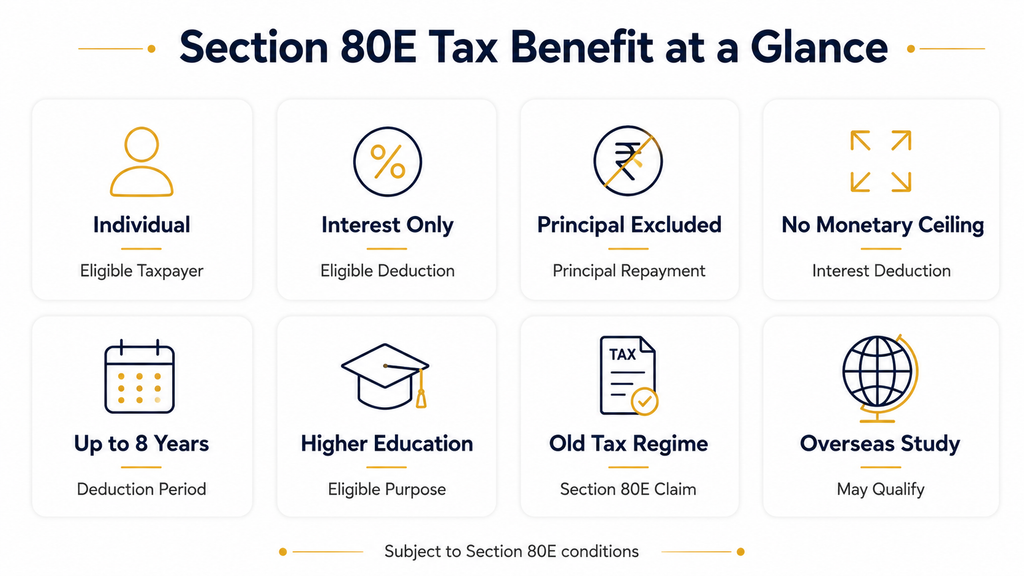
Section 80E tax benefit at a Glance.
| Factor | Current section 80E position |
| Eligible taxpayer | Individual |
| Deductible element | Qualifying interest paid. |
| Principal repayment | Not deductible under Section 80E. |
| Maximum amount of interest- | No monetary limit on Section 80E |
| Limit of period of time | First year of assessment plus seven consecutive assessment years. |
| Qualifying education | Qualifying higher education following Senior Secondary or equivalent. |
| Eligible student | Self or qualifying relative |
| Tax regime | Usually applies in making a decision in the old tax regime. |
| Study abroad | It can be qualified in case of statutory requirements. |
| Eligible lender | Financial institution or approved charitable institution that meets the statutory definition. |
The Section 80E tax benefit may thus be construed as a deduction of interest, instead of a tax rebate of a particular amount. The real decrease in tax liability will depend on the total taxable income of the tax-paying entity, the rate of tax, cess, surcharge where relevant and other tax conditions.
What is the Section 80E Tax Benefit?
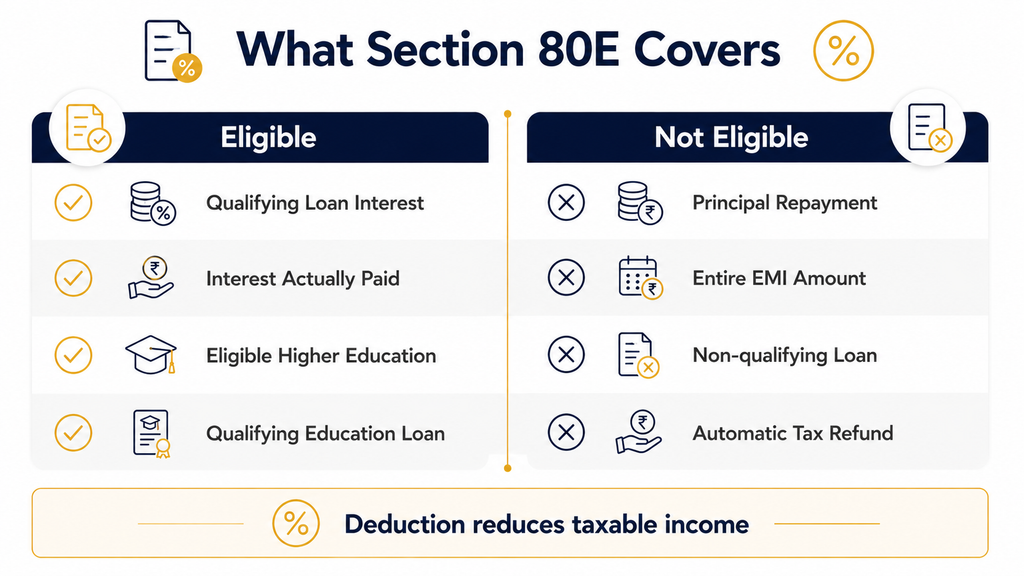
Section 80E tax benefit entitles an individual who is qualified to deduct the qualifying interest amount paid on an educational loan taken for higher education. The deduction is limited to interest, but not the principal repayment amount.
Under Section 80E tax benefit, there is no laid-down limit on the amount of qualifying interest deduction that has to be in monetary terms. Nevertheless, the amount claimed should satisfy the required applicable eligibility, lender, payment and deduction-period requirements.
What can you deduct?
- Interest charged on an education loan actually paid during the period in the financial year in question.
- Interest on a loan that is eligible and used to finance eligible higher education.
- Interest qualifies without a limit to a certain amount of deduction.
Instead of receiving a straight refund of the interest that was paid, the tax benefit on an education loan only lowers the income tax to be paid to the government.
Who Is Eligible to Receive the 80E Deduction Education Loan Benefit?
The provision of 80E deduction education loan is applicable to any person who fulfils the requirements of the law.
You can borrow a higher education loan in the form of a qualifying loan of:
- The taxpayer personally.
- The taxpayer’s spouse.
- The taxpayer’s children.
- A student whose taxpayer is the legal guardian.
This definition of a relative in Section 80E is specifically applied to these relationships in the statutes.
Important rule for parents and co-borrowers
How one happens to be a parent or co-applicant does not in itself qualify the deduction.
The individual who asserts the Section 80E tax benefit is required to be in compliance with the requirements of Section 80E, such as that such qualifying interest is paid to such an individual on the basis of income that is subject to tax charge and that the loan used to do the same is also in compliance with the stipulations of the law.
Parent Tip: Have loan records and interest records issued by the lender containing identification of the borrower and the payment of the qualifying interest.
Check out: Government education loan for students to study abroad
What Education Loans Do Qualify under Section 80E?
Not all loans incurred to pay university expenses automatically qualify.
To be eligible to claim an education loan tax exemption that is often referred to as Section 80E, the financing should meet a statutory definition of a qualifying higher-education loan.
Check these four factors
- Purpose: The loan should be borrowed in the name of a qualified higher education.
- Borrower: The one making the claim must meet the requirement of Section 80E.
- Lender: This loan has to be advanced by a qualified institution.
- Payment: The deduction refers to the amount of eligible interest paid in the applicable year.
Section 80E: The term higher education is wider and includes a course of study undertaken once one has successfully written the Senior Secondary Examination or any equivalent examination by a recognised school, board, university or other recognised authority.
How about personal loans?
There would be no automatic classification of a general personal loan as one that qualified because the proceeds were subsequently used to pay education.
Education loan students who are interested in the tax deduction on the loan must ensure the structure of a loan, lender eligibility, and then presume that their interest payments are due to call.
Would You Be Eligible to Claim Section 80E to Study Abroad?
Overseas higher education can have the Section 80E tax benefit, so long as the conditions are met. The most important consideration is the lender; not all foreign lenders or other international financing platforms are automatically eligible.
| What to Check | Requirement |
| Higher education | Qualified overseas study may be eligible. |
| Lender | Should be as defined in Section 80E. |
| Foreign lenders | Do not presuppose full eligibility. |
| Approved charity institution | May qualify on specified terms |
Notice: When using the education loan tax exemption, make sure that the lender is eligible, especially in cases where the borrower has taken an international loan or foreign financing facility.
How is the Section 80E Tax Benefit Claimed?
Section 80E is silent on an unlimited deduction period.
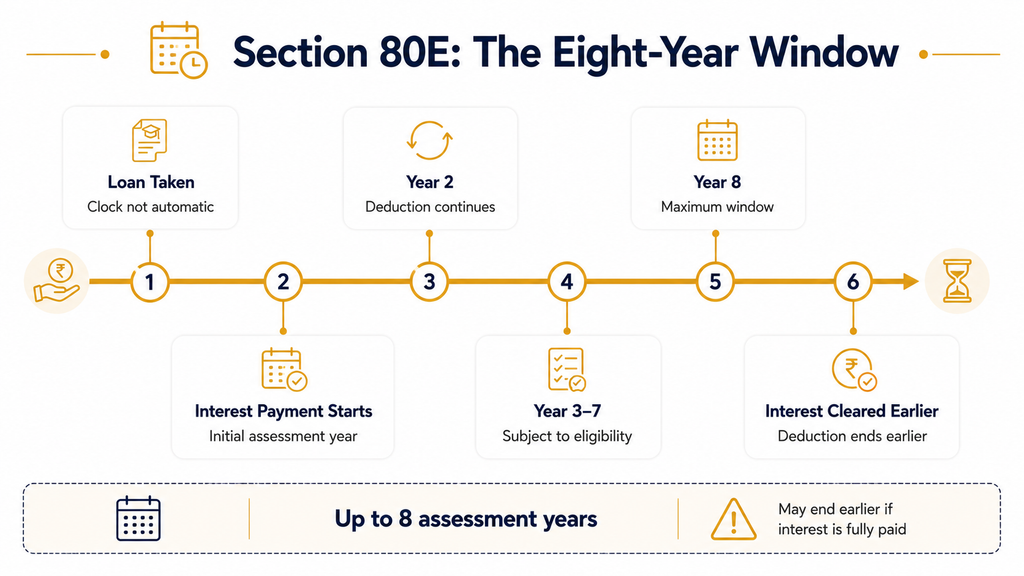
The first assessment year and seven consecutive assessment years immediately preceding the year in which the qualifying interest is fully paid, or the period ends with the first of them, whichever occurs first.
The “initial assessment year” is linked to the previous year in which the taxpayer starts paying interest on the qualifying loan.
Simple timeline
| Repayment stage | Section 80E implication |
| Until interest payments on qualification commence. | The deduction period has not commenced due to the existence of the loan. |
| Year qualifying interest payment starts. | The relevant first year of assessment is activated. |
| The seven following assessment years. | Deduction is optional, provided there is eligibility. |
| Interest cleared earlier | Deduction is terminated when an allowed interest is paid. |
| Interest will accumulate after the allowed time. | Interest that accrues later cannot keep enjoying Section 80E deduction. |
This brings about repayment planning in the assessment of the Section 80E tax benefit on educational loan.
Repayment Tip: Do not borrow more money just to maintain a tax deduction. Compare the sum of interest saved by accelerated repayment to any tax benefit.
The maximum tax that can be saved in Section 80E
Section 80E tax benefit is subject to the circumstances of the taxpayer, not the rate of interest of education loans.
Assume that a qualified borrower is paying ₹2,00,000 in qualified interest within a financial year.
The deduction would have a potential of ₹2,00,000, which is subject to applicable provisions. That does not imply that the borrower will get back ₹2,00,000.
Why exact savings differ
Impact on taxes can be based on:
- The gross pre-deductible income.
- Relevant slab of old-regime income-tax.
- The deduced income will be influenced by the marginal tax rate.
- Health and Education Cess.
- Any applicable surcharge.
- Other revenue, deductions and any taxes.
- Eligibility to decide and make the right choice in favour of the old regime.
So, it can be deceptive to publicise only one universal figure, which is the Section 80E saves X% figure.
Tax Planning Notice: Plan tax liability under each of the two available regimes based on your total income and total deductions, and pick the regime you want based on the fact that you have Section 80E available.
Terminology: Education loan tax exemption is usually written on the internet, but technically Section 80E is a deduction from the total income as opposed to an exemption from repayment or interest on the loan.
Check out: EMI Calculator: How to estimate loan payments, interest, and affordability
Does the New Tax Regime Have Section 80E?
No, Section 80E is not one of the Chapter VI-A deductions one has chosen in case of the new tax regime selection per the existing regulations.
The Income Tax Department validation regulations applicable to AY 202627, explicitly contain Section 80E amongst deductions, which are not claimable in case of the new tax regime chosen.
Taxpayers wishing to claim the Section 80E tax benefit must, therefore, look at their overall tax position for the old and new regimes, not at this deduction alone.
The default regime is the new regime; it is, however, subject to the filing requirements, and eligible taxpayers may choose to use the old regime.
How to Claim Section 80E in filing your ITR?
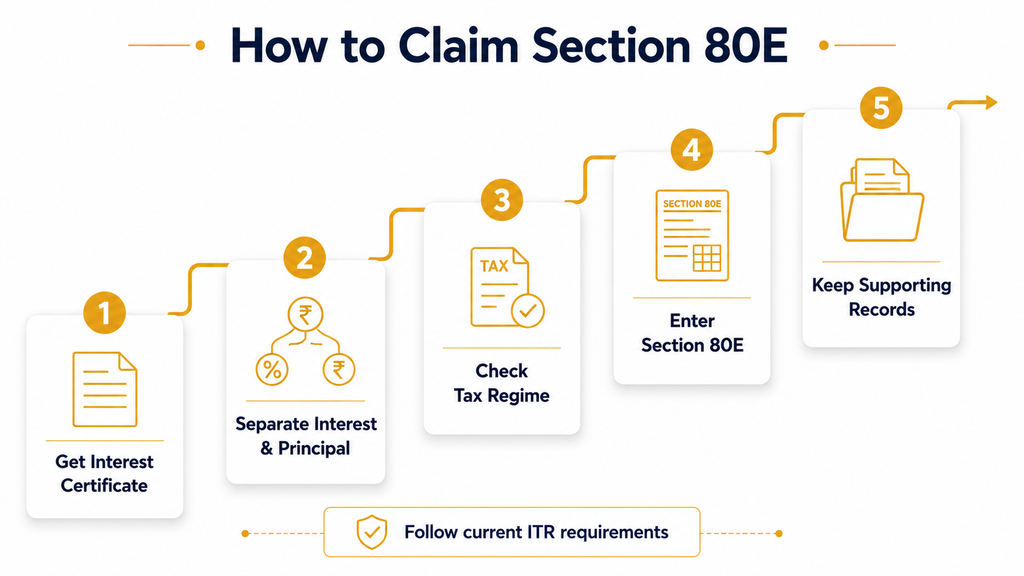
The Section 80E tax benefit will necessitate accurate information on the interest.
- Obtain your interest information: Ask the lender to provide you with an education-loan interest certificate or similar statement indicating the applicable interest component.
- Separate principal- interest: Does not claim all the EMI. Section 80E relates to the qualifying interest and not the principal repayment.
- Check your tax regime: You should make sure that you qualify and have properly made your choice over the old tax regime where applicable.
- Record the allowable deduction: The qualifying amount should be entered in the corresponding Chapter VI-A/Section 80E of an applicable income-tax return.
- Preserve supporting records: Keep the loan contract, interest certificate, evidence of repayments and any other documentation.
Notice: The specific ITR interface and reporting may vary across assessment years. It is to be filed in accordance with the relevant direction of the Income Tax Department.
Moratorium Interest and Eight-Year Window.
Moratorium postpones frequent repayments, though it does not prevent the accrual of interest in terms of a lender. In the case of Section 80E tax benefit, it is anticipated that the deduction period commences when the taxpayer initiates paying qualifying interest.
Consider: Before the payment of interest during the moratorium takes place, consider:
- Whether you have taxable income under the old tax regime.
- Compliance with Section 80E in the payment of interest.
- The eight-year deduction window and how early payments could impact it.
- Can you save overall cost of borrowing by repaying early?
The Section 80E tax benefit of a loan taken to fund education in the country needs to be evaluated with the total interest and plotting of a repayment.
Some of the prevalent Section 80E Mistakes to be circumvented
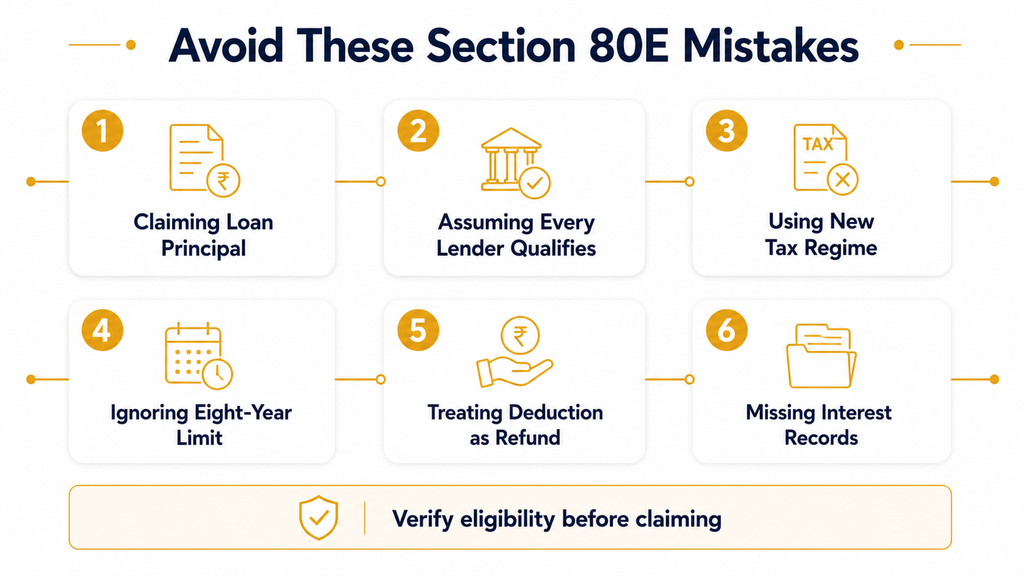
Claims can be undermined or nullified by the following fallacies:
- Looking to claim principal repayment as opposed to interest, which qualifies as a Section 80E tax benefit.
- The assumptions made include that all lenders will be qualified without verifying the relevant Section 80E lender requirements.
- Making a claim on the Section 80E tax benefit for education loans under the new tax regime.
- Avoidance of the eight-year time frame on deductions of interest on education loans.
- Billing the borrower and payment terms without fulfilling the borrowing terms and conditions.
- Treating the tax benefit on education loan as a refund instead of a taxable-income deduction.
- Prolongation of loan period with the sole aim of saving tax, which could lead to higher interest expenses.
- Failure to keep interest certificates and remittance accounts of the education loan to claim the tax exemption.
By being able to read these points, it becomes more justifiable and economically reasonable to claim the 80E deduction for an education loan.
Should You Pay off an Education Loan in Eight Years?
Indicatively, an overseas education loan can be a 10- or 15-year loan depending on the borrower profile and the lender. The deduction under section 80E has not been made automatically to match that tenure.
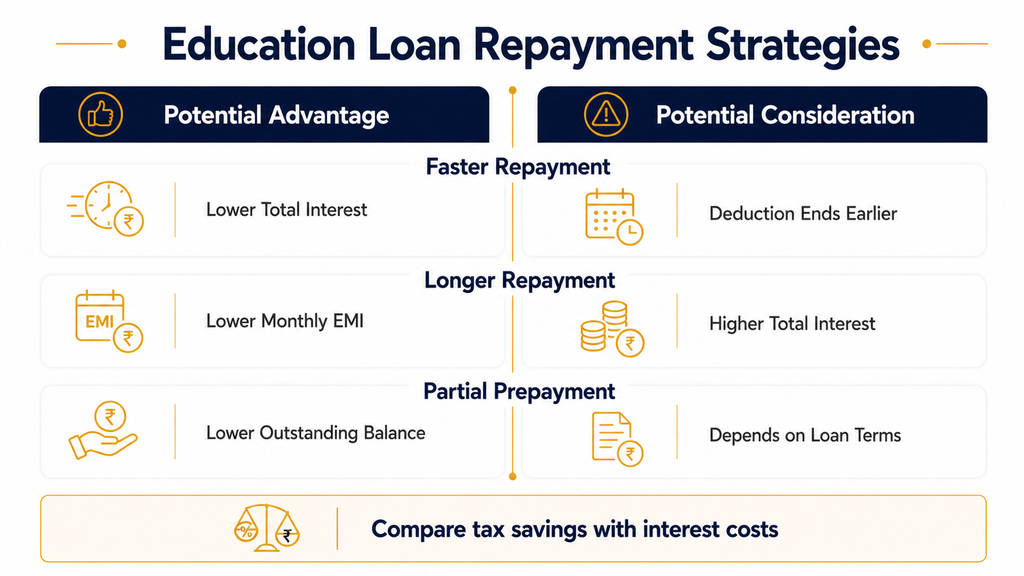
| Strategy | Potential advantage | Potential drawback |
| Shorter cash-through time repayment | Reduction in total interest payment | Section 80E deductions commenced sooner. |
| Multiplexed repayment | Reduced monthly EMI can enhance cash flow | Multiplexed repayment can lead to higher cumulative interest. |
| Partial prepayment | Lowers outstanding balance, but still keeps the money liquid. | The benefits are based on the cash position and terms with a lender. |
The value of a Section 80E tax benefit lies in its qualification of underlying interest payment in reducing tax liability.
Borrowing Rule: Do not take unnecessary interest, just to get a deduction of only part of that interest.
How can it be helped with Foreign Edu Loans?
Foreign Edu Loans assist students in making comparisons of overseas education-loan programs depending on their course, university, funds required and their profile. The question of lender eligibility and repayment should also be part of the considerations of students who want the Section 80E tax benefit.
Support may include:
- Evaluation of possible appropriate education loans.
- Knowledge of secured and unsecured financing.
- Reviewing education-loan eligibility.
- Assembling pertinent loan paperwork.
- Addressing the process of education-loan application.
Last approval, approved interest rate, approved amount and loan terms are open to change based on the credit evaluation and policies of the respective lender.
Application: Check Your Education Loan Eligibility. Know what some of your university, course, funding needs and co-applicant profile education-loan solutions are.
FAQs
What is the tax benefit under section 80E?
The section 80E tax allowance is to enable individuals to claim eligible deductions on the interest on an education loan under the old regime tax system.
Is the limit of Section 80E deduction maxed?
There is no monetary ceiling in relation to the qualifying interest, but the deduction is subject to the conditions of Section 80E.
Are parents eligible for the 80E deduction education loan benefit?
Yes, the qualified parents could avail of the 80E deduction education loan benefit at the time of meeting statutory borrowing and payment requirements.
Is overseas study covered under Section 80E?
Yes, it can apply in regard to higher education that is obtained abroad, under the condition that the borrower, loan, and lender satisfy the requirements.
Deductibles: Is principal deductible?
No. Section 80E tax benefit on education loan has a restriction on eligible interest payments.
Is the new taxation regime Section 80E available?
No. Education loan tax exemption, which is usually synonymous with Section 80E, does not apply under the new regime.
Enduring to what length is the deduction?
The deduction is applicable up to a maximum of eight years in which the assessment is to be made or until the payment of qualifying interest, whichever is lower.
Conclusion
The Section 80E tax benefit may decrease taxable earnings to qualified borrowers paying suitable interest on higher education loans, such as loans relating to overseas studies, provided statutory requirements are met. Its value is determined by the actual tax position of the taxpayer and not on a percentage or saving that is constant given the tax position.
You must ensure that the lender is eligible to claim the deduction; determine the interest paid, know when your 8-year term expires and ensure that the tax regime you are in allows the claim. Your repayment plan should not be determined by the Section 80E tax benefit but must at least be supported by it.
Some of the criteria to be considered when comparing education loans include total cost of borrowing, flexibility of repayment, and terms of the lenders, as well as taxation.
Check Your Education Loan Eligibility to explore funding opportunities that best match your study-abroad profile.
Pingback: Know the Rules for an Education Loan for Online Courses