A student can be refused an education loan despite the fact that he has been accepted by a recognised foreign university. The most predominant education loan rejected reasons are credit history, co-applicant finances, academic profile, university or course eligibility, requested loan amount, collateral, and documentation.
It would be significant to know why an education loan is denied since admissions do not act as the sole determinants of lenders. They will investigate whether the entire profile of the borrower can match their underwriting as well as repayment-risk needs.
This guide describes education loan rejected reasons by lenders, the efforts of lenders in relation to various risk factors, as well as how it is possible to get an education loan once more without believing that changing lenders can automatically remedy the underlying situation.
Accuracy Warning: Eligibility for education-loan programs, interest rates, loan-sums, collateral-needs and repayment-terms differs among lenders and applicant-types. The appropriate terms and final approval are set by the respective lender.
How to have an Education Loan Approved: Loan Screeners Determine Risk.
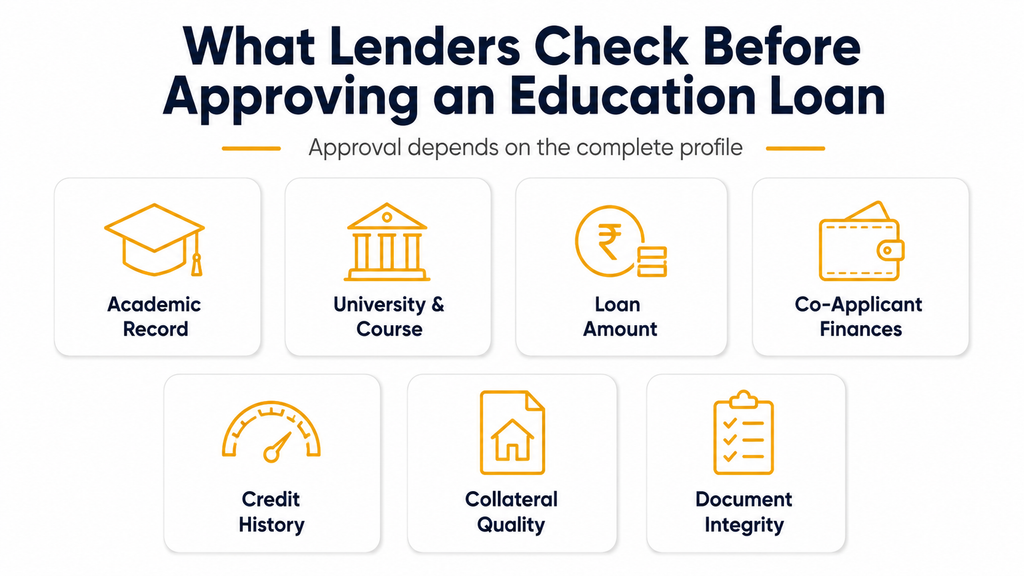
An education loan is rejected because, first of all, we have to understand underwriting. Education lenders are not in the habit of using a single figure, but tend to determine things based on numerous factors that are interrelated.
These can include:
- Scholastic record and proven admission of the student.
- The university, course, destination and study level.
- The amount of loan requested and the cost of education altogether.
- The income and financial requirements of the co-applicant that have been recorded.
- Background credit of applicants.
- Quality of collateral for secured applications.
- Integrity and integrity of documents presented.
As an example, ICICI Bank mentions that education-loan assessment is able to look at the applicant or co-applicant profile, credit profile, existing EMIs and institute category. Its published data also affirm that recognised institutions and verifiable co-applicant income could be part of the assessment of eligibility.
So, causes of rejection of education loan vary depending on each application.
Read out: Common Overseas Education Loan Problems & Solutions
6 Major Education Loan Rejected Reasons You Should Know
1. Weak Credit History
The issue of credit is a significant education loan rejected reasons since the lenders review the repayment record and financial stability.
A lender may review:
- Previous loan repayment behaviour.
- Credit-card payment history.
- Current overdue accounts.
- Existing loan obligations.
- Recent credit enquiries.
- Co-applicant creditworthiness.
There is no magic credit score to ensure that someone gets an education loan with all the lenders. There are indicative credit-score guidelines published by some lenders, but ultimate judgment is based on the general profile of the applicant.
Credit Check: A given CIBIL score is not to be considered a standard pass-all test.
What should you do?
- Assess your recent credit record, then reapply.
- Check closed accounts and outstanding balances.
- Definite valid overdue payments, where feasible.
- Dispute genuine credit-reporting errors.
- Do not apply several applications without establishing the education loan rejected reasons.
These measures will help resolve key education loan rejected reasons, and credit enhancement is not sufficient to get approval.
Check out: Reasons Why Student Loan Application May Face Rejection
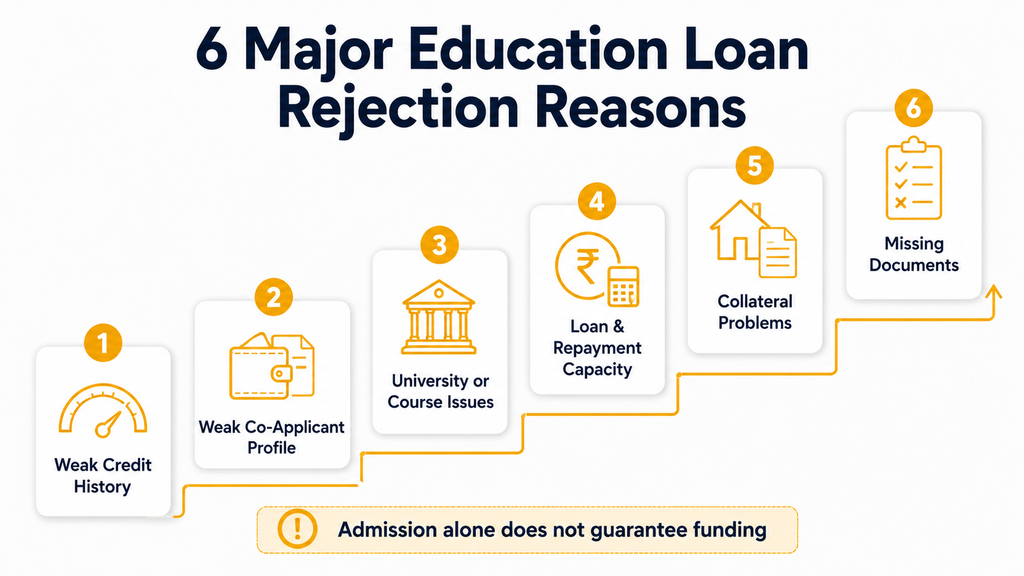
2. Weak Co-Applicant Financial Profile
The co-applicant can affect the fact that an education loan is denied due to earning, credit history, and ability to repay the loan, as the lenders might evaluate the level of income, credit report and ability to pay.
- Lack of or inadequate income records.
- Existing high EMI obligations.
- Irregular financial records.
- Weak repayment history.
- Significant outstanding debt.
- Missing financial documents.
The minimum income amount in banks and NBFCs, as well as the loan products, can differ.
What can be done to enhance the application?
Where available, look at a qualified co-applicant with appropriate income, credit history and documentation.
Parent Tip: Read the current EMIs since lenders might determine the household repayment ability and approve the loan.
3. University, Course or Academic Profile Issues
The other classification of education loan rejected reasons pertains to the type of education and where the student wants to study.
Lenders can assess:
- Their capability to meet the eligibility requirements at the institution.
- Familiarity or approval of the school.
- Type of course and qualification.
- Student’s previous academic performance.
- Unexplained academic gaps.
- Backlogs or unfinished qualifications.
- Professional opportunities relevant to the programme.
The education-loan eligibility structure of ICICI Bank includes recognised and accredited institutions. Other factors considered by Axis Bank to influence applications are academic performance and course-related considerations.
Admission will not necessarily imply all the lenders will finance the programme.
Before applying again
- Your university.
- Your specific programme.
- Your study destination.
- Your qualification level.
- Funding structure you need.
This check will be able to hold up another application on the grounds of rejection of the same education loan.
4. Amount of Loan and Repayment Capacity requested.
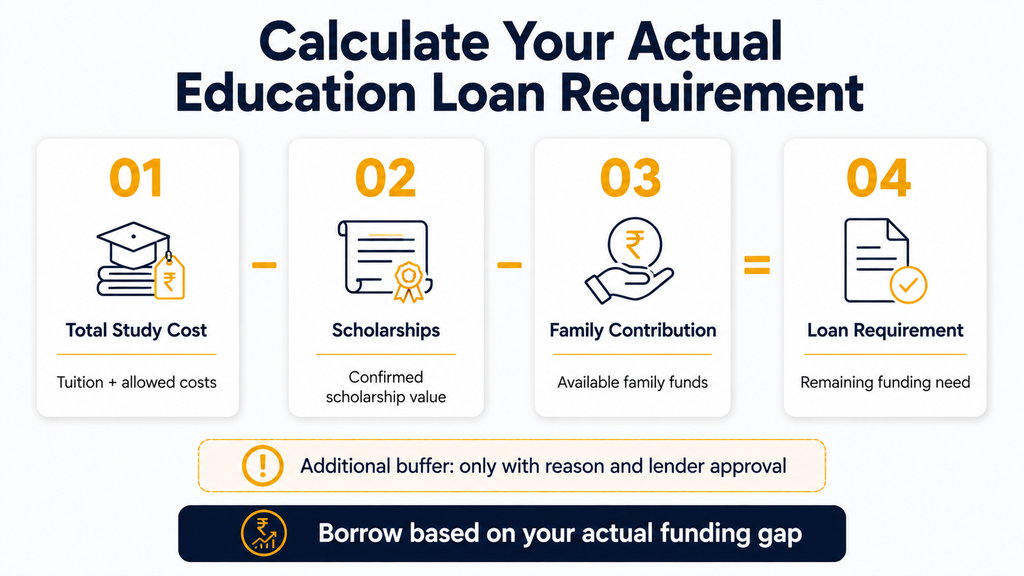
A good offer as presented by a university does not mean that the requested amount will be funded as long as it is not equal to the lender’s assessment. This may be the reason why an education loan is rejected.
Rather than asking how much you want, make a calculation of the gap in your actual funding.
| Funding Calculation | What to Include. |
| Cost of total study | Tuition and allowed costs of education. |
| Less scholarships | Confirmed scholarship values. |
| Less family contribution | Available family funds |
| Remaining requirement | Required loan amount for education. |
| Additional buffer | Only with reason and conditional by the lenders. |
Borrowing Rule: Borrow to the extent you require funding and to which you are sure to pay off.
The interest rates can depend on the lender, the size of the loan, the course, a specific institution, the security, and the type and profile of the applicant. As such, the promoted initial rates cannot be believed to be the ultimate rate that every candidate will receive.
5. Collateral Problems in Secured Education Loans
One major cause of education loan denial on secured applications is collateral-related issues.
One of the properties might seem worth a lot of money yet unworthy of a lender.
- Poor title or ownership.
- Missing property documents.
- Existing legal disputes.
- Unacceptable property category.
- Existing Burdens on eligibility.
- Appraisal not enough to support the suggested structure.
- Property which does not meet lender-specific legal criteria.
The level of collateral requirements is regarded differently. As an illustration, ICICI Bank includes property and fixed deposits in the list of security types for a range of education-loan products, and Axis Bank states that collateral can be requested in certain cases.
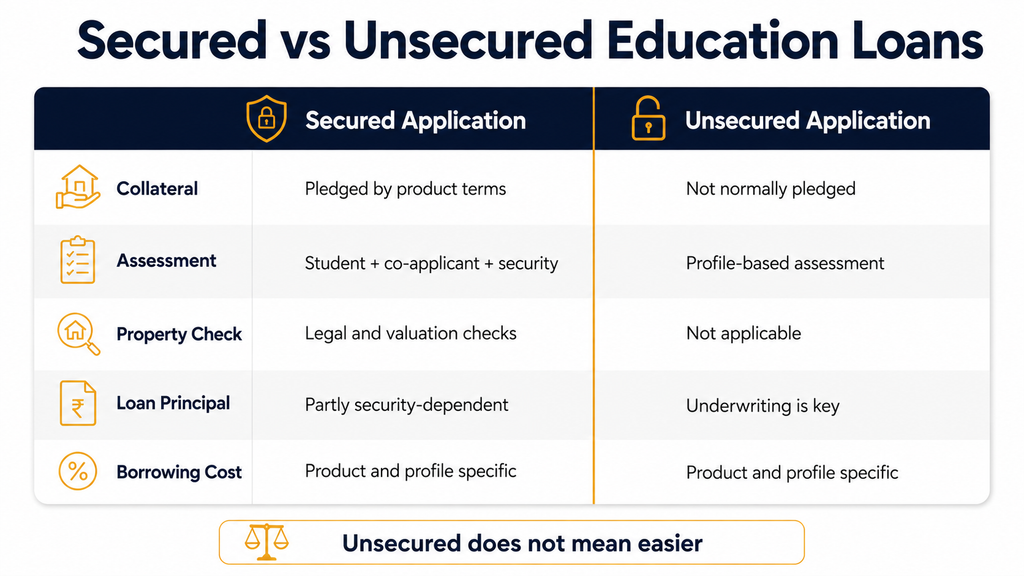
Secured and unsecured applications.
| Factor | Secured application | Unsecured application |
| Collateral | Pledged by terms of products | Not normally pledged. |
| Assessment | Student, co-applicant and security more | robust profile-based assessment. |
| Check of property | May entail legal and valuation check | Not applicable in a property-free structure. |
| Loan principal | The acceptable security determines this in part | Lender underwriting is key. |
| Cost of borrowing | Product and profile specific | Product and profile specific |
What this implies to you: An unsecured loan is not necessarily simpler, and valuable property does not necessarily qualify an application as obtaining a secured loan.
6. Missing or Inconsistent Documents
Students tend to ignore documentation issues when education loan rejected reasons.
In the guidance, ICICI Bank outlines a list of documents, such as admission information, academic records, identity/address documents and co-applicant income proof, as those that would be relevant in education-loan processing.
Student documents
- Always have it up-to-date and legible, and send your education loan application with identity and address documents.
- Make sure that academic records are always included with the right personal information in all the documents submitted to the lenders.
University documents
- Send the existing admission or offer letter with appropriate programme and institution details.
- Have the most recent university fee structure to compute your realistic funding requirement in education.
Co-applicant documents
- Present full-income documentation as per the requirements of the particular lender to your category of employment.
- Make certain that the information of income being stated in the loan application is supported in bank statements and other financial documents.
Collateral documents
- Gather full ownership and property records prior to initiating legal checks in a secured education loan.
- Fix any known title or documentation anomalies prior to basing the asset on that asset as security for education loans.
Prior to Submission: Document requirements also depend on the lender, borrower profile, the loan structure and the collateral type and are known as the specific document checklist.
How to Get an Education Loan After Rejection: A Practical Process?
Students who seek information on how to get an education loan after rejection need to do so without rushing to submit the same application to a large number of lenders.
Step 1: Determine the root rejection problem.
Enquire of the lender the education loan rejected reasons behind the unsuccessful application where possible. Check the file that was submitted also.
Categorise the problem under:
- Co-applicant
- Credit
- Academic profile
- Loan amount
- Institution or course
- Collateral
- Lender-specific eligibility
- Documentation
Being aware of the underlying issue makes it more straightforward to tackle education loan rejected reasons in a systematic manner.
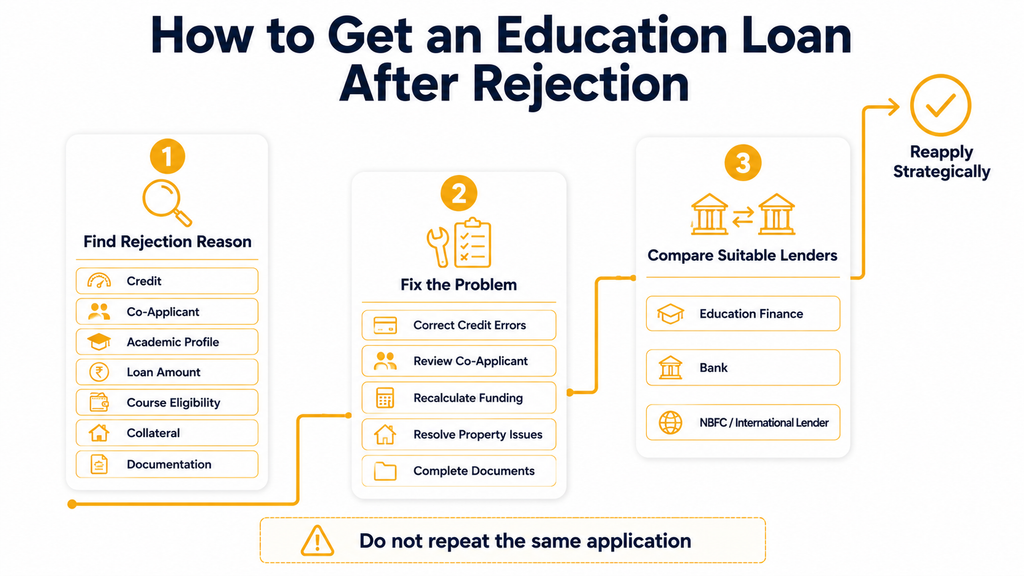
Step 2: Fix problems right and then redo.
Problem-related solutions vary according to the problem.
| Identified problem | Corrective action that may be taken. |
| Credit report error | Contest actual inaccuracies with the appropriate bureau or lender. |
| Ineligible co-applicant profile | Check out another qualified co-applicant where lender policies allow. |
| Inadequate loan demand | Recompute expenses, scholarships, and family contributions. |
| Property issue | Discuss another security which is approved by the lender. |
| Documentation gap | Complete and reconcile the required records. |
| Ineligible university/course | Explore lenders whose current policies cover the programme. |
The existing advice of the ICICI bank also implies that it is possible to reinforce co-applicant data, filling up the mandated documents and enhancing the credit history in case of poor initial qualification.
Step 3: Compare appropriate categories of lenders.
The necessity to know how to acquire an education loan after being rejected may include evaluating banks, NBFCs and, as applicable, foreign education lenders.
| Factor | Education-finance | Bank | NBFC International lender. |
| Collateral | Depends on product | Depends on product | Depends on lender |
| Eligibility | Product and profile specific | Product specific | Programme and lender specific. |
| Interest | Applicant and product specific | Applicant and product specific | product specific |
| Co-applicant | often relevant | Often relevant | Sometimes can be other structure. |
| University assessment | May apply | May apply | Often important |
| Currency | Usually INR | INR in most cases, when dealing with the Indian lenders | May not be the same |
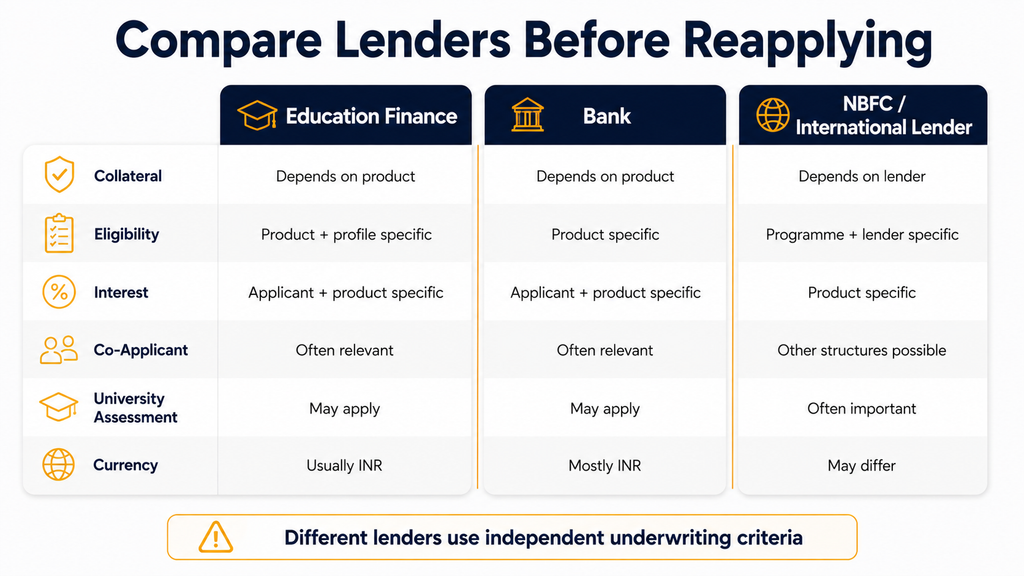
Do not expect an NBFC to grant an application the green light because a bank has refused the same. Independent underwriting criteria exist among each lender.
This differentiation is necessary in considering education loan rejected reasons.
Common Mistakes After an Education Loan Rejection
Students who are doing research on the ways of obtaining an education loan after rejection should avoid making the following mistakes:
- It is advisable to disregard the education loan rejected reasons and make another application.
- Having an excellent credit rating is equated to the approval of loans.
- Switching lenders without checking university and course eligibility.
- Disregarding co-applicant liabilities and pending EMI liabilities.
- Asking to borrow more than the amount of funding asked.
- Turning in incomplete, erroneous or conflicting loan applications.
- Looking at advertised rates alone in considering the education loan rejected reasons.
- Loan approval is given automatically as there is some form of collateral that is valuable.
The assistance of Foreign Edu Loans.
Foreign Edu Loans may assist students who might have education loan rejected reasons in exploring appropriate financing options.
- Check your student profile, university profile, co-applicant profile and funding profile.
- Find the appropriate banks, NBFCs and international lenders.
- Compare rates of loans in terms of funding needs.
- Confirming checks prior to applying for a second loan.
- Invest in the appropriate secured and unsecured education loans.
- Application to qualified lenders for education loans.
- Loan terms and final approval depend on the actions and judgment of the respective lender.
- Estimate your eligibility for an education loan.
Know which education-loan solutions can best fit your university, course, funding need and co-applicant profile.
FAQs
What are the most obvious education loan rejection reasons?
The most common education loan rejected reasons are: bad credit background, insufficient co-applicant repayment, inappropriate course eligibility, collateral, and missing paperwork.
How can an education loan be rejected despite admission to the university?
Rejection of an education loan, even though there is admission, is dependent on the evaluation of credit, finances, eligibility of courses, amount of loan and documentation by the lender.
Will a low CIBIL score lead to rejection of an education loan?
Yes. Bad credit history will influence approval, though not all creditors will accept all credit scores.
Is it possible to submit to a different lender?
Yes. Identify the education loan rejected reasons, correct them and submit another application.
Will the replacement of co-applicant enhance the possibilities of approval?
It can be advantageous if some other qualified co-applicant has a higher income, fewer liabilities, and fair credit.
What to do when an education loan is refused?
To know how to take an education loan when rejected, find out the rejection reason, fix weaknesses, check mobile-eligible lenders and reapply keenly.
Are loans that have been rejected by banks approved by an NBFC?
Not automatically. NBFCs and Banks adhere to another set of underwriting guidelines, eligibility requirements and risk-reciprocity strategies.
Is it advisable to lower the amount I am requesting in the loan?
Reduction should be considered only after the actual funding gap is less due to the scholarships or family contribution.
Conclusion
Knowledge of education loan rejected reasons provides students with an additional point of departure in enhancing a rejected application. Check credit history, co-applicant finances, university and course eligibility, loan requirements, collateral and documentation and reapply.
The appropriate response to be taken is based on the type of rejection. Others might require superior documentation; other applicants might require an otherwise eligible co-applicant, alternative arrangement of funding, alternative security or a lender with policies more suited to their programme.
Also, interest rates and terms of loans must be compared based upon the amount required in a loan and the entire profile of the applicant and not on the advertised rates alone.
Check Your Education Loan Eligibility to research the right choice, keeping in mind that ultimate approval and terms are still subject to evaluation by the lender.