A co-applicant in education loan is usually someone who enters alongside the student in the education loan and has a contractual obligation to the loan documents as specified by the lender. It is typically played by parents or guardians, with acceptable relationships depending on the lender and product. In the case of a married applicant, a spouse or parents-in-law might also be accepted by some lenders. To illustrate, the Bank of Maharashtra provides that a co-applicant should be ordinarily a parent or natural guardian and a spouse or parents/parents-in-law may be considered in the case of married borrowers.
The selection of the right person is important since lenders can determine their income, credit history, existing liabilities and capacity to repay the loan in general. Nevertheless, no one income, credit score, or age criterion fits all lenders.
Accuracy Note: Co-applicant eligibility, acceptable relationships, credit evaluation, amount of money lent, level of security and interest rates differ by code and products. Always check existing terms prior to application.
Check out: Education loan without collateral: Eligibility, lenders, costs, and application steps
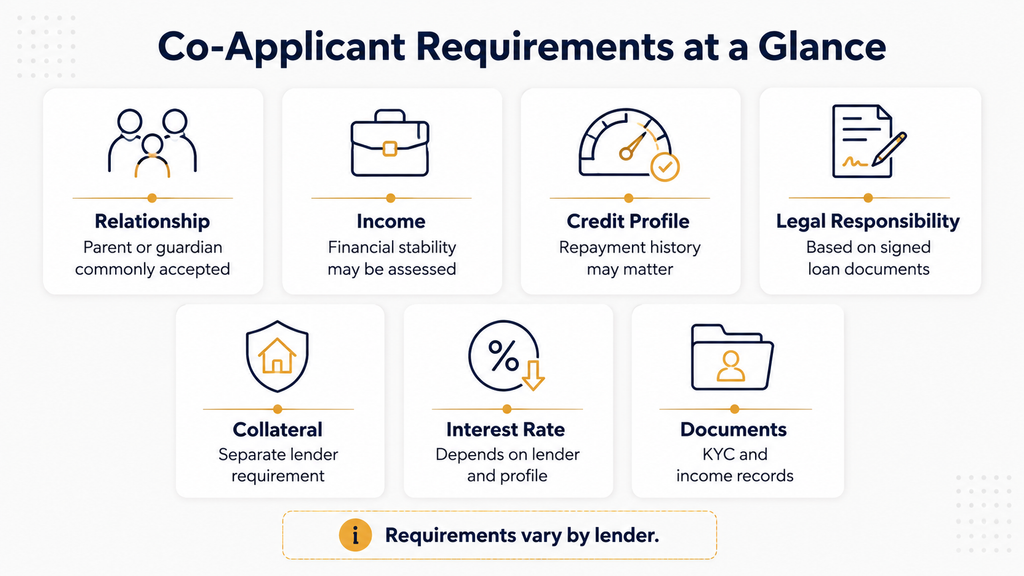
Co-applicant in education loan Requirements at a Glance
| Factor | What the borrowers need to know. |
| Relationship common | Parent or guardian; other relations based on lender policy. |
| Income | Can be evaluated, especially as a lending profile. |
| Credit profile | Repayment record and any current liabilities can be considered. |
| Legal responsibility | By executed loan documents and terms of the lender. |
| Collateral | This is independent of whether one is a co-applicant; collateral requirements differ. |
| Interest rate | Varies according to the lender, product, loan amount and applicant profile. |
| Documents | KYC, income, banking and employment/business documents may be required. |
What it implies to you: You should not choose a co-applicant in education loan on the grounds that the relative tends to have the highest income. Determine whether the lender is comfortable with the relationship and whether the overall financial profile of the individual fits their underwriting policy.
What is a Co-Applicant in Education Loan?
In a co-applicant in education loan is the one who is co-applicant with the student and is sometimes referred to as a co-borrower or joint borrower. In certain versions of the Model Education Loan Scheme, parents or guardians are co-lenders. Consequently, the co-applicant in education loan can bear the burden of repayment by providing financial documents.
- Read all the repayment requirements in sanction and loan documents.
- Establish that the lender is treating the parties as a borrower.
- Know how default in repayment would impact the credit profile of each borrower.
- Look at collateral obligations individually as compared to joint-borrower obligations.
- Questions to be asked include how they expected repayments during the moratorium and after the moratorium.
An education loan co-signer must also clearly realise the true contractual responsibility rather than depending on terminologies.
Who Can Be Co-applicant in education loan?
No common list can answer the question of who is eligible to be a co-applicant in education loan with all Indian banks, NBFCs and foreign lenders.
Commonly Accepted Relationships
The natural guardians or parents are the typical choice in many customary bank products. Certain products permit more than one relationship in a certain situation.
As an illustration, Bank of Maharashtra now mentions:
| Student circumstance | Possible co-applicant as per published policy. |
| Parent or natural guardian | Unmarried student |
| Married student | A spouse, parent or parents-in-law may be taken into account. |
| Other relative | Subject to the policy of the lender/product. |
The published Skill Loan Scheme of SBI also entails requiring a parent or a guardian as a joint borrower with the option of having a spouse as a co-borrower.
Various underwriting policies can be implemented by the private lenders. Hence, siblings and uncles, aunts or other family members should not necessarily be provided as universally acceptable.
Loan Tip: Before organising financial documents of an extended-family member, it is wise to ask the shortlisted lender who can be a co-applicant in education loan.
What Do Lenders Check in Co-Applicant?
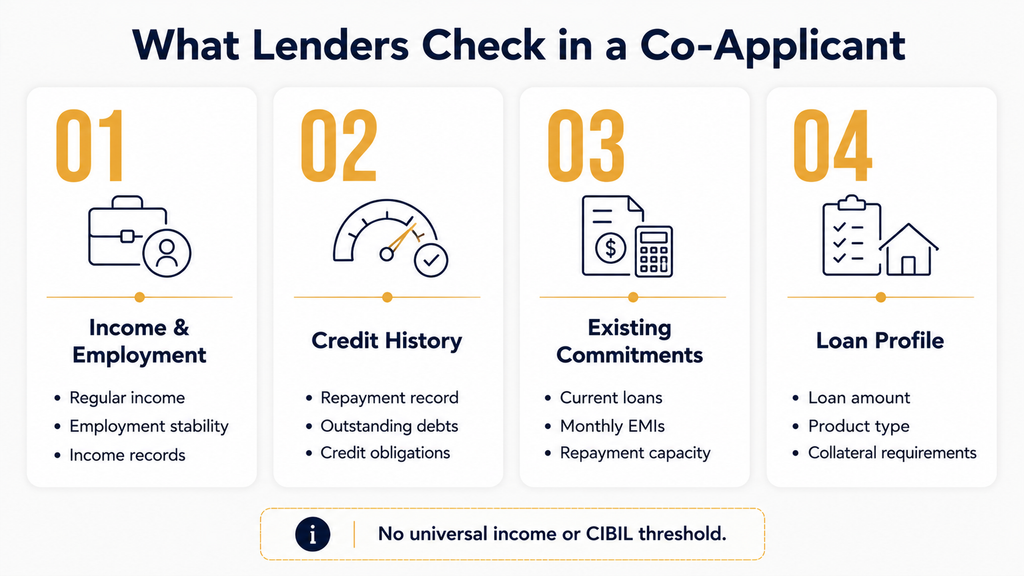
In determining the eligibility of a co-applicant in education loan, the assessors typically look at relationship eligibility, financial stability, credit history and repayment power.
Income and Employment
- The lenders can look at monthly incomes, job security, wage history, business statements and other income-tax filings.
- The lenders can also make judgments based on the current loans and monthly EMIs on the total repayment ability.
- No co-applicant in education loan has a common minimum income requirement.
Credit History
- Lenders can review the history of repayment, accounts due, outstanding debts, credit enquiries and other outstanding credit commitments.
- The specific score on the CIBIL does not necessarily grant approval since not all lenders use the same credit requirements and underwriting policies.
Existing Financial Commitments
- An education loan applicant with high prevailing EMIs as a co-applicant might not be able to make more repayments.
Product and Amount of Loan.
- Increased loan requirements might include further evaluation of income, security, university, course and general ability to repay.
- Depending on the amount of the loan, the product and the policies of a lender, co-applicant requirements and interest rates may differ.
Does a Strong Co-Applicant Improve Education Loan Eligibility?
An education loan application can be enhanced with a financially stable co-applicant whose borrowing capacity is looked at by the lender in terms of repaying the loan.
As an example, Avanse says that a strong co-applicant in education loan can enhance an application by financial strength.
The potential benefits can be realised in:
- An enhanced combined repayment-capacity analysis.
- Increased eligibility to some profile-based products.
- Increased advocacy in favour of increased funding requirement.
- Better eligibility of certain unsecured lending products.
There is no guarantee that a financially sound co-applicant in education loan will be approved, have a larger loan amount or have a lower interest rate. Another area that is taken into account by the lenders is student profile, university, course, country, collateral, and loan requirement.
Interest Rate Check: Final rates are different depending on the lender, the amount of the loan, the product and the overall profile of the borrower.
Read out: Education loan with collateral: How it works, what you can pledge, and how to apply
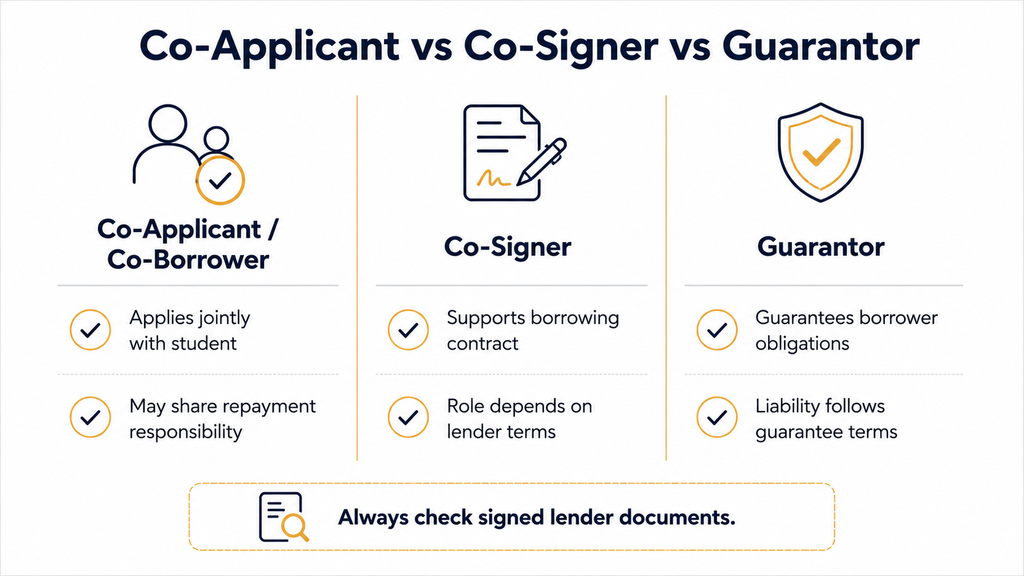
Co-Applicant vs Co-Signer vs Guarantor
These terms are not interchangeable without verifying the documentation of the lender.
| Position | General requirement | Important to the position. |
| Co-applicant/co-borrower | Co-applicant with student | Can share a contractual repayment responsibility. |
| Co-signer | Guarantees the borrowing contract | Depends on lender and jurisdiction. |
| Guarantor | Makes sure obligations of the borrower | Terms follow on guarantee. |
| Collateral provider | Gives an asset as security | Can also be a non-borrower. |
Indian lenders refer to a co-signer of an education loan as a co-borrower or joint borrower. A guarantor education loan entails separate liability according to the guarantee and the law.
Critical: Never ignore the lender documents so as to know the legal obligations of each party.
Do Smaller Education Loans Require a Co-Applicant?
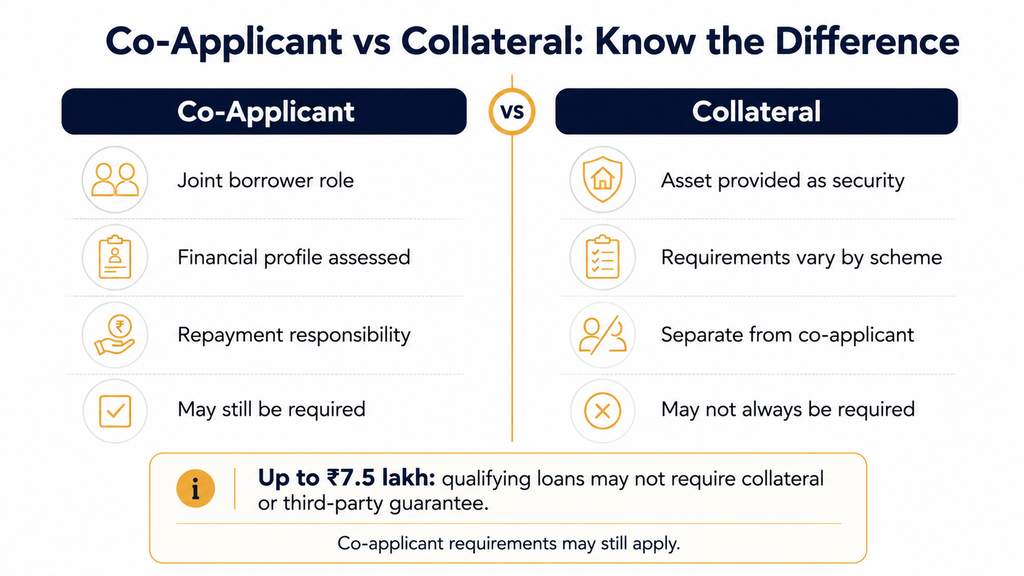
The reduced size of the loan does not necessarily eliminate the necessity to have a co-applicant in education loan.
- Parents or guardians can be kept as joint borrowers on loans of up to 7.5 lakh.
- RCFs on qualifying loans, which do not exceed 7.5 lakh, do not need any third party or collateral.
- Security requirements might also vary above 7.5 lakh, based on the scheme and lender.
- The fact that collateral-free lending does not imply that the co-applicant is not necessary.
- Check the existing co-applicant, collateral and guarantor requirements prior to application.
Critical: Do not make old-fashioned assumptions that loans to the maximum of 4 lakh do not require a co-applicant or loans of 4-7.5 lakh do necessarily require a guarantor.
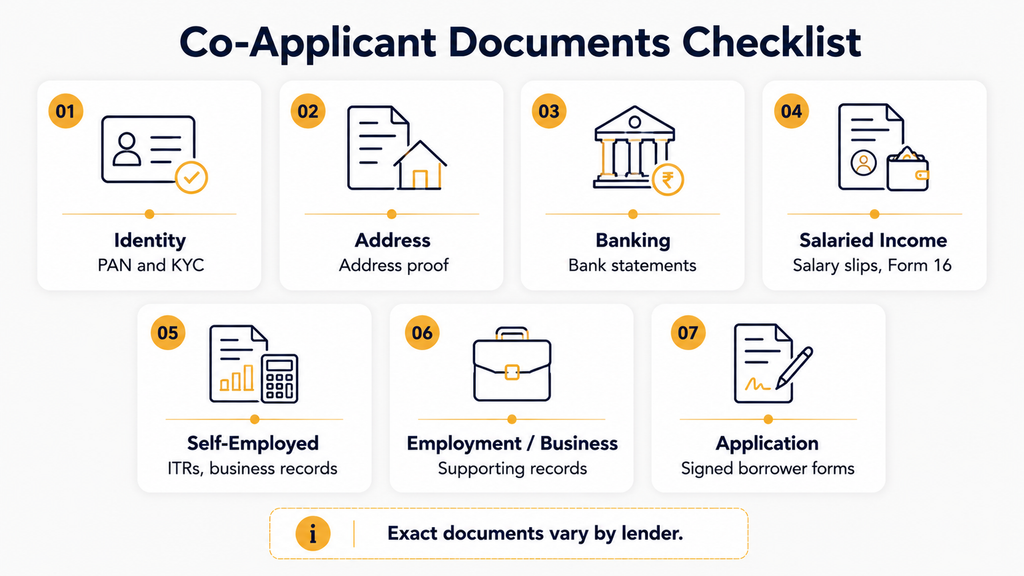
Documents that a Co-Applicant is likely to be asked to provide.
When you are aware of the co-applicant in education loan, then get prepared documents relative to the income category of this co-applicant.
Common document categories
| Category | Examples |
| Identity | PAN and accepted KYC documents by lenders. |
| Address | Proof of address accepted by the lender. |
| Banking | Recent bank statements as requested |
| Salaried earnings | Salary slips, Form 16 or other necessary evidence. |
| Self-employment adjustable income | ITRs and business records. |
| Employment/business | Employer or business documentation. |
| Loan application | Signed borrower/co-borrower form. |
Publication of education-loan information by Canara Bank, such as, specifies the KYC, age evidence and income-associated documentation of the co-applicants or the guarantor where possible.
Prior to Your Application: The specific documentation of a co-applicant in education loan changes depending on the lender, nature of employment and applicant profile.
Co-Applicant Financial Risks
Being a co-applicant in education loan is not a formality but a financial obligation.
Potential consequences include:
- The loan can be repaid as agreed upon in the signed loan agreement.
- Late loan payments can have a negative impact on the credit records of borrowers.
- Additional financial commitments can impact existing borrowing capacity.
- Pledged collateral can be subject to separate risks besides secured loans.
- Family budgets can be pressured in the event of alterations in the repayment arrangements of the student.
- Education loan co-signer must inform him/herself of the overall amount of repayment before signing.
Parent Tip: Check the affordability with the assumption that the graduate will be employed or receive the anticipated salary that will come after a longer time than expected.
Can You Get an Education Loan Without a Co-Applicant?
Yes, education loan with no co-applicant in education loan could be a possibility with certain lenders and products.
- Other foreign financiers do provide qualified students with education loans without a co-applicant or collateral, for Indian nationals.
- The qualification can be based on the university, course, destination, academic profile and prospective income.
- Some lenders’ products might contain varied co-applicant requirements based on the restrictions being applied by the selected institutions or student profiles.
- Learners ought to contrast interest structure, charges, currency risk, repayment terms and overall cost of borrowing.
- An education loan, in which there is no co-applicant in education loan, is not necessarily less expensive and less appropriate.
- Loan eligibility and terms are finalised after the policies of the respective lender in its immediate underwriting.
What is a Guarantor?
A guarantor education loan facility is not the same as getting an extra joint borrower.
The terms of guarantees give the assurance of what is promised by the guarantor and the time when the lender can exercise the promise. By scheme, as well, requirements vary.
Markedly, a 3rd party guarantee may not be applicable in case one wants to finance a Model Education Loan Scheme of up to ₹7.5 lakh.
Thus, students making a comparison of a guarantor education loan need to inquire:
- Does this product really need a third-party guarantee?
- What is the guarantee triggered by?
- How much may be made liable on the part of the guarantor?
- Is the party guaranteeing being joined as a co-borrower?
- Is collateral part of the same?
This difference does not allow the two to be confused with the guarantor education loan structure and joint borrowing.
Section 80E: What Co-Applicants Should Know
A co-applicant in education loan ought to realise that section 80E could offer tax advantages to interest paid on eligible higher-education loans.
- The deduction is taken on the interest paid, which is allowed, not the amount loaned.
- There is no given limit on the maximum monetary amount of eligible interest deduction.
- Deduction is allowed as long as eight assessment years without the payment of the conditions applied.
- The qualification is based on the borrower and repayment of the qualifying education loan, which is provided under Section 80E.
- An applicant in a co-applicant in education loan should never assume that the status of co-applicant alone is beneficial by itself to his taxes.
- The benefits of section 80E are to be reconciled with the prevailing tax structure and up-to-date tax regulations.
Mistakes to be avoided in selecting a Co-Applicant.
Selecting a co-applicant in education loan without checking the requirements of the lenders may influence the eligibility and cause financial problems. These are some of the pitfalls that should be avoided:
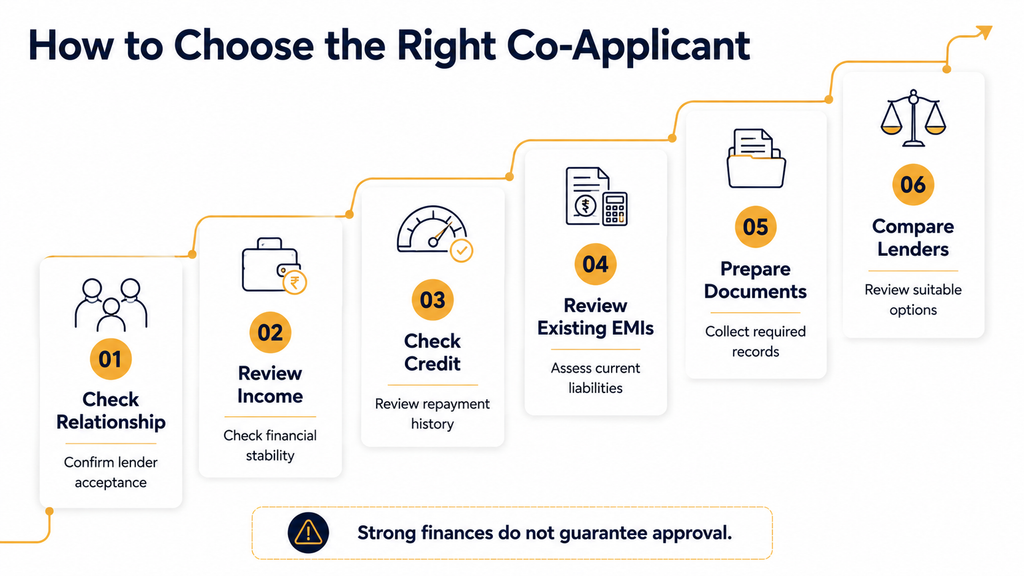
- Choosing a relative without inquiring of the lender whether the relationship is accepted.
- Looking at the revenue and disregarding the current EMIs, debts and routine financial obligations.
- Having a certain CIBIL score will automatically ensure that one can secure an education loan.
- Disregard credit history and consider the co-applicant in education loan profile.
- Mixing the responsibility of a co-applicant and guarantor despite the fact that they are to assume different responsibilities in a contract.
- Submitting an application without drawing comparisons to co-applicant requirements to appropriate education-loan lenders.
- The provision of assumption of good finances ensures a greater amount of loan or a better interest rate.
- You sign without knowing the obligations of repayment and requirements of collateral.
The way Foreign Edu Loans can assist.
Identification of the appropriate co-applicant in education loan entails checking the lenders and the financial background of the co-applicant. Foreign Edu Loans can enable students to learn and compare education-loan options available that can suit their needs individually.
- Review the profile of the students and co-applicants and then find out education-loan options.
- Compare qualified banks, non-bank financial companies and foreign lending companies by individual financing needs.
- Check co-applicant income, credit report, current liabilities, and lender relationship requirements.
- Determine records that the co-applicant in education loan should furnish in the application.
- Compare secured and unsecured lending arrangements in terms of eligibility, security and funding.
- Documentation, application preparation, and liaising with the shortlisted education-loan lenders: Assist students.
- Get students familiar with the lender requirements without giving them hope of receiving a loan, size, and interest rate.
Depending on the eligibility and credit evaluation of the respective lender, final approval of the loan and terms is subject to application.
FAQs
Who is able to be a co-applicant in education loan?
Usually, parents or guardians are accepted. There are also lenders who might take spouses or designated family members. Always enquire who is allowed to be a co-applicant to the current lender’s policy.
Is a co-applicant in an education loan obligatory?
Many Indian education-loan products require a co-applicant in education loan, but not all lenders do so.
What income should an education loan co-applicant have?
An education loan co-applicant has no minimum income. The lenders evaluate the stability of income, current EMIs, credit history and repayment ability.
Must a CIBIL score be 700?
There is no definite score that can assure approval. A co-applicant in education loan can be evaluated on general credit history and lender-specific criteria.
Is it possible to have a sibling as a co-signer to an education loan?
Possibly. The possibility of a sibling being a co-signer to an education loan varies according to the relationship and eligibility regulations of the lender.
What is a guarantor?
No. A guarantor education loan may have varying contractual obligations to a co-applicant or joint borrower.
Will I be able to borrow an education loan without a co-applicant?
Yes, there are lenders who might provide eligible products in the absence of an income earner such as a co-applicant in the education loan, depending on the university, course, destination and applicant profile.
Conclusion
It takes more than identifying a salary earner family member to be my co-applicant in education loan process. It is good to start by enquiring about the types of relations that the lender accepts and then consider a steady level of income, credit history, current liabilities, documents and the financial liability that the loan would put forward.
Do not use general CIBIL scores, age bracket restrictions or old-fashioned loan brackets. Specifications may vary depending on the lender, product, size of loan requested and creditworthiness of the borrower.
Above all, make comparisons of the entire borrowing structure as opposed to believing that a stronger co-applicant will be guaranteed approval or recipient of specific interest rates. Both student and co-borrower must be knowledgeable of repayment, security and long-term financial implications before signing.