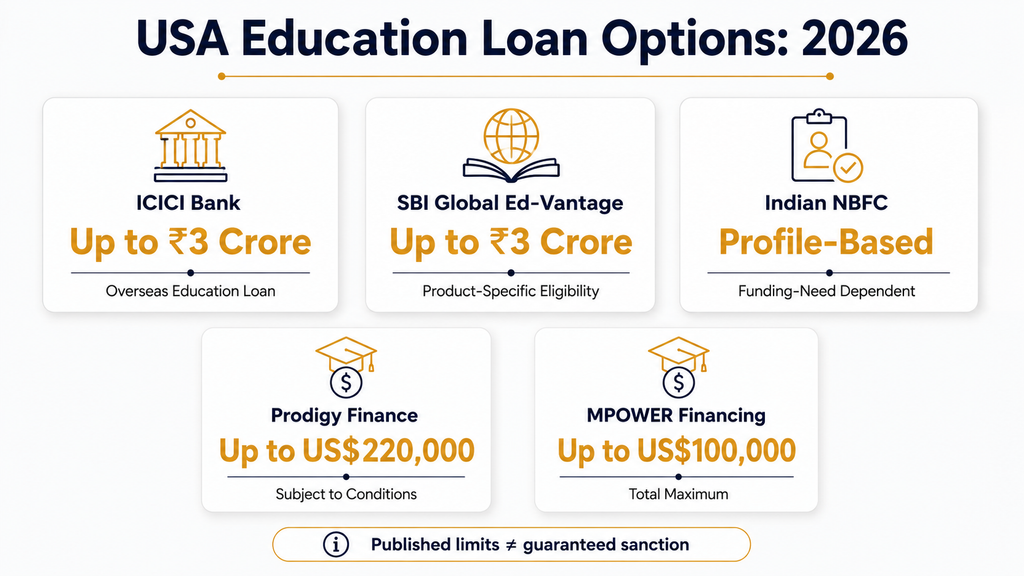
Borrowing an education loan for studying in USA from India does not imply that all students are entitled to receive a loan of a specific amount. In 2026, certain Indian lenders offer overseas education loans up to ₹3 crore, whereas international lenders can utilise separate dollar limits or the university Cost of Attendance. SBI now publishes up to ₹3 crore via Global Ed-Vantage, and ICICI Bank additionally publishes overseas education loans to the value of ₹3 crore.
You can be even less eligible. It is important to consider the university, the programme, the overall cost, collateral, co-applicant finances, credit evaluation and lender underwriting. This guide describes the process of making a realistic calculation of requirement, and balancing financing without presuming that the maximum advertised amount is necessarily available.
Education loan for studying in USA from India: 2026 at a glance.
| Financing route | Main eligibility consideration | Published/structural funding position |
| ICICI Bank overseas education loan | Course, institution, profile of the applicant and term being used. | Up to ₹3 crore |
| SBI Global Ed-Vantage | Eligibility of product, type of collateral and institution. | Up to ₹3 crore |
| Indian NBFC | Student, university, co-applicant and underwriting | Profile and funding-need dependent |
| Prodigy Finance | School Programme and assessment, School Cost of Attendance. | Up to US$220,000, subject to conditions |
| MPOWER Financing | School, programme, costs and eligibility | Up to US$100,000 total |
The latest Global Ed-Vantage page of SBI claims to provide up to ₹3 crore and collateral-free loans up to ₹50 lakh to select premier institutions. ICICI Bank states overseas education loans up to ₹3 crore. MPOWER offers a maximum of US$100,000, and Prodigy currently promotes collateral-free usage up to US220,000, as long as you are eligible, funded and assessed on credit and the Cost of Attendance at the school.
Read out: Education Loan to Study in USA 2026
How Much education loan for studying in USA from India Can You Actually Get?
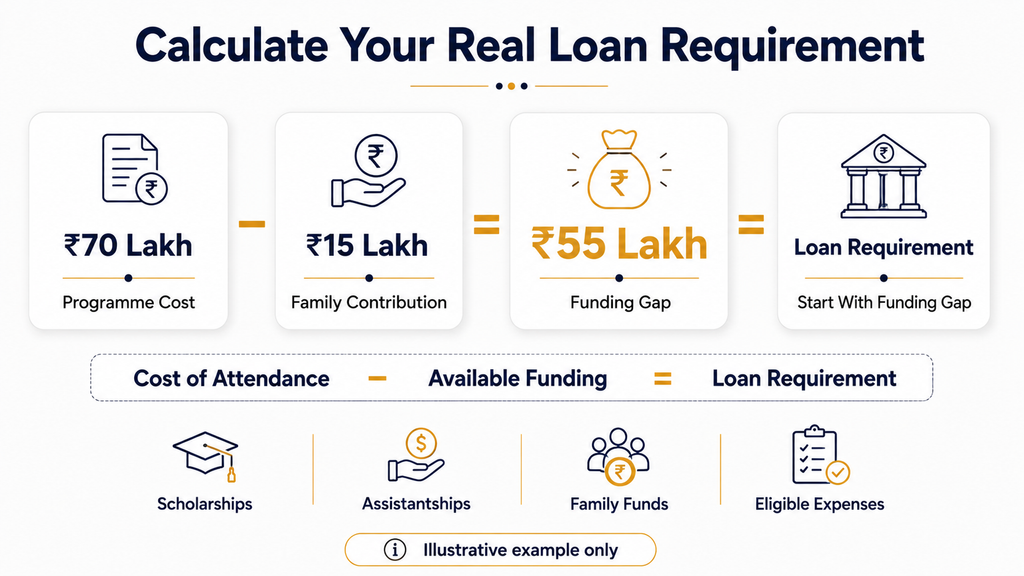
Your funding gap is the starting point of a realistic education loan for studying in USA from India instead of the maximum limit of the lender.
Use this calculation:
Requirement in Loan = Cost of attendance minus loans calculated above plus scholarship + assistantships and family contribution.
Assuming that your university-qualified programme would cost the equivalent of ₹70 lakh and you can donate ₹15 lakh. You have a gap of about ₹55 lakh in funds to raise, not yet taking into account lender-specific eligible expenses, the margin set-ups and currency movements.
The amount that your US student loan India requirement must represent must therefore reflect the real costs and not the maximum allowable sanction.
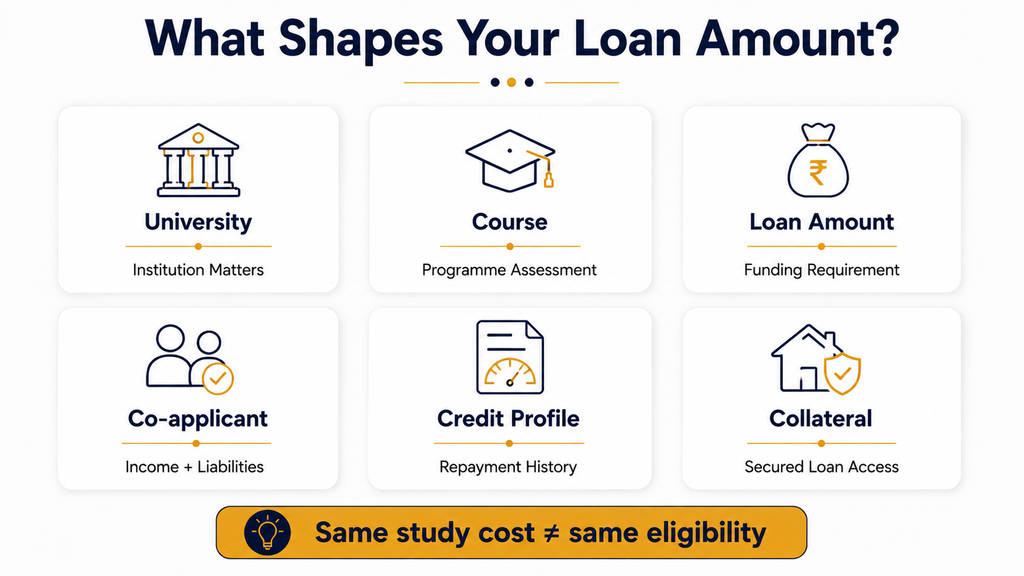
Five factors usually shape the amount.
- Your college and course matter to the lender’s creditworthiness, since underwriting policies are attentive to the distinctions between the institutions and courses.
- The amount requested has to be in close relation to the known costs of education and the financing policies used by the lender.
- The income, liabilities and credit history of your co-applicant may significantly influence the results of assessing an Indian loan traditionally.
- The accessibility of secured products and the allowable limit of borrowed funds can vary, depending on available collateral, to be available to your family.
- Scholarships and family funds available bring the gap in financing; that is really what requires an external loan to be educated.
Cost of MS in USA vs Loan Amount: Start with the Full Cost
Where available, the calculation of the cost of MS in USA vs loan amount should be done using the current Cost of Attendance of the university.
The US universities tend to compute expenses on top of tuition. They can be housing, meals, health insurance, books, supplies, transport and personal expenses. In the case of F-1 students, financial planning is exceptionally significant since the US authorities demand students to exhibit financial capacity to cover tuition and living expenses.
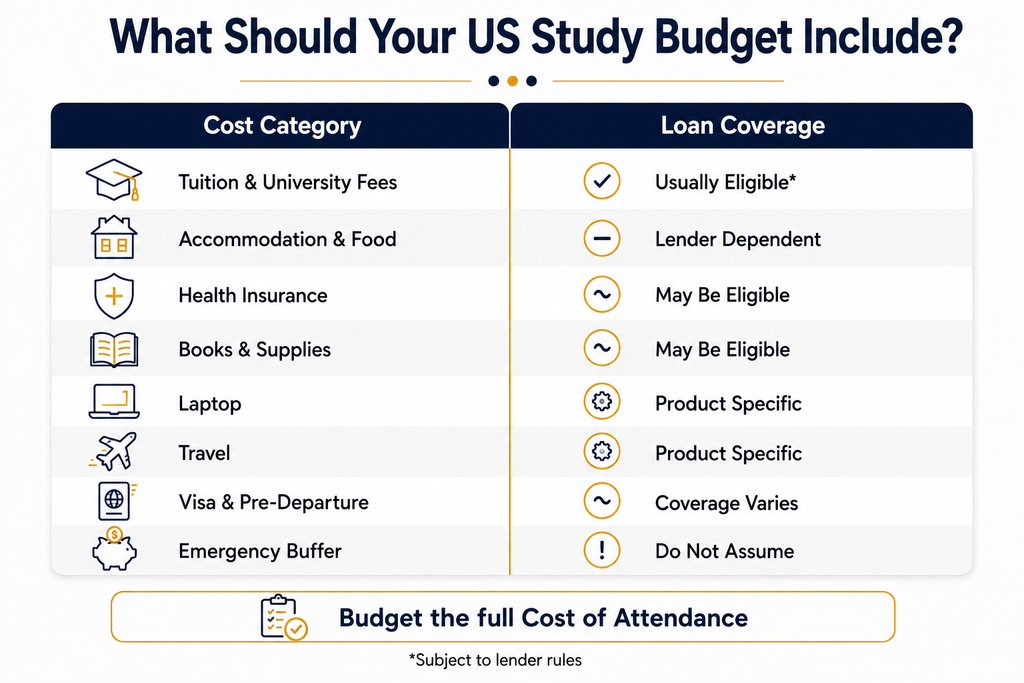
| Type of costs | Does it have automatic coverage of loans? | Do you need to budget it? |
| Accommodation and food | Depends on lender/product. | Yes |
| Tuition and university charges | Typically (also subject to lender restrictions) eligible. | Yes |
| Books and school supplies | Can be eligible. | Yes |
| Emergency/currency buffer | Do not presume lender coverage. | Recommended |
| Health insurance | May be eligible | Yes |
| Travel | Product-specific | Yes |
| Laptop | Product-specific | When necessary |
| Visa and pre-departure costs | Depending on coverage. | Yes |
In comparing the cost of an MS in the USA vs the loan amount, do not refer to national averages but rather refer to the published figures in your own university.
In this case, Avanse, a present education loan for studying in USA from India, is declaring that its loans can pay up to 100% of tuition fees, as well as designated rates on living costs, deposits and travel. The conditions exemplify the reasons why students have to look at expense-wise coverage instead of believing that all lenders will finance all the costs in equal measure.
Budgeting Rule: Find out the full programme obligation, living and pre-departure costs before determining the amount to borrow.
Secured, Unsecured or International Financing?
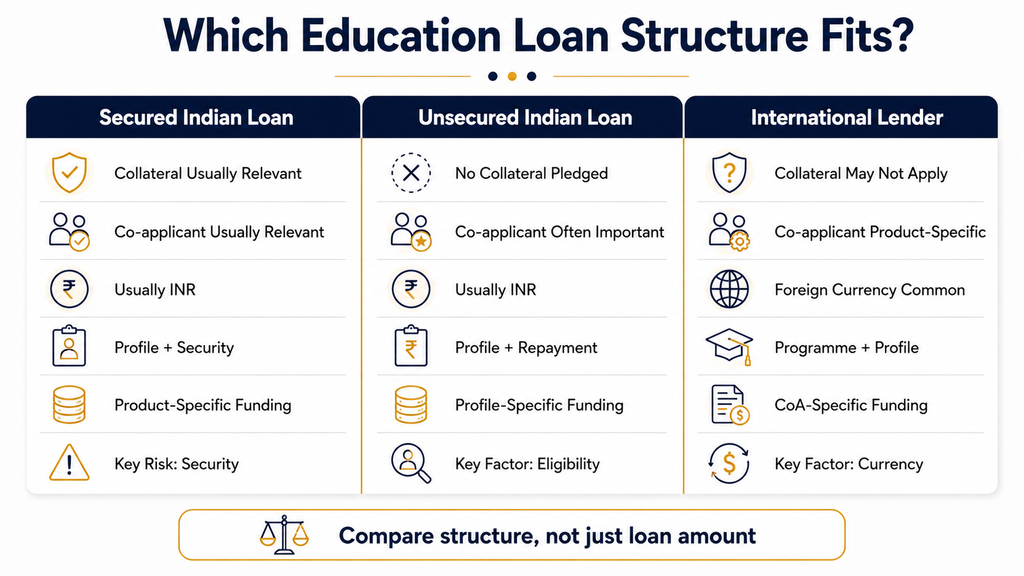
Education loan for studying in USA from India in general face three major funding packages.
| Factor | International lender | Unsecured Indian loan | Secured Indian loan |
| Co-applicant | Product-specific | Commonly important | Usually relevant |
| Collateral | May not be required | Not pledged | Usually relevant |
| Currency | Commonly foreign currency | Usually INR | Usually INR |
| Assessment | Programme/profile model | Cross profile and repayment power. | Profile plus security |
| Main consideration | Currency and repayment structure | Qualification and interest rate. | Security risk |
| Maximum funding | Product and CoA-specific | Strongly profile-specific | Product-specific |
Secured loans
Large borrowing with agreeable security can be secured with persistence of collateral. Classification of ownership, title, legal documentation, estimation of value and current encumbrances may be evaluated by the lender.
SBI Global Ed-Vantage now has tangible collateral security but permits collateral-free financing up to 50 lakh to select premier institutions separately.
Unsecured Indian loans
A non-collateral loan to a US university is dependent more upon the student, the institution, programme, requested loan and financial co-applicant.
Thinking that not being secured is a sure thing for easier approvals. Securing Larger unsecured requests can be underwritten more closely.
International lenders
Another US student loan trap is international products, especially in cases where the qualifying student is not interested in common collateral requirements.
According to MPOWER, their qualified international-student loans do not require a cosigner or collateral and have a range of between US$2,001 and US$100,000.
Currently, Prodigy Finance promotes both no-cosigner and no-collateral products where borrowing is up to US$220,000, and financing may be as high as 100% of school-defined Cost of Attendance, all subject to eligibility and determination.
Critical: Not all US university loans are collateral-free. Eligibility of university, programme and applicant is decisive.
Why Your Loan Amount Can Be Lower Than Expected?
Two students who have been offered a similar priced programme will obtain different results when seeking an education loan for studying in USA from India.
Student factors
- Past qualification and academic performance enable lenders to evaluate the progress and the profile of the applicant as to education.
- The choice of university and course might be able to affect Lender appetite, particularly with larger unsecured funding requests that can greatly impact this.
- Admission status and documented programme cost assist in determining whether the requested funding requirement has been well supported.
Co-applicant factors
- Predictable reported earnings can enhance repayment evaluation when a financial co-applicant is formally needed by an Indian lender.
- The current EMIs and other liabilities diminish the disposable income towards making comfortable repayments of future education loan for studying in USA from India.
- The credit history can affect the judgment of the lender, yet no specific credit score will guarantee a loan for education.
To apply for a traditional US student loan in India, parents should thus first analyse their own financial situation before deciding on the amount to be requested.
Margin Money Can Change Your Real Funding
The margin is the part of the expenses that the borrower is required to secure as opposed to covering them with the loan.
Assume no single percentage. As per the existing information on education loan for studying in USA from India offered by ICICI Bank, e.g. there is no margin for premier institutes, and the margin is 15% at other institutes. On the same page, it clarifies that under certain circumstances, scholarships or initial fees can be part of the margin.
That is one of the things to consider when comparing the cost of an MS in the USA vs the loan amount, since a sanction might not amount to 100% of your entire budget.
Parent Tip: Question lenders on how scholarships, university deposits, and already-paid fees are computed to help with your contribution.
Interest rate, compare structure, Not One number.
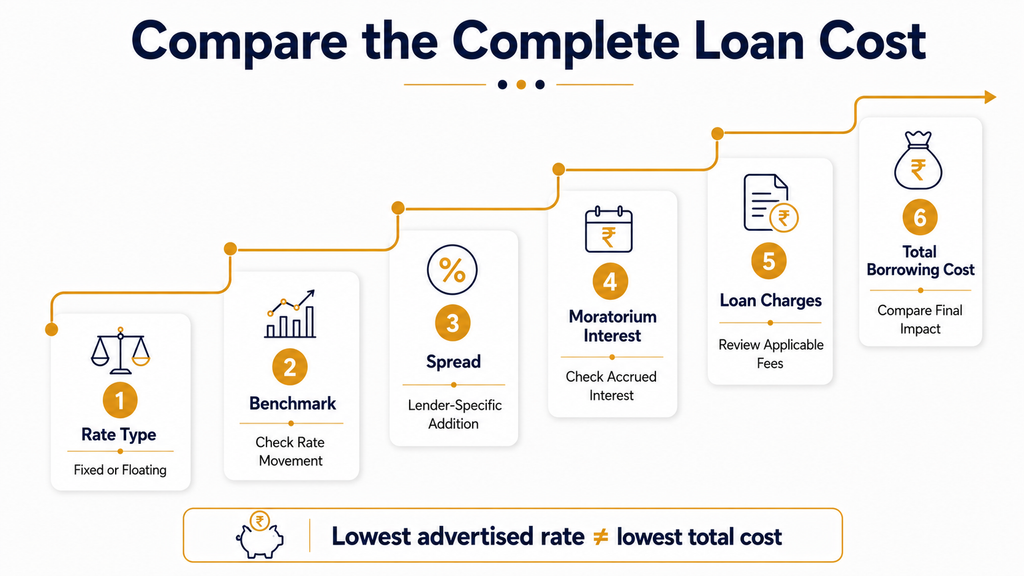
Interest rate on an education loan for studying in USA from India depends on the lender, loan sum, security, the applicant’s profile, and other lending factors. Rather than putting your faith in the single advertised percentage, compare the entire rate structure.
| Factor | What to Look at | Why It Matters |
| Type of rate | Fixed or floating | Decides whether the rate is subject to change during the repayment. |
| Benchmark | Standard of floating loans. | The relevant rate may have an impact on benchmark movements. |
| Spread | Additional lender-specific percentage | Helps decide on the final rate of borrowing. |
| Loan value | Actual amount required. | Depending on the approved price, the price can go up or down. |
| Collateral | Secured/unsecured structure. | Security may impact lender pricing and eligibility. |
| Moratorium interest | Interest paid in the period of study. | The accrued interest can have the effect of adding to the repayment balance. |
| Other fees | Handling and loan charges. | These are added to the total cost of borrowing. |
Check Interest Rate: From the last rate, not the lowest rate given, but the overall cost of borrowing.
Moratorium and Repayment can elevate the amount owed.
Moratorium defers normal repayment as per the terms of the lender; this must not necessarily be seen as interest-free borrowing.
According to SBI, the course and the moratorium periods are put under Global Ed-Vantage with simple interest levied. It has added a repayment period of six months after completion of the course, and the repayment of this loan should be in the form of EMI spread over a maximum period of 15 years. In cases where it is not serviced, accrued moratorium interest may be added to the principal.
Thus, an education loan for studying in USA from India will be with a higher repayment balance than the balance initially provided.
Repayment Tip: request an exemplar when regular repayment of EMIs has to start, illustrating the outstanding principal with interest due on the moratorium.
Currency Risk is an issue for US Education.
When a learning education loan for studying in USA from India is approved in rupees, but the cost of the university is to be paid in dollars, changes in the exchange rate would change the amount of rupees needed.
The bad news is that a stronger US dollar will cause your previously calculated INR budget to no longer afford the same dollar amount to spend. Fill a sensible currency buffer with up-to-date rates as opposed to a legacy conversion.
Repayment and borrowing currency may vary between an international loan and an Indian loan, particularly given that the US universities have no collateral for the loan. Compare the currency exposure and the cost of borrowing.
Common Mistakes When Deciding How Much to Borrow
- The highest possible sanction may be selected, which might impose unwarranted interest amounts over an eventual repayment period in the future.
- Budgeting tuition only overlooks accommodation, insurance, travelling and other costs that are required during the whole programme duration.
- Making assumptions on the basis of all unsecured lenders financing the same universities and courses can create unrealistic expectations in financing the applicants.
- Failing to take into consideration the moratorium interest can significantly underreport the balance remaining at the time when the regular repayment begins when the student finishes the studies.
- When comparing headline interest rates, it only excludes fees, margin, currency exposure and repayment terms and conditions that impact total costs.
- Late application may cause the set of university payment and visa preparation deadlines to be unduly strained on students.
- The misperception of sanction and disbursement may lead to students believing that approved money is already disbursed to be paid.
The way Foreign Edu Loans can help.
Selecting an education loan to pursue studies in the USA or India goes beyond getting a lender with a high loan principal. Foreign Edu Loans can assist students with appreciating and comparing financing facilities based on their university, course, funding necessity and financial history.
- Screen appropriate public banks, private banks, NBFCs and foreign education lenders.
- Research the possibilities of obtaining secured and unsecured loans depending on what collateral is available and applicant qualifications.
- Get capacity in loan amount, margin money, moratorium, terms of repayment and other noteworthy borrowing points.
- Determine the documentation that is required based on the option of financing that is chosen and the requirements of a co-applicant.
- Get help with application documentation, coordination with lenders, conditions of sanctions and the disbursement process.
- Assess alternative loan arrangements and make a choice that will be appropriate to the true financing need.
Foreign Edu Loans streamline the lending procedure; thus, the ultimate approval, terms and approved amounts are at the discretion of the particular lender and their rules.
FAQs
What is the amount of loan that I can secure in the USA to study?
It varies according to college expenses, program, security, co-applicant funds, credit history and lender programs. Sanctions on individual applicants are not the same because of published maximum limits.
Is it possible to secure a loan to study in US universities without collateral?
Yes. Indian and International lenders may provide a loan to US universities without collateral. The eligibility is based on the university, course, the amount required and the profile of the applicant.
Is a US student loan India option inclusive of living expenses?
US student loan option in India can take care of tuition, accommodation, books, insurance, travelling, as well as any other necessity that is approved. Precise coverage depends upon the lender and the loan product.
What is the comparison between the cost of an MS in the USA and the loan amount?
Calculate cost of MS in USA vs loan amount including tuition, living expenses, and scholarships, family contribution and other funds available. Only realistic funding gap should be borrowed.
What is an Indian interest rate in an education loan for studying in USA from India?
No single rate is applicable. The final rate may depend on the lender, loan amount, loan type, profile of applicant, co-applicant, collateral and existing loan lender policies.
Conclusion
Education loan for studying in USA from India can potentially meet a big slice of the choice of any qualified student as regards his or her US education, yet the highest loan limit was never intermingled with the individual eligibility. Begin with the total Cost of Attendance of the university, which is less the scholarships and family funds(confirmed), and compute the actual financing deficit.
Next, compare them based on security, no security and cross-border needs depending on collateral, co-applicant need, qualifying expenses, currency, fees, moratorium and repayment liability. Existing products indicate that there are a lot of financing and collateral-free options available, yet all sanctions are profile- and lender-based.
Verify Your Education Loan eligibility to determine financing arrangements that can be appropriate to your real need.