Education loan for MBA abroad from India can assist students to fund a foreign MBA without having to compromise most of their long-term savings as a family. The cost of an MBA goes beyond tuition fees to include living expenses and transport, health insurance, textbooks, laptops and any other reasonable study expense. To select a proper education loan for MBA abroad from India, it is important to compare secured v/s unsecured, co-applicant, and collateral requirements, moratorium, terms of repayment and extra fees. Borrowing should also depend on the students and their college, course, amount of financing shortfall and their ability to repay. This guide covers the options of MBA loans in India, qualification of MBA loans in India, types of lenders, documentation, and prudent borrowing. It further outlines the way an education loan to the best B-schools in the world could be evaluated under the lender-specific policies and eligibility guidelines.
MBA Funding at a Glance
| Funding factor | What Indian families ought to know. |
| Total requirements | Tuition, living expenses, travelling, insurance, equipment, deposits and contingency funds. |
| Claim of sale on security | Interest based on collateral as accepted by the lender and can be used to serve an increased need, so long as it agrees with valuation and underwriting. |
| Unsecured loan | It highly relies on university, course, student profile, co-applicant strength and lender policy. |
| Public bank example | SBI Global Ed-Vantage has a current permission for loans of 3 crore, under specified conditions. |
| An example of private banks | Private banks: International education loans up to 3 crore are now available under eligibility by ICICI Bank. |
| The example of NBFCs | Another type of financing available at present is secured and unsecured overseas education financing (up to 1.25 crore) offered by Avanse. |
| International option | Prodigy Finance provides products to qualified postgraduate borrowers that are free of collateral and hardly require a co-signer. |
SBI now offers Global Ed-Vantage financing up to 3 crore and collateral-free funding up to 50 lakh to some of the premium institutions. ICICI provides international educational loans amounting to 3 crore and unsecured financing from 1 crore. The maximum number of loans advertised by Avanse is 1.25 crore, and Prodigy Finance allows eligible borrowers to borrow loan amounts without collateral and no co-signer.
How to Get an education loan for MBA abroad from India: 8 Essential Steps?
Step 1: Calculate the Complete MBA Cost
Begin with the official cost figures that are given by the university, since tuition on its own does not reflect the exact need.
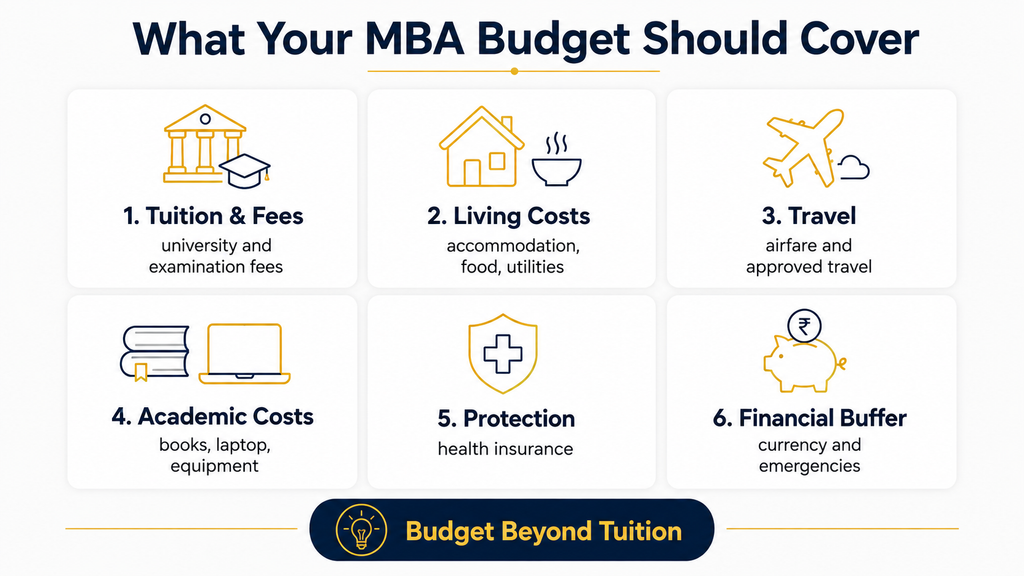
| Cost category | Incorporate in your plan. |
| Living | Tuition, compulsory payment, examination charges. |
| University | Tuition, compulsory payment, examination charges. |
| Travel | First airfare and travel costs accredited by lenders. |
| Protection | Health cover and other programme coverage that is mandatory. |
| Academic | Books, computer, hardware, learning aids. |
| Buffer | Movement of currency, first settlement, emergency reserve. |
Before establishing the requirement of an education loan for MBA abroad from India should consider the contribution made by the family and then determine the requirement of an education loan.
Budgeting Rule: Retirement funds, medical savings, and necessary liquidity in the household should be excluded from the MBA contribution in the funds.
Step 2: Choose Secured or Unsecured Financing
A secured education loan for MBA abroad from India uses assets approved by lenders as collateral. An example of this is SBI, which allows collateral under Global Ed-Vantage, and offers collateral-free ₹50 lakh funding to some of their top institutions.
An unsecured loan does not entail the pledged property. ICICI Bank now mentions that overseas education loans without collateral are allowed up to 1 crore cases, and that depends on factors such as the institution, course and its applicability.
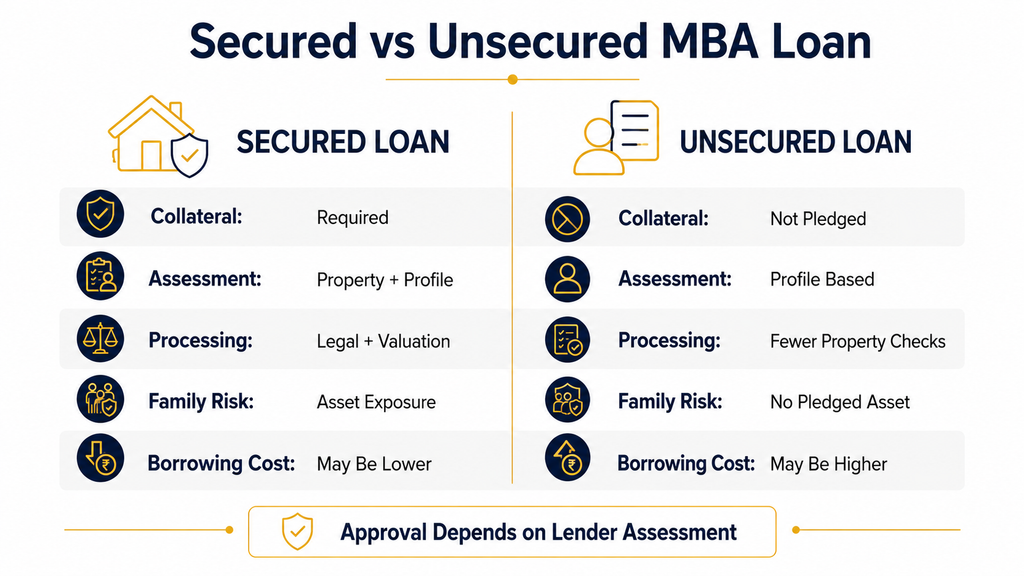
| Factor | Secured loan | Unsecured loan |
| Collateral | Pledged as stipulated in pertinent product rules | Not secured. |
| Assessment | Student, co-applicant, property, course, university | Student, co-applicant, course, university |
| Processing | Legal/valuation checks potentially necessitate additional steps. | Fewer formalities in the property-related processes. |
| Family risk | Pledged asset becomes subject to exposure in case of failure to pay obligations. | No pledged property |
| Rate of borrowing | Could be relatively low | Could be relatively high. |
And this is not to say that collateral will automatically boost approval. Title to property, valuation, capacity of co-applicants and policy by lender are also important.
Step 3: Compare International Lenders, NBFCs and Banks.
Select education loan for MBA abroad from India by lender models and compare with the paying ability.
| Lender category | Useful comparison points | Current examples |
| Private-sector bank | Insecurity, rating of profiles, amount of loan, processing conditions. | Axis Bank, ICICI Bank |
| Public-sector bank | Security, pledging, banking institutions, period of payback. | BOB, SBI |
| International lender | Juvenile guarantor schools, money and charges, lab, variable rate, repayment, co-signer guidelines. | Prodigy Finance |
| Education-finance NBFC | Course coverage, co-borrower power, secured/unsecured, payment plan. | Avanse, Credila |
The existing lender limits depend on the product and profile of applicants. SBI, Bank of Baroda, ICICI Bank, Avanse, and Credila have varying funding limits, but at the same time, the advertised amounts do not guarantee sanction.
A loan to study at the best B-schools in foreign countries can have special consideration by the institution. But it has the condition of approval based on the eligibility of a lender and underwriting.
What it does to you: When providing an education loan for MBA abroad from India, compare the amount available, collateral, fees, moratorium, repayment terms and disbursement terms.
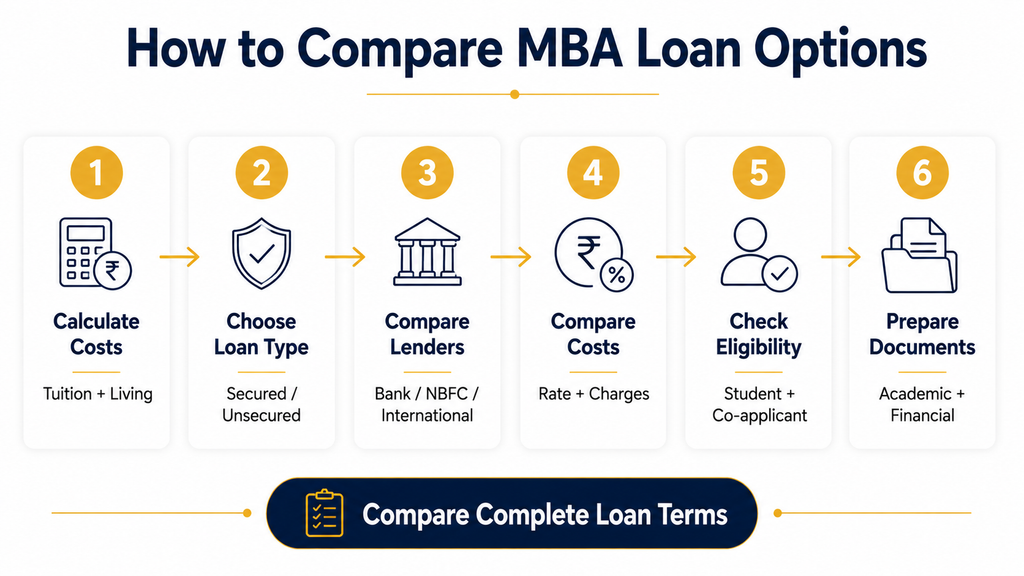
Step 4: Get to know the reason why interest cost changes.
Do not pick an MBA loan India option on the basis of the rate advertised. Pricing has the potential to change according to the lender and loan amount, security, university, co-applicant, and credit profile.
Prior to any education loan for MBA abroad from India, compare:
- Determine whether the rate to which it applies is fixed, floating or pegged to a benchmark.
- Know how interest is charged in the course and also in the moratorium, which is defined by the lenders.
- Compare processing, legal, valuation, insurance, remittance and other charges as necessary.
- Reexamine prepayment terms since prepayment previously can decrease the total cost of the borrowing.
- Ask them to provide an example of a repayment, according to your approved amount and terms.
Interest Rate Check: The most advertised rate may not always be the lowest overall cost of the loan.
Read out: Education Loan Checklist for Students Preparing for MBA Admissions
Step 5: Before you apply, check that you are eligible for an MBA Abroad Loan.
The eligibility of MBA abroad loans depends on the lender but requires conditions to be satisfied by the student, university, co-applicant, the amount of loan and whether it is secured.
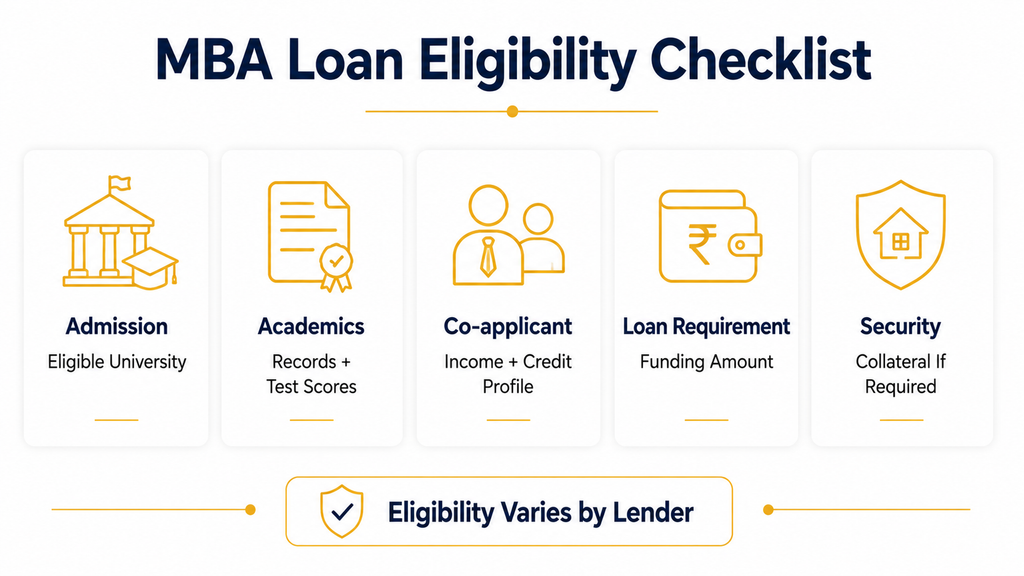
- Having a recognised or lender-eligible foreign institution which has confirmed admission to the institution is usually required.
- Academic transcripts and pertinent entrance or English-language test scores can serve in assessing lenders.
- Co-applicants might require a steady income, good credit history and manageable current financial commitments.
- Indian MBA aids without collateral are education loan for MBA abroad from India, and are highly dependent on the profile of the applicant as a whole.
- Secured loans have collateral secured by the lender, supporting documents, valuation and are legally verifiable.
A loan to B-schools that are ranked high in overseas markets can be considered by other lenders; however, it will have to undergo underwriting.
Step 6: Prepare the Loan Documents.
An entire file is capable of minimising timelines on the application of an education loan for MBA abroad from India.
| Document group | Most often ordered documents. |
| Student identity | PAN, Aadhaar (where required), passport, address verification, photographs |
| Scholarly documents | Marksheets, university records, transcripts, ETS and language test scores. |
| University | Offer letter, fee schedule, course information, confirmation of admission. |
| Co-applicant | Bank statements, tax documents, salary or business income statements. |
| Collateral | Title documents, approved plans, tax records, ownership records, papers requested by lenders. |
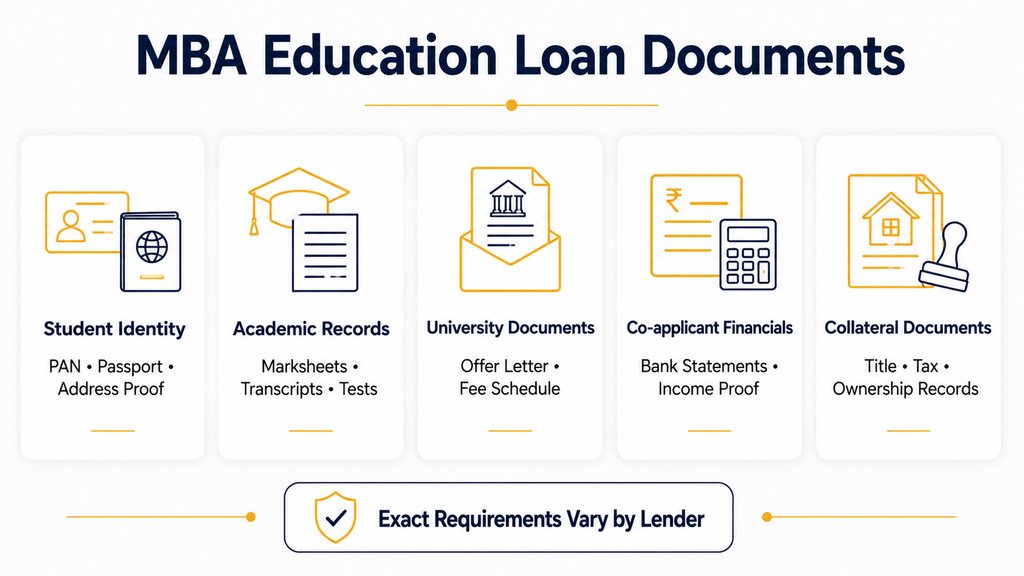
The precise list is variable. The existing list of checks used by SBI consists of: Checking passport, academic records, admission proof, course cost, bank statements and co-applicant income documents. Bank of Baroda also demands KYC and academic documents, admissions, the cost of studies, and relevant financial or property documents.
Step 7: Understand Moratorium, Sanction, and Disbursement
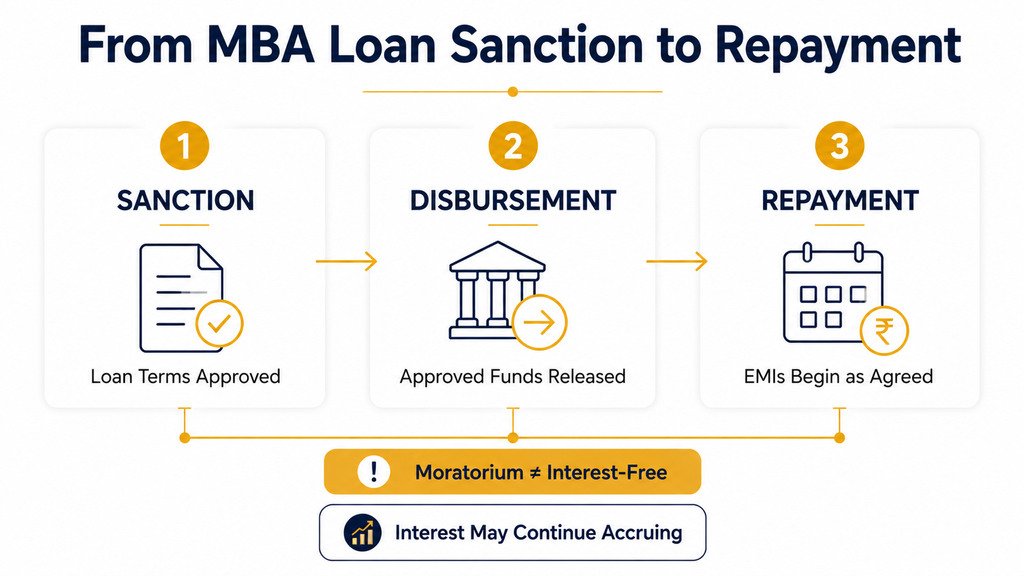
A moratorium defers regular repayment of principal, according to conditions specified by the lenders; it does not imply the cessation of interest. According to SBI Global Ed-Vantage, simple interest is charged on the course and moratorium, with repayment commencing 6 months after course completion. Baroda Scholar of Bank of Baroda has a course period plus one year repayment holiday specified.
As a Borrower of an education loan for MBA abroad from India, a person must differentiate between three phases:
- Sanction: This is where the lender agrees to fund under laid-down conditions and documents.
- Disbursement: The qualified money is disbursed by the lender based on college and loan criteria.
- Repayment: The EMIs will start under a mutually agreed schedule of repayment and moratorium.
With an MBA overseas loan in India, enquire whether the interest on the loan will be subject to the moratorium later on, or not.
Step 8: Save Your Family Money by Being a responsible lender.
An education loan for MBA abroad from India should probably be geared towards funding a real divide without compromising family security.
- Don’t use all the liquid family assets to pay university fees; save the emergency money instead.
- Only borrow when scholarships and safe family contribution have been deducted, as well as verified other personal sources of funding.
- DO NOT promise to provide significant property without having a good idea of what happens in cases of default and collateral-release processes.
- Make approximate payments based on conventional career assumptions as opposed to favourable post-MBA earnings expectations.
- Maintain a currency stock since the fees and living costs in foreign currencies might fluctuate in rupee values.
- When interest on studying is affordable, even look at servicing, since this may lessen the strain of paying back at a later stage.
Increased availability of funds might be tempting, but the approved sum must correspond to what is realistically payable.
Tax Treatment: Section 80E Needs Careful Interpretation
Section 80E allows eligible individuals to deduct interest on qualifying education loans of up to eight assessment years. The Income Tax Department affirms that the repayment of principal is not considered under this deduction.
Nonetheless, the validation regulations of the AY 2026-27 of the Income Tax Department indicate that in case an individual has chosen the new tax regime, one cannot be entitled to claim Section 80E. They should also ensure that borrowers consult their relevant tax regime and consult a professional tax advisor where appropriate.
Planning should be assisted with tax, not an incentive to take a bigger education loan for MBA abroad from India.
Common MBA Financing Mistakes to Avoid
- Making such comparisons without considering the fees, moratorium and repayment conditions and collateralization.
- There is an automatic guarantee of approval of education loans by assuming admission to a good business school.
- Utilising emergency or retirement savings without first determining an adequate family allocation.
- Application to a single lender without a comparison of the eligibility, the structure of the loan, and the repayment.
- Disregarding income of co-applicants, credit history, current liabilities and general ability to repay.
- Misunderstanding loan sanction and the actual money disbursement to school and visa-related needs.
- Accepting an education loan for MBA abroad from India without evaluating the ability to repay.
- Selecting an education loan to B-schools of the finest institutions in foreign countries without verifying the requirements of the lenders.
How Foreign Edu Loans Can Help?
Foreign Edu Loans will assist you in seeking an appropriate education loan for MBA abroad from India, based on your academic and economic background.
- Compare appropriate banks, NBFCs and foreign lenders with regard to personal eligibility and financing needs.
- Compare the availability and unavailability of secured and unsecured loans based on the financial assets of the collateral and co-applicants.
- Receive tips on academics, finances, admission, co-applying and collateral documents needed by the lenders.
- Compare the terms of repayment, moratorium terms, charges that apply and disbursement terms before making a decision.
- Get assistance during the proceedings in MBA abroad application and coordination of the education loans.
The granting of final approval and terms of the loan will still depend on the assessment and policies of the respective lender.
FAQs
Is it possible to take an MBA loan in India without completing my MBA offshore?
Yes. education loan for MBA abroad from India can be a non-secured loan which may be granted depending on the university, loan sum, the profile of the co-applicant and the learning policy of the lender.
How much MBA loan can Indian students get?
The loan amount depends upon the costs of programmes, the profile of the applicant, the university, collateral and evaluation by the lender (MBA loan India).
Are the best business schools able to enhance loan eligibility?
A loan to attend the best B-schools in international countries might have greater consideration on the part of the lender, but no assurance of admission.
How to determine the eligibility of MBA abroad loans?
For MBA abroad loans, one should qualify based on academics, admission, university, course, co-applicant finances, loan requirement, credit profile and course.
Are living expenses included in an MBA education loan?
Education loan for MBA abroad from India could include all the approved accommodation, travel, books, insurance, equipment, and living expenses.
When would I begin to compare lenders?
Compare MBA India loan opportunities post-admission on clarity with sufficient time to fulfil documentation, sanction, and disbursing.
Conclusion
Education loan for MBA abroad from India may enable Indians to borrow less than family savings and long-term savings that may be sold off. This will be achieved by starting the borrowing process with a full programme budget and an achievable repayment schedule. Compare secured and unsecured buildings and make sure that the lender qualifies, knows the interest on the moratorium, and all other possible charges will be paid and accepted before financing is accepted. The option that has the best chance of success is not necessarily the lender who is offering the most or the lowest rate that is quoted. It is the construction that matches your capital requirement, the family risk-taking, and mortgage repayment ability. Use up-to-date lender materials prior to signing and Check Your Education Loan Eligibility to find your options that could fit your MBA profile.