| Feature | Published information |
| Secured overseas rate | Starting from 9.00% p.a. |
| Unsecured overseas rate | Starting from 10.25% p.a. |
| International loan limit | Up to ₹3 crore |
| General maximum tenure | Up to 15 years |
| Minimum applicant age | 16 years |
| Study destination | Eligible overseas institutions |
| Security | Secured and unsecured options |
| Moratorium interest | Interest continues to accrue |
| Final pricing | Depends on applicable borrower/product terms |
The ICICI Education Loan page provides the general product framework. Students considering an ICICI Bank education loan for abroad studies should treat advertised limits and starting rates as reference points rather than guaranteed sanction terms.
What Is the Current ICICI Education Loan Interest Rate?
The published ICICI education loan interest rate for overseas education currently starts from:
- 9.00% p.a. for secured loans
- 10.25% p.a. for unsecured loans
These rates are published on the official ICICI Education Loan interest-rate page.
The final rate for an ICICI Bank education loan for abroad studies may depend on factors including the course, institution, applicant profile, co-applicant profile, collateral and applicable loan structure.
Therefore, a student should not interpret “starting from 9.00%” as a guaranteed 9.00% sanction.
When comparing lenders, use the rate stated in the actual sanction offer. A slightly lower advertised starting rate does not necessarily mean a lower total repayment.
How Much Can You Borrow for Overseas Education?
According to the official ICICI Education Loan page, international education loans may be available for amounts of up to ₹3 crore.
But even the maximum limit that an ICICI Bank education loan for abroad studies is not necessarily the limit that any student can obtain.
The final sanctioned amount may depend on:
- Course and institution
- Total cost of education
- Student profile
- Co-applicant income and creditworthiness
- Security offered
- Repayment capacity
- ICICI’s current underwriting policies
Can You Get ₹3 Crore Without Collateral?
Students should be especially careful with this question.
ICICI’s own official pages currently show different unsecured limits across different offerings.
Its general education loan information and detailed product material contain different unsecured structures, while the ICICI Instant Education Loan page advertises higher limits for eligible customers who already have an applicable loan offer.
Can You Get an ICICI Education Loan Without Collateral?
Yes. ICICI publishes both secured and unsecured education-loan options.
However, there is an important limitation in the available official information.
Different ICICI pages currently describe different unsecured limits and offerings. The general ICICI Education Loan page should be read alongside product-specific information such as the Instant Education Loan.
Therefore, students seeking an ICICI Bank education loan for abroad studies without collateral should confirm the exact unsecured limit applicable to their university, programme and borrower profile.
Do not assume the full ₹3 crore international limit is universally available without collateral.
What Are the ICICI Loan Eligibility Criteria?
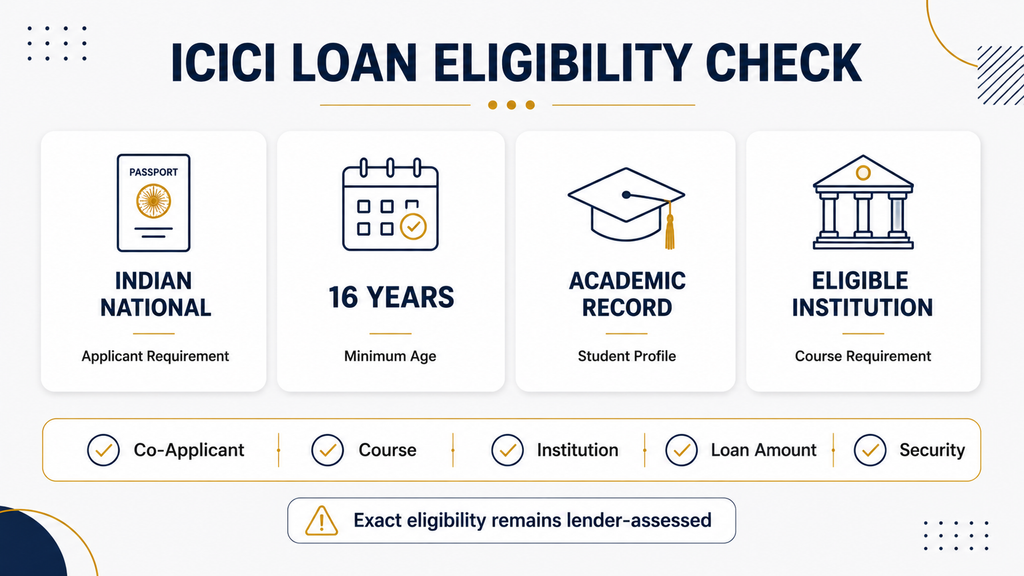
The general ICICI loan eligibility criteria include several borrower and education-related conditions.
According to the ICICI Education Loan FAQs:
- Applicant should be an Indian national.
- Minimum applicant age is generally 16 years.
- Student should have a satisfactory academic record.
- Required prior education should be completed.
- Institution should meet applicable recognition/listing requirements.
- Eligible higher-education programmes may qualify.
- A suitable co-borrower may be required.
For an ICICI Bank education loan for abroad studies, eligibility is therefore not determined only by admission to a foreign university.
ICICI may also assess the co-applicant, institution, programme, requested loan amount and security.
Who Can Be a Co-Applicant?
The ICICI Education Loan page lists possible co-borrowers including certain:
- Parents
- Siblings
- Spouses
- Grandparents
- Parents-in-law
- Maternal or paternal relatives
The exact acceptance of a co-applicant remains subject to the applicable product and lender assessment.
Is There an Age Limit?
This requires caution.
ICICI’s official pages currently contain different age wording. Its main product information provides a broader age framework, while the ICICI education-loan eligibility guidance contains narrower wording in parts of the page.
Applicants considering an ICICI Bank education loan for abroad studies should therefore confirm the age requirement if they are near the applicable upper threshold.
What Expenses Can the Loan Cover?
The ICICI courses and expenses page indicates that eligible costs may include:
| Expense | Potential coverage |
| Tuition fees | Yes |
| Hostel/accommodation | Yes |
| Examination fees | Yes |
| Books and study materials | Yes |
| Computer/laptop | Where applicable |
| Travel | Eligible expenses |
| Laboratory/library costs | Where applicable |
| Other education expenses | Subject to lender approval |
An ICICI Bank education loan for abroad studies should therefore be planned using the university’s actual tuition schedule and realistic living expenses.
Borrowing the maximum possible amount is not automatically financially sensible.
What Collateral Can ICICI Accept?
For secured borrowing, the official ICICI Education Loan page identifies security options that can include:
- Residential property
- Commercial property
- Fixed Deposits
- Eligible cross-collateralisation involving an existing ICICI Home Loan or Mortgage Loan
The bank must still assess the security, valuation and supporting documentation.
For an ICICI Bank education loan for abroad studies, collateral should not be confused with margin contribution.
Collateral is an asset securing the loan.
Margin is the portion of education costs that the student or family contributes from other sources.
Which ICICI Education Loan Charges Should You Check?
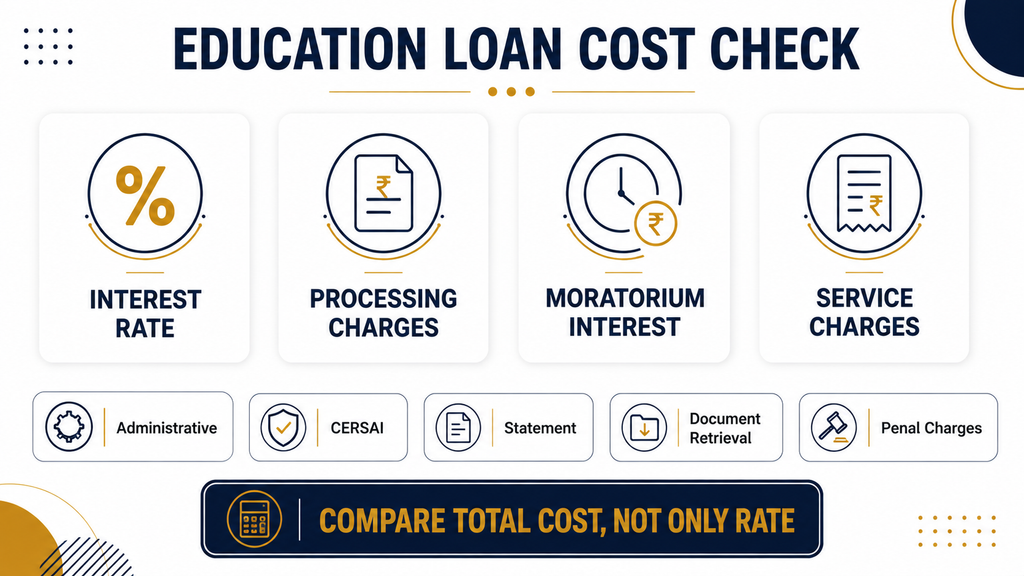
The interest rate is not the complete cost of borrowing.
ICICI’s official education-loan rates and charges information publishes charges that may apply depending on the loan product and transaction.
Students should check for:
- Processing charges
- Administrative charges
- CERSAI-related charges
- Repayment mode change fees
- Statement charges
- Amortisation schedule charges
- Duplicate NOC charges
- Document retrieval charges
- Payment dishonour charges
- Penal charges
The cost of an ICICI Bank education loan for abroad studies should therefore be evaluated using both interest and applicable non-interest charges.
The ICICI GST guidance for education loans also explains the treatment of GST on applicable financial services and charges.
Are These Really “Hidden Charges”?
Not literally.
ICICI publishes fee and charge information on its website. Calling every additional fee a hidden charge would imply concealment without evidence.
A better description is:
Education-loan charges that students may overlook.
Always request the applicable schedule of charges before accepting the loan.
Does ICICI Charge for Prepayment?
Prepayment rules can depend on the loan structure.
The ICICI NRI Education Loan FAQs publish different treatment for relevant floating and fixed-rate loans.
The applicable conditions for an ICICI Bank education loan for abroad studies should therefore be checked against the exact product and sanction agreement.
Do not assume that the prepayment conditions of one ICICI education-loan product apply to every other offering.
This becomes particularly important if the family expects to repay a large part of the loan early.
How Does the ICICI Education Loan Moratorium Work?
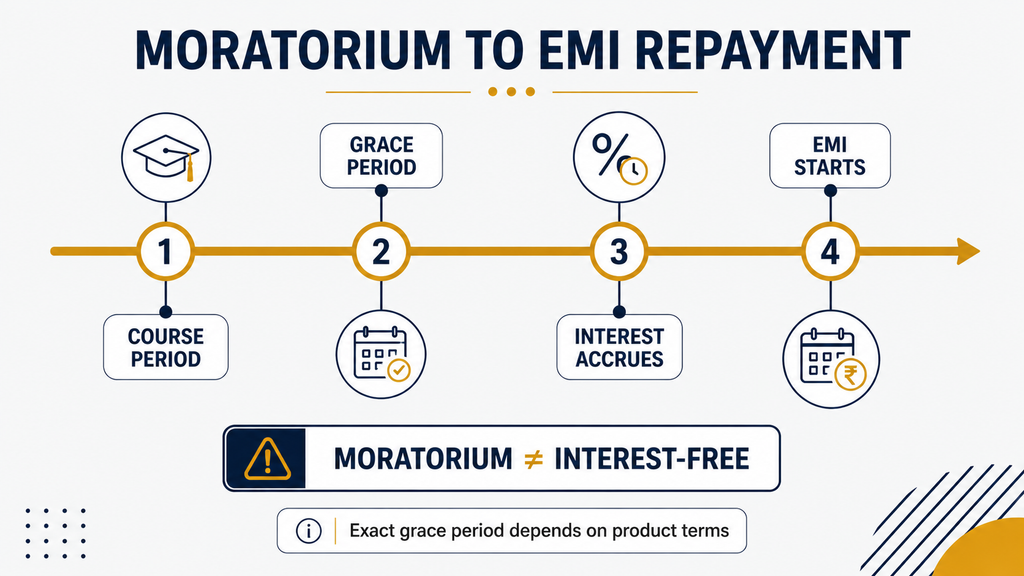
A moratorium allows principal repayment to be postponed for an applicable period.
It does not automatically make the borrowing interest-free.
ICICI’s education loan moratorium guidance explains that interest can continue accumulating during the moratorium.
For an ICICI Bank education loan for abroad studies, this can materially increase the repayment commitment if accrued interest remains unpaid.
Students should confirm:
- Interest payable during study
- Interest payable during the grace period
- Whether partial interest servicing is allowed
- Treatment of unpaid accrued interest
- EMI commencement date
What Is the Exact Moratorium Period?
ICICI’s official pages currently contain different grace-period descriptions.
Its dedicated moratorium guidance discusses a course-period-plus-six-month structure, while other ICICI product information contains different possible grace periods.
Therefore, one universal moratorium period cannot safely be assigned to every borrower.
Students should verify the exact period in their sanction terms.
How Much Could the Loan Cost to Repay?
Consider this purely illustrative example for an ICICI Bank education loan for abroad studies.
Assume:
- Amount of Loan: ₹30,00,000
- Assumed rate of Interest: 10.25% p.a
- Repayment tenure: 10 years
- Monthly compounding
- 120 monthly instalments
- Moratorium interest excluded
- Processing fees excluded
- Other charges excluded
EMI formula:
EMI = P × r × (1+r)ⁿ ÷ [(1+r)ⁿ − 1]
Where:
- P = ₹30,00,000
- Annual rate = 10.25%
- Monthly rate = 10.25% ÷ 12
- n = 120 months
| Calculation | Approximate amount |
| EMI | ₹40,062 |
| Total of 120 EMIs | ₹48,07,404 |
| Interest during repayment | ₹18,07,404 |
This is an Illustrative Instance, not an ICICI Bank quotation.
Actual repayment may differ because of:
- Different final interest rate
- Floating-rate changes
- Moratorium interest
- Processing charges
- Other lender fees
Different repayment tenure
ICICI vs SBI Education Loan: Which Could Cost Less?
An ICICI vs SBI education loan comparison should use equivalent overseas products and identical assumptions.
For SBI, students can review SBI Global Ed-Vantage and SBI’s official education-loan interest-rate schedule.
| Factor | ICICI | SBI Global Ed-Vantage |
| Secured published rate | Starts 9.00% p.a. | Depends on applicable SBI category |
| Unsecured published rate | Starts 10.25% p.a. | Select-institution pricing applies |
| Overall maximum | Up to ₹3 crore | Up to ₹3 crore |
| General maximum tenure | Up to 15 years | Up to 15 years |
| Pricing | Product/profile dependent | Floating, benchmark-linked |
| Security | Product/profile dependent | Institution/product dependent |
| Moratorium | Product-specific | SBI product terms apply |
An ICICI Bank education loan for abroad studies may look attractive from its starting secured rate, but that alone does not prove it will cost less than SBI.
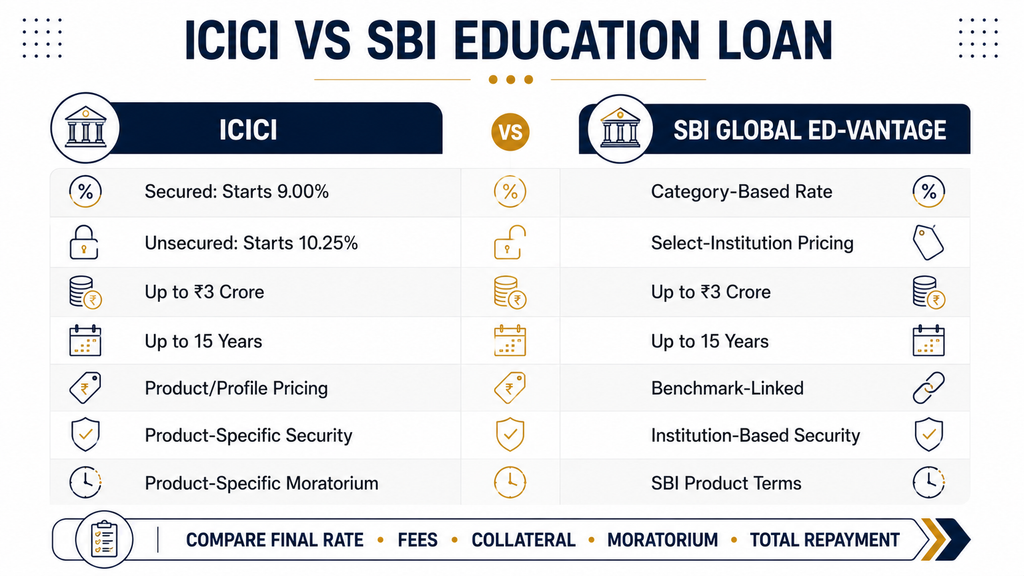
The comparison should include:
- Final offered interest rate
- Processing fee
- Margin requirement
- Collateral
- Moratorium interest
- Repayment tenure
- Prepayment conditions
- Total estimated repayment
There is no evidence that either lender is universally cheaper for every student.
What Documents Should You Prepare?
The ICICI education-loan documentation guide identifies documents that can include:
- Identity proof
- Address proof
- Academic marksheets
- Academic certificates
- Admission letter
- PAN
- Co-applicant KYC
- Salary slips
- Bank statements
- Income Tax Returns
- Business documents where applicable
- Property documents for secured loans
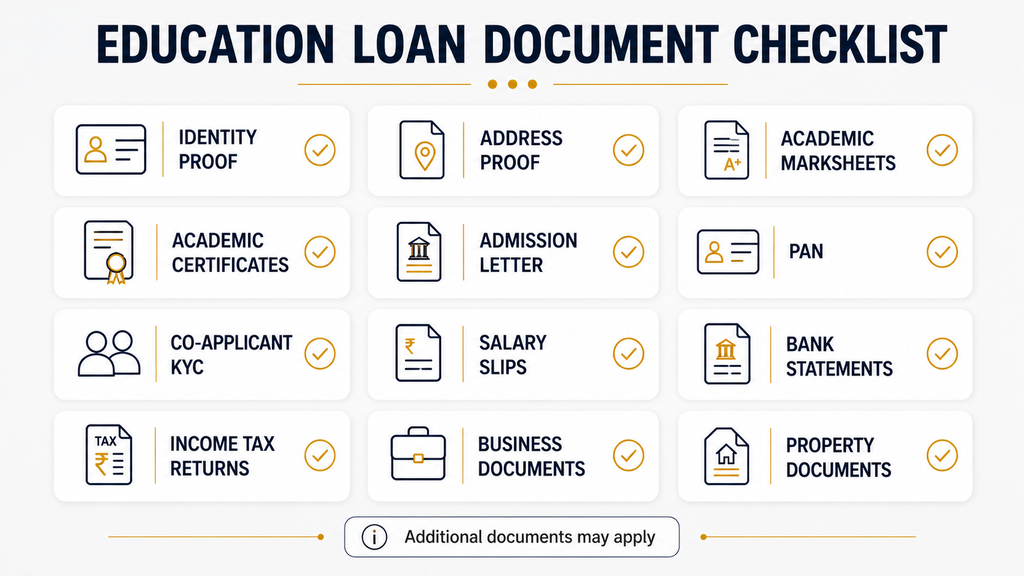
Applying for an ICICI Bank education loan for abroad studies with complete and consistent documents can help prevent avoidable processing delays.
Additional documents may still be requested based on the borrower and product.
Can Education Loan Interest Qualify Under Section 80E?
Qualifying education-loan interest may receive tax treatment under Section 80E, subject to statutory conditions.
The Income Tax Department’s official guidance should be checked for current eligibility.
The deduction concerns qualifying interest, not principal repayment.
Students or parents using an ICICI Bank education loan for abroad studies should not assume tax eligibility merely because the borrowing is labelled an education loan.
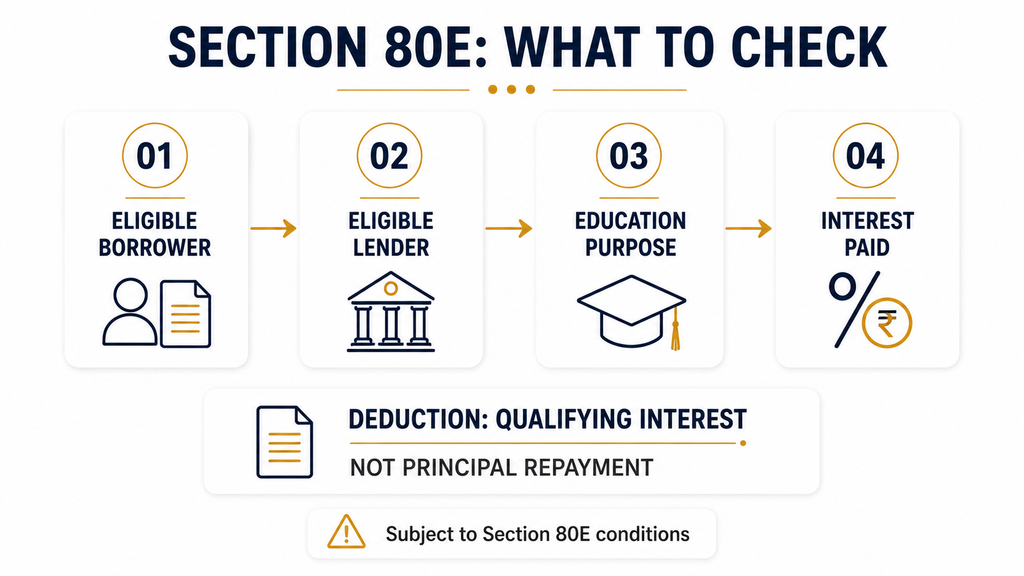
Confirm:
- Eligible borrower
- Eligible lender
- Purpose of loan
- Interest actually paid
- Applicable deduction period
Tax rules should always be checked against the taxpayer’s individual circumstances.
What Mistakes Should Students Avoid?
Students considering an ICICI Bank education loan for abroad studies should avoid these common mistakes:
- Comparing only advertised starting rates.
- Assuming the lowest rate is guaranteed.
- Treating ₹3 crore as an automatic sanction.
- Assuming ₹3 crore is universally collateral-free.
- Ignoring moratorium interest.
- Confusing sanction with disbursement.
- Ignoring processing and service charges.
- Borrowing more than the genuine funding gap.
- Comparing lenders using different assumptions.
- Ignoring the final sanction letter.
How Should Families Borrow Responsibly?
Before accepting an ICICI Bank education loan for abroad studies, calculate the complete repayment commitment rather than focusing only on how much the bank is willing to sanction.
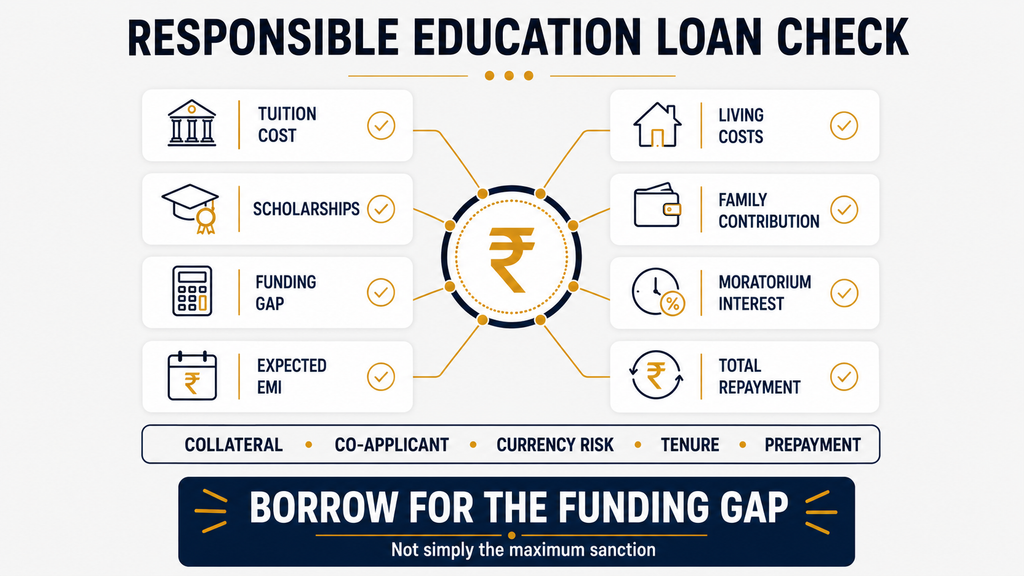
Before signing an education loan, calculate:
- Total tuition cost
- Living expenses
- Scholarships
- Family contribution
- Actual funding gap
- Required loan amount
- Moratorium interest
- Expected EMI
- Estimated total repayment
- Collateral exposure
- Co-applicant liability
- Currency risk
- Longer-tenure interest cost
- Prepayment flexibility
A larger sanction amount is not automatically a better financial outcome..
How Can Foreign Edu Loans Help?
Foreign Edu Loans is an education-loan facilitation and guidance platform for students planning international education.
Students comparing an ICICI Bank education loan for abroad studies with other suitable options can use Foreign Edu Loans to:
- Explore education-loan options.
- Understand secured and unsecured structures.
- Compare suitable lenders.
- Organise documentation.
- Coordinate the application process.
Foreign Edu Loans is not a lender and does not make the final credit decision.
The final interest rate, sanctioned amount, collateral requirement, approval and disbursement remain subject to the lender’s underwriting, documentation, eligibility rules and current product policies.
Check Your Education Loan Eligibility
FAQs
Is an ICICI Bank education loan for abroad studies available without collateral?
Yes. ICICI publishes unsecured education-loan options. However, different official ICICI education-loan products currently show different unsecured structures. Confirm the applicable amount for your institution and borrower profile.
In what is the interest rate of the ICICI education loan?
The current overseas education-loan rates at the ICICI Bank rates page are 9.00% p.a. secured and 10.25% p.a. unsecured. The rate of offer might vary.
What are the main ICICI loan eligibility criteria?
The ICICI Education Loan FAQs identify factors including Indian nationality, academic profile, eligible institution, course eligibility and applicant/co-applicant assessment.
Is ICICI cheaper than SBI for an education loan?
Not necessarily. Compare the final ICICI offer with the current SBI Global Ed-Vantage terms using the same loan amount, tenure and repayment assumptions.
Does interest stop during the ICICI moratorium?
No. ICICI’s moratorium guidance explains that interest can continue accruing during the moratorium.
Can parents claim a tax deduction on education-loan repayment?
Qualifying borrowers may be able to claim eligible education-loan interest under Section 80E, subject to the conditions explained by the Income Tax Department.
Conclusion
An ICICI Bank education loan for abroad studies offers secured and unsecured funding options for eligible international education expenses. Current ICICI information publishes overseas starting rates of 9.00% p.a. secured and 10.25% p.a. unsecured, but the actual offered rate can differ.
Before accepting an ICICI Bank education loan for abroad studies, compare processing charges, collateral, moratorium interest, tenure and total repayment alongside the interest rate. ICICI’s official pages also contain differences regarding some unsecured and moratorium conditions, making the sanction letter particularly important.
Compare ICICI with SBI or other eligible lenders using the same borrowing assumptions. Borrow for the genuine funding gap rather than automatically taking the maximum available sanction.