The RBI Model Education Loan Scheme (MELS) guidelines correctly are not a single RBI education-loan product with one interest rate, one sanction limit or automatic approval. The Model Educational Loan Scheme was prepared by the Indian Banks’ Association (IBA), while RBI advised Scheduled Commercial Banks to adopt it. The Department of Financial Services states that the scheme was last modified in June 2025.
MELS provides a broad framework covering need-based lending, specified collateral treatment, margin, moratorium and repayment. The bank still evaluates the application and applies its current product and credit policies. This guide explains what MELS gives borrowers, what it does not guarantee and what overseas students should verify before signing a loan agreement.
RBI Model Education Loan Scheme (MELS) guidelines: Overview
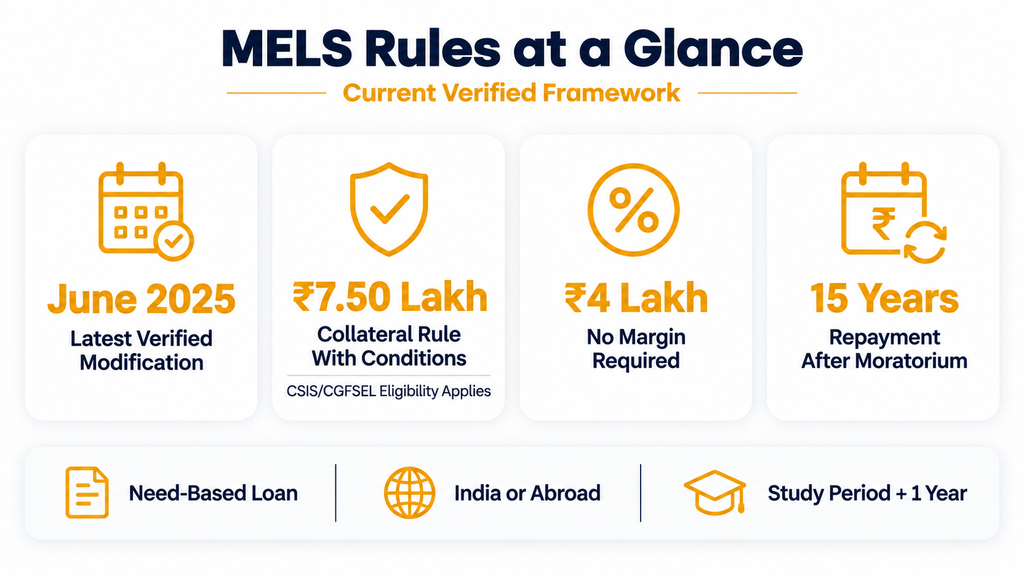
| Question | Current verified position |
| Who prepared MELS? | Indian Banks’ Association |
| RBI’s role | RBI advised Scheduled Commercial Banks to adopt the IBA scheme |
| Latest modification verified | June 2025 |
| Study location | Recognised higher-education institutions in India or abroad, subject to the scheme’s eligibility route |
| Loan basis | Need-based |
| Collateral | No collateral or third-party guarantee up to ₹7.50 lakh where eligible for CSIS and/or CGFSEL coverage |
| Margin | No margin up to ₹4 lakh |
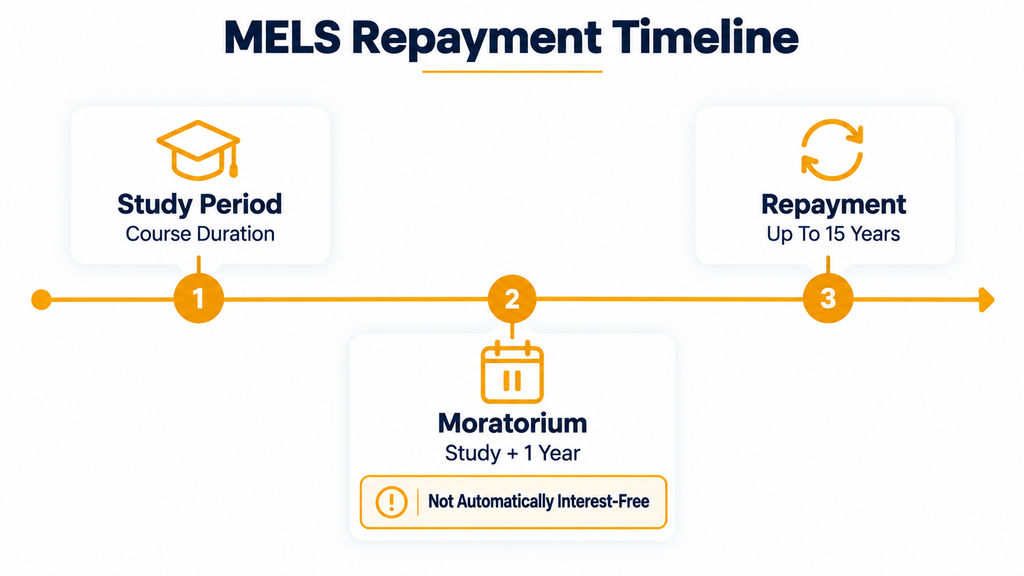
| Moratorium | Study period plus one year |
| Repayment | Up to 15 years after moratorium |
| One RBI-set education-loan rate? | No |
The Department of Financial Services’ 2025-26 Annual Report provides this core MELS summary and states that the scheme was last modified in June 2025.
What Is the RBI Model Education Loan Scheme?
The RBI Model Education Loan Scheme (MELS) guidelines properly start with one correction: MELS was prepared by the IBA, not created as a retail loan product issued by RBI.
RBI Model Education Loan FAQ says it advised Scheduled Commercial Banks in 2001 to adopt the Model Education Loan Scheme formulated by IBA. RBI’s 2023 FAQ, referring to MELS 2022, also described that version as broad guidance and stated that implementing banks had discretion when operationalising their education-loan schemes.
That means students should not assume that mentioning MELS gives them the same product terms at every bank. The actual sanction, rate, security requirements and other conditions still need to be checked against the lender’s current product.
Read RBI’s official Education Loan FAQ
Readers can also review Foreign Edu Loans’ loan products page before comparing lender offers.
Explore Foreign Edu Loans loan products
Who Can Come Under the MELS Framework?
The RBI Model Education Loan Scheme (MELS) guidelines that applies to international applicants are important as the present-day summary of the Department of Financial Services covers the Indian nationals that get accepted in a higher-studies course in a recognised institution in India or abroad through the prescribed entrance-test or through merit.
It ensures that MELS applies to foreign applicants but not all foreign courses or universities or applicants are automatically eligible.
The official summary used here does not provide a complete June 2025 list of eligible foreign institutions or every course category. Those points should therefore be verified against the lender’s current education-loan product rather than assumed.
What Are the Current Verified MELS Rules?
The RBI Model Education Loan Scheme (MELS) guidelines through the latest government summary contain five core points:
- The loan is need-based.
- No collateral security or third-party guarantee is required for loans up to ₹7.50 lakh where the loan is eligible for CSIS and/or CGFSEL coverage.
- No margin is required for loans up to ₹4 lakh.
- The moratorium can extend through the study period plus one year.
- Repayment after the moratorium can be available for up to 15 years.
What These Rules Mean for Borrowers
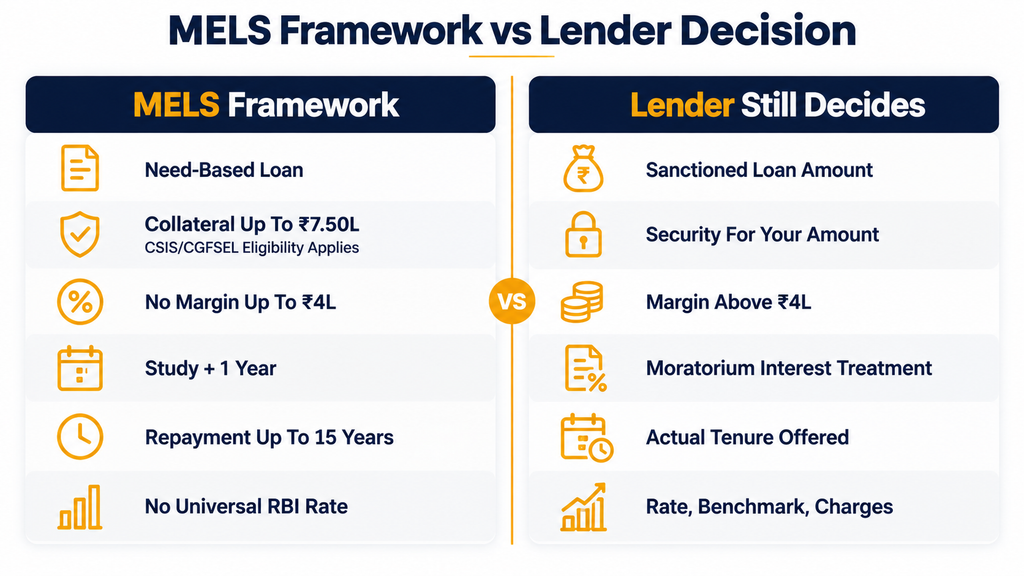
| MELS provision | What it means |
| Need-based loan | Do not assume one universal entitlement amount |
| ₹7.50 lakh collateral provision | Check the attached CSIS/CGFSEL eligibility condition |
| No margin up to ₹4 lakh | Do not extend it above ₹4 lakh without current evidence |
| Study period + 1 year moratorium | Deferred EMI does not automatically mean interest-free |
| Up to 15-year repayment | Longer tenure can reduce EMI but increase total interest |
For repayment planning, see Foreign Edu Loans’ moratorium and EMI guide.
Understand education-loan moratorium and EMI planning
Does MELS Guarantee a Collateral-Free Education Loan?
No. The RBI Model Education Loan Scheme (MELS) guidelines without the condition attached to the ₹7.50 lakh rule would be misleading.
The Department of Financial Services says no collateral security or third-party guarantee is required up to ₹7.50 lakh where the loan is eligible for CSIS and/or CGFSEL coverage. Separately, RBI’s Education Loan FAQ says banks must not mandatorily obtain collateral security for education loans up to ₹4 lakh.
These are different provisions.
Above the relevant thresholds, check the lender’s current policy instead of assuming that “MELS means unsecured”.
Foreign Edu Loans’ collateral versus non-collateral guide explains secured and unsecured borrowing in more detail.
Compare collateral and non-collateral education loans
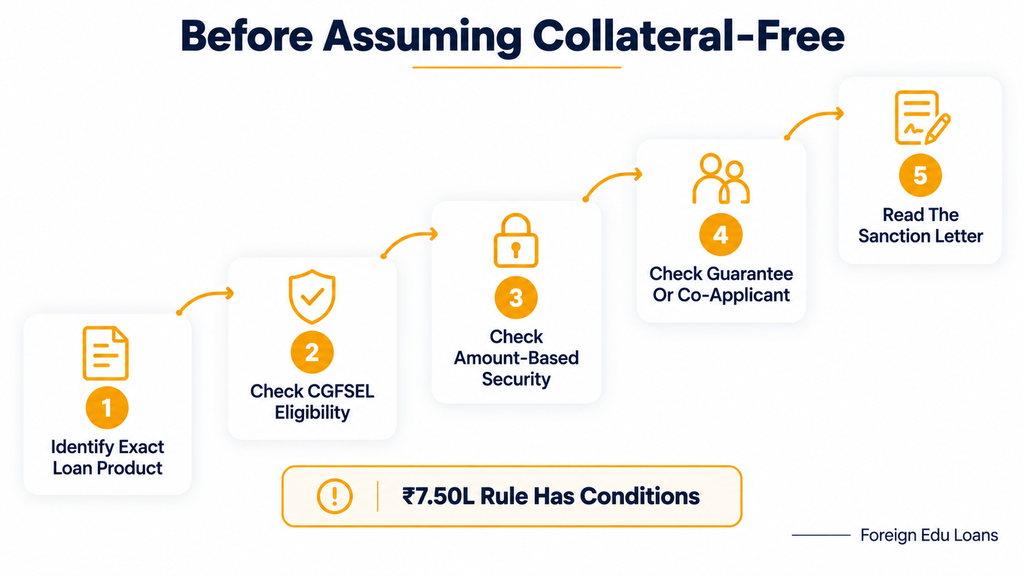
Questions to Ask Before Assuming a Loan Is Collateral-Free
- Which exact education-loan product am I applying for?
- Is my loan eligible for CGFSEL coverage?
- Does the security requirement change with the amount?
- Is a third-party guarantee or co-applicant required?
- What does the sanction letter actually state?
What Is CGFSEL and How Is It Different From MELS?
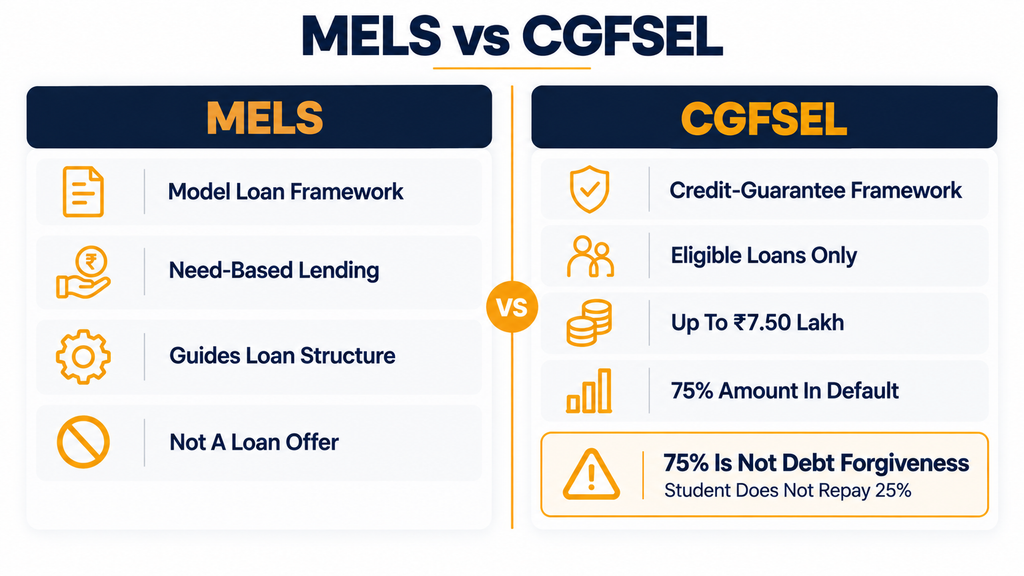
The RBI Model Education Loan Scheme (MELS) guidelines alongside CGFSEL become easier to understand because the two serve different purposes.
NCGTC’s official CGFSEL FAQ says guarantee support can apply to eligible education loans up to ₹7.50 lakh extended without collateral and third-party guarantee by participating lenders. Maximum guarantee cover is 75% of the amount in default for an eligible borrower.
That 75% is not debt forgiveness. It does not mean the student repays only 25%.
| Framework | Main purpose |
| MELS | Model education-loan framework |
| CGFSEL | Credit-guarantee framework for eligible loans |
| RBI regulation | Regulates banks and relevant lending practices |
| Lender policy | Determines actual product terms and credit decision |
Read the official NCGTC CGFSEL FAQ
Does RBI Set the Education-Loan Interest Rate?
No. The RBI Model Education Loan Scheme (MELS) guidelines accurately must separate MELS from loan pricing.
RBI states that interest rates on advances, including education loans from Scheduled Commercial Banks, are deregulated. Banks determine their applicable rates under Board-approved structures, subject to RBI regulatory directions.
There is therefore no single figure that can accurately be called the “RBI MELS interest rate”.
When comparing offers, check the actual rate, fixed or floating structure, benchmark and spread where relevant, charges, moratorium-interest treatment, tenure, collateral, co-applicant obligations and total expected repayment.
Foreign Edu Loans’ EMI-calculator guide can help with scenario planning, but calculator results are estimates, not lender quotes.
Learn how to use an education-loan EMI calculator
Is ₹25 Lakh the Maximum Education Loan Under RBI Rules?
No. The RBI Model Education Loan Scheme (MELS) guidelines should not mix MELS with RBI priority-sector classification.
RBI’s current Priority Sector Lending Directions say education loans to individuals for educational purposes, including vocational courses, not exceeding ₹25 lakh are eligible for priority-sector classification. RBI’s related FAQ also explains that the outstanding can later exceed ₹25 lakh because of accrued moratorium-period interest, provided the sanctioned limit did not exceed ₹25 lakh.
That does not establish ₹25 lakh as the maximum a lender may sanction under every education-loan product.
Priority-sector classification and a lender’s product limit are different concepts.
Read RBI’s current Priority Sector Lending Directions
What Borrower Protections Should Students Know?
The RBI Model Education Loan Scheme (MELS) guidelines should also separate MELS from wider RBI borrower-protection rules.
1. Key Loan Information
RBI’s Key Facts Statement framework requires regulated entities within scope to give retail and MSME term-loan borrowers key information, including the all-in cost. Compare the KFS with the sanction letter and final agreement.
See RBI’s Key Facts Statement guidance
2. Application and Rejection Records
RBI’s current Priority Sector Lending Directions require banks to maintain records covering receipt, sanction, rejection and disbursement, including the reasons for rejection. Banks must also acknowledge priority-sector loan applications, and their Boards must prescribe a time limit for communicating the decision in writing.
This is a process protection, not a right to approval.
3. Grievance Escalation
The Reserve Bank Integrated Ombudsman Scheme, 2026 took effect on 1 July 2026 and replaced the 2021 scheme. It provides a cost-free route for eligible complaints involving deficiency in service by covered regulated entities.
Start with the lender’s grievance process. The Ombudsman route is not a way to compel approval merely because an applicant disagrees with a legitimate credit decision.
Read RBI’s Integrated Ombudsman Scheme 2026 FAQ
What Should an Overseas Student Check Beyond MELS?
The RBI Model Education Loan Scheme (MELS) guidelines lay out the general framework, yet a foreign borrower requires product-specific responses.
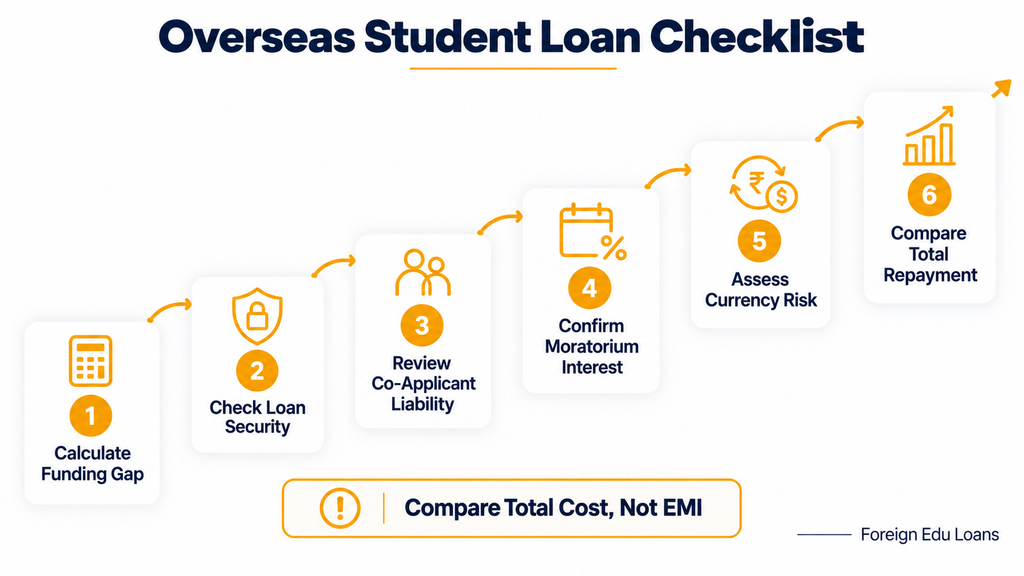
- Gap before scholarship and savings: Tuition and other allowable expenses less scholarships, savings and known family contribution.
- Security: Determine if the loan is secured or not and the amount of exposure in case of security.
- Co-applicant: Learn about the underwriting factors and impact of co-applicant on the contract.
- Moratorium: verify the time of regular repayment commencement and the interest.
- Currency risk: INR borrowing against foreign currency expenses may turn out to be more expensive in case of the adverse shift in the exchange rates.
- Repayment: Not EMI alone but the total repayment.
For wider planning, see Foreign Edu Loans’ study-abroad education-loan guide.
Read the Foreign Edu Loans study-abroad education-loan guide
Common Mistakes Borrowers Make With MELS
The RBI Model Education Loan Scheme (MELS) guidelines are often misread in five ways:
- Calling MELS an RBI loan product. IBA prepared the framework.
- Assuming all banks offer identical terms. Product and credit policies still differ.
- Treating ₹7.50 lakh as an unconditional collateral-free promise. The verified wording includes CSIS and/or CGFSEL eligibility.
- Treating moratorium as interest-free. Deferred regular repayment does not automatically stop interest.
- Calling ₹25 lakh the RBI maximum loan. That figure concerns priority-sector classification, not a universal sanction ceiling.
Responsible Borrowing: Use MELS as a Framework, Not a Target
The RBI Model Education Loan Scheme (MELS) guidelines should help students understand financing rules, not encourage them to maximise debt.
Before borrowing, calculate:
- the actual funding gap;
- likely study-period and moratorium interest;
- expected balance when regular repayment begins;
- EMI at the lender’s actual rate;
- collateral exposure;
- co-applicant liability; and
- currency risk for overseas study.
Borrowing Rule: Compare the complete repayment commitment, not only the sanctioned amount or advertised rate.
How Foreign Edu Loans Can Help
Foreign Edu Loans is an education-loan facilitation and guidance platform for students pursuing international education. Its website says it helps students compare banks and NBFCs and supports documentation.
It does not make the final credit decision. Its published terms state that approval, rejection, sanction amount, rate, tenure, collateral and disbursement decisions are made by the relevant lending institution.
Check Your Education Loan Eligibility
FAQs
1. Do the RBI Model Education Loan Scheme (MELS) guidelines here create identical terms for every bank?
No. RBI’s Education Loan FAQ describes the version it discusses as broad guidelines for Scheduled Commercial Banks and states that implementing banks have discretion when operationalising the scheme. Borrowers should therefore verify the bank’s current product terms.
2. Can MELS Apply to Indian Students Studying Abroad?
Yes. The current Department of Financial Services summary includes qualifying Indian nationals admitted to recognised higher-education institutions in India or abroad through the applicable selection route.
3. Does MELS Guarantee a Collateral-Free Loan?
No. The current ₹7.50 lakh provision includes an eligibility condition linked to CSIS and/or CGFSEL. Check the exact product and applicable guarantee conditions.
4. Does RBI Decide My Education-Loan Interest Rate?
No. RBI states that rates on education loans sanctioned by Scheduled Commercial Banks are deregulated and determined by banks under their applicable Board-approved structures and regulatory requirements.
5. Is the MELS Moratorium Automatically Interest-Free?
Do not assume so. The verified MELS summary provides a moratorium of the study period plus one year, but that provision by itself does not say that interest stops accruing. Borrowers should check the lender’s specific treatment of interest.
Conclusion
The RBI Model Education Loan Scheme (MELS) guidelines correctly give borrowers a framework, not a guaranteed loan offer. IBA prepared MELS, RBI regulates relevant banking practices, and the lender makes the actual credit and product decision.
The current government summary verifies need-based lending, specified collateral treatment up to ₹7.50 lakh subject to the stated eligibility condition, no margin up to ₹4 lakh, a moratorium of the study period plus one year and repayment of up to 15 years after moratorium.
For overseas students, compare the final rate, security, co-applicant liability, moratorium treatment, total repayment and currency risk before borrowing.