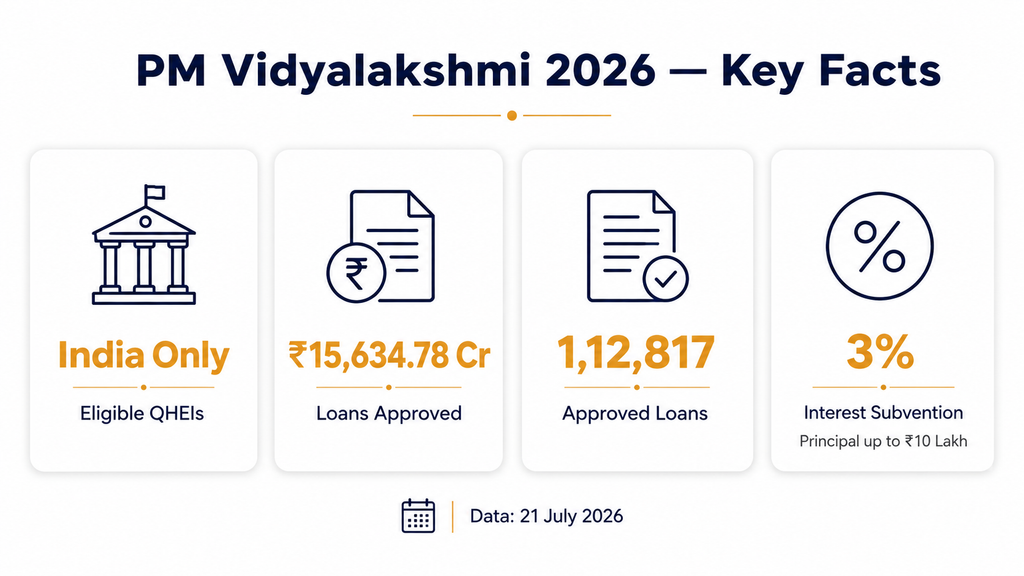
The key thing about the PM Vidyalakshmi Scheme 2026 is simple: it covers eligible students admitted to degree or diploma programmes at the specified Quality Higher Educational Institutions in India. It is not an overseas education financing scheme.
The scheme offers collateral-free and guarantor-free financing to students who are admitted to qualified Indian QHEIs based on their merit. The actual loan amount may be determined depending on course fees and related educational costs. Based on the annual family income and lifestyle, eligible borrowers can also avail a 3% interest subvention of the eligible loan principal up to 10 lakh lent in the moratorium period.
Students intending international education must thus make comparisons on distinct study-abroad funding opportunities as opposed to presuming that this plan is applicable abroad.
Accuracy Tip: Rates and terms of education loans differ between the lenders and the applicants. The applicable terms can depend on the amount of the loan, student profile, financing of co-applicants, course, and university and lender policies. There is thus no universal interest rate presented in this article.
What Is the PM Vidyalakshmi Scheme 2026?
The PM Vidyalakshmi Scheme 2026 is a Central Sector Scheme that aims at enhancing access to financing for meritorious students enrolled in selected Quality Higher Educational Institutions in India.
Its special PM Vidyalakshmi education loan product eliminates the need for collateral and a third-party guarantor for eligible students. When students meet other conditions of the scheme, they can apply for the education loan itself regardless of their family-income category.
The scheme does not have a maximum amount of education-loan cut-off. In its place, the requirement may be seen to mirror the course fee and costs, where allowed, that one is obliged to pay or incur to pursue his/her studies at the QHEI.
Those costs may cover tuition, hostels/mess expenses among other institutional expenses, decent living costs and a decent-quality laptop.
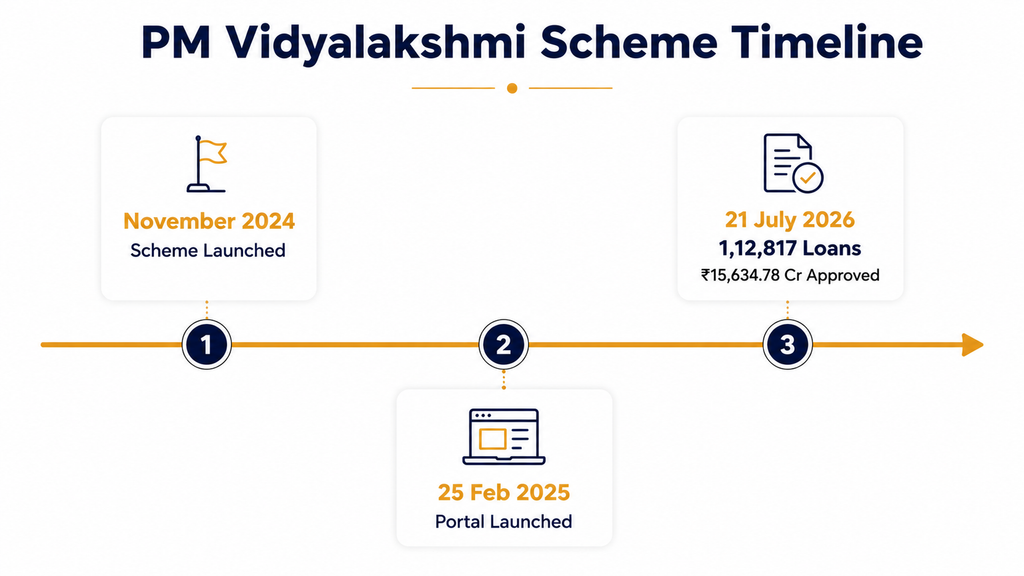
In November 2024, the scheme was launched. The special portal has been in circulation since 25 February 2025.
By 21 July 2026, the Ministry of Education had approved 1,12,817 collateral-free and guarantor-free loans under the scheme with a total of ₹15,634.78 crore.
Who Is Eligible for the PM Vidyalakshmi Scheme 2026?
The PM Vidyalakshmi scheme 2026 is more concerned with linking eligibility to the institution and mode of admission than the basic loan benefit is limited to a single income group.
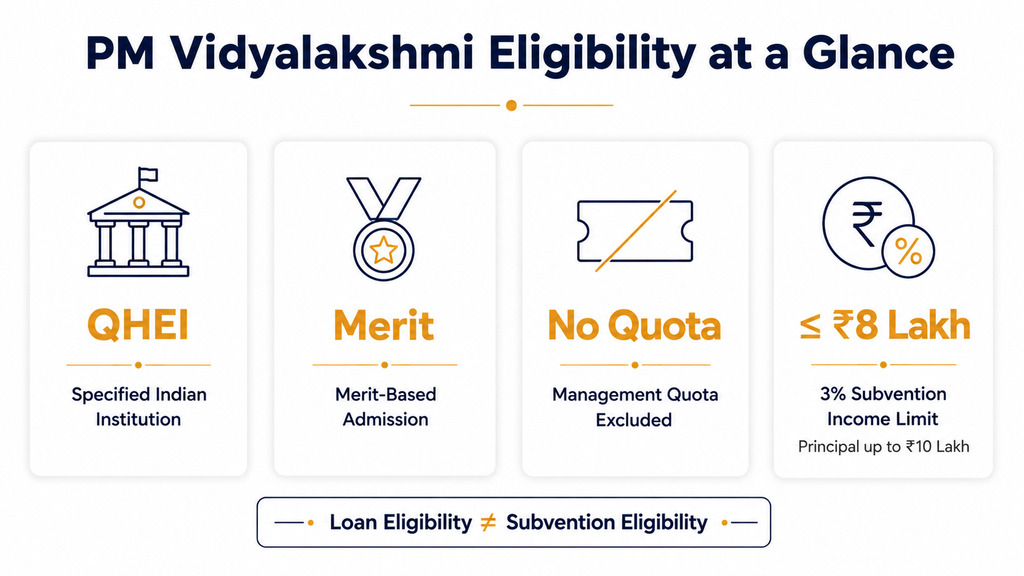
To be eligible to obtain a certain degree or diploma programme, a student will usually require admission to a specific QHEI in India, on the basis of merit.
Those students who have been admitted under a management quota (or some other kind of quota system) cannot have access to the officially provided scheme.
Important Eligibility Distinction
The PM Vidyalakshmi scheme 2026 as such is provided in family income groups to otherwise eligible students. The income ceiling also comes into play, especially when it comes to eligibility for the extra 3 per cent interest subvention.
A student with an annual family income of up to ₹8 lakh may avail of a subvention of 3% on the outstanding loan principal of up to 10 lakh to a student who meets the scheme requirements.
In cases where the total loan surpasses 10 lakh, the subvention is not automatically scaled on the whole sum of the loan borrowed.
Loan Tip: You should not mistake being eligible to take the loan with being eligible to receive further government interest benefits.
Can PM Vidyalakshmi Scheme 2026 Be Used for Abroad Studies?
No. The PM Vidyalakshmi Scheme 2026 is designed for students studying at the identified Quality Higher Educational Institutions in India.
This difference is especially significant when students seek a government education loan to go abroad, as the terminologies used domestically and abroad may make domestic and foreign financing programmes seem synonymous.
According to the official scheme guidelines, eligible students should be able to secure admission to QHEIs in India. Therefore, a student is not eligible for an overseas university simply because admissions are on a merit basis.
This implies that students attending the United States, United Kingdom, Canada, Australia, Germany, Ireland, France or other foreign countries require funding other than this specific program.
What it implies to you: International students are encouraged to make comparisons of the education-loan programs offered to their institution, country/destination, course as well as the amount of funds they need to repay.
Why the PM Vidyalakshmi Education Loan Is Different From an Overseas Education Loan
The PM Vidyalakshmi scheme 2026 has a particular government-policy intent and eligibility scheme of the institution.
An overseas education loan is different. The lenders can evaluate the destination, university, programme, overall funding needs, academic performance of the student, finances of co-applicant, availability of collateral and repayment ability.
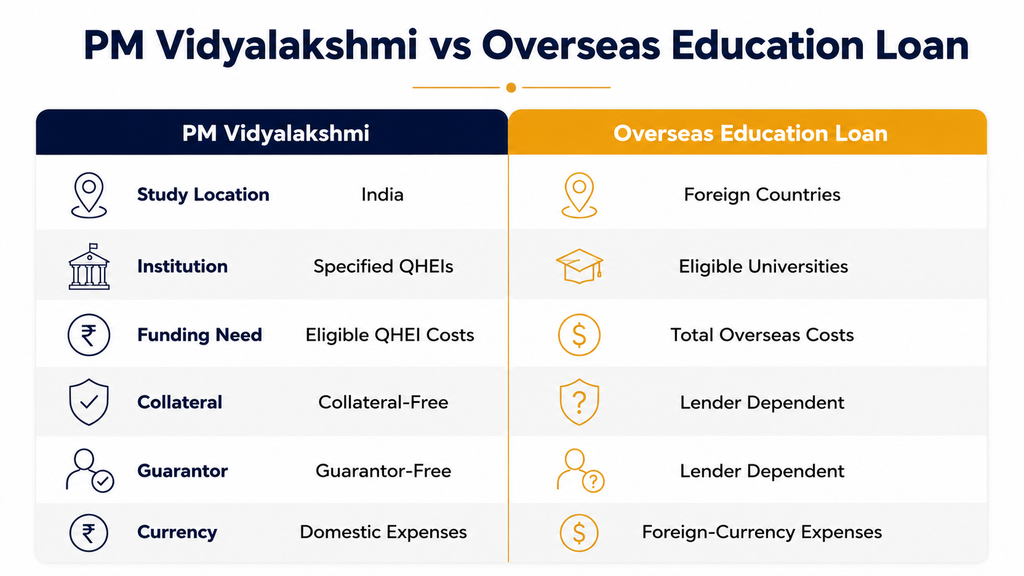
| Comparison | PM-Vidyalakshmi | Normal foreign financing of education. |
| Location of eligible | institutions in India | QHEIs in foreign countries, eligible foreign universities. |
| Collateral structure | Scheme loan is unfixed | Lenders-and-product-dependent. |
| Guarantor | Scheme loan will not be guarantor-free | Requirements depend on lender |
| Loan requirement | Depending on the eligible QHEI costs | Depends on the aggregate costs of overseas studies. |
| Interest rate | Bank/applicant dependent | Lender, amount and applicant dependent |
| Government benefits | Scheme-specific benefits do apply | Depends on applicable programme. |
| Currency factors | Mainly domestic expenses | Primarily foreign-currency expenses cause added risk. |
The comparison also describes the reason why a student in search of a collateral-free government loan would first want to make sure the programme in question covers overseas education.
What is the working of VidyalakshmiPortal?
The system of application of the scheme dedicated to students should be distinguished by those who are students, who may find out additional information about education-loan portals on the internet, but only older information is present there.
According to the Government, the PM-Vidyalakshmi platform was launched on 25 February 2025. It enables students to apply for scheme education loans and other interest subvention through a reduced process which the participating banks use.
As part of applying to the Vidyalakshmi portal, it is important to ensure that the applicants are using the existing official PM-Vidyalakshmi portal and updated scheme details.
With the PM Vidyalakshmi scheme 2026, application access is simplified with digital processing but does not imply an automatic approval of each submitted application.
The lender continues to judge the application based on relevant scheme requirements, documentation and lending processes.
Before You Apply: Make sure that your institution is visible in the current skilled QHEI structure, then create the application.
Which interest rate is charged as per the Scheme?
No universal interest rate can be put out there as the one that is to be applied to all borrowers.
The final rate may be different depending on the bank, amount of the loan, product structure directed to it, as well as any factors with regard to a borrower. Students ought to thus ensure that they check the real rate charged by the given lender prior to accepting a sanction.
The separate PM Vidyalakshmi scheme 2026 offers an eligible 3% interest subvention benefit. This is a government aid option and is not to be mixed with the full interest rate of the lender on the education loan.
To eligible students, the subvention is applicable to eligible loan principal under moratorium of up to 10 lakh provided scheme conditions are met.
Interest rate Review: Compare the final rate to be charged, repayment format, treatment of moratorium as well as the full cost of the borrowing.
Even with the situation where two applicants may go to the same bank, there is a large learning loan that will establish a very distinct repayment obligation.
Government Education Loan to study abroad: What else can students think of?
When a student considers getting a government loan to study in a foreign country, he or she should not assume that all government-funded educational programs simply offer direct up-front overseas funding.
For recognised overseas programmes depending on the eligibility, regular education-loan products are also available in other lenders like banks of the public sector.
Certain students can also be targeted by government assistance.
In 202627, the National Overseas Scholarship is offered to eligible low-income candidates of certain categories, such as Scheduled Castes, Denotified, Nomadic and Semi-Nomadic Tribes, Landless Agricultural Labourers and Traditional Artisans. It offers Master’s and PhD studies abroad, which are eligible.
The students are not to use old articles which suggest new applications of Padho Pardesh. In 2022-23, the scheme was discontinued, but the benefits were still paid to existing beneficiaries as per the relevant conditions, according to the Ministry of Minority Affairs.
The other type of financial support is the government education loan to overseas students and government scholarship.
Is it possible to borrow a Collateral-Free Loan to study abroad?
- It is possible, and it may be determined by the lender, requested amount, institution, course and applicant profile.
- A student with a particular interest in finding a collateral-free government loan needs to differentiate between the government credit-guarantee coverage and the unsecured overseas loan products of specific lenders.
- Credit-guarantee arrangements supported by the governments can always work within a stipulated limit and eligibility requirements. They are never to be construed in any way as free unconditional funding of all global programmes.
- Outside of those arrangements, some banks, NBFCs and foreign education lenders might wish to look at unsecured foreign education loans.
- Evaluation may include academic records, quality of the university, the courses available, co-applicant earnings, previous debts and financial record information.
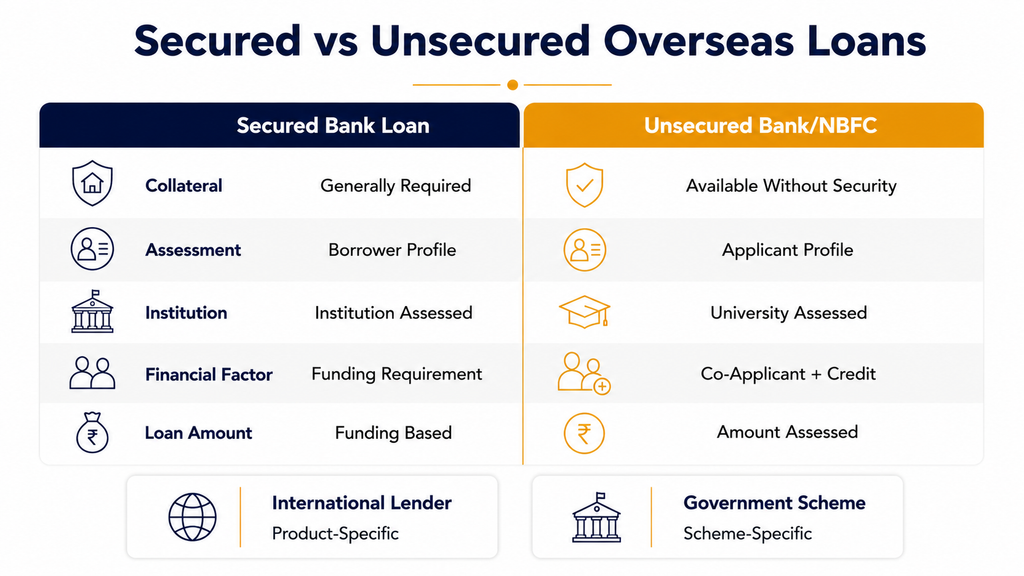
| The financing route | Collateral Position | Significant assessment factors. |
| Secured bank loan | Security required, in general, | Collateral, profile of borrower, institution and funding requirement. |
| Bank/NBFC loan(unsecured) | Available on request | Univ, course, co-applicant, credit and loan amount. |
| International lender | Product-specific | Fundamental: new international lenders, programme, borrower profile and lender rules. |
| Government-backed scheme | Scheme-specific | Eligibility, loan limits and conditions applicable by the government. |
The implication of this is that a government lending collateral-free should never be assumed merely because there exists another government education scheme that promises collateral protection.
Common Mistakes to Avoid
- The assumption of the international universities in the case of the domestic education schemes can lead to severe funding insufficiencies prior to the enrolment dates.
- A comparison of only the advertised rates does not consider the loan amount, fees, moratorium interest, flexibility of repayment and other terms.
- A sanction should not be considered disbursed; this may lead to difficulties when university payment deadlines demand urgently released funds.
- Taking as much money as possible with no evaluation of the ability to pay it back can lead to severe financial strain in the long term.
- Utilisation of out-of-date scheme details may bring applicants to the wrong benefit conclusions or eligibility expectations needlessly.
- It can give unrealistic world financing assumptions in a short time on the assumption that all collateral-free government loans finance unlimited borrowing.
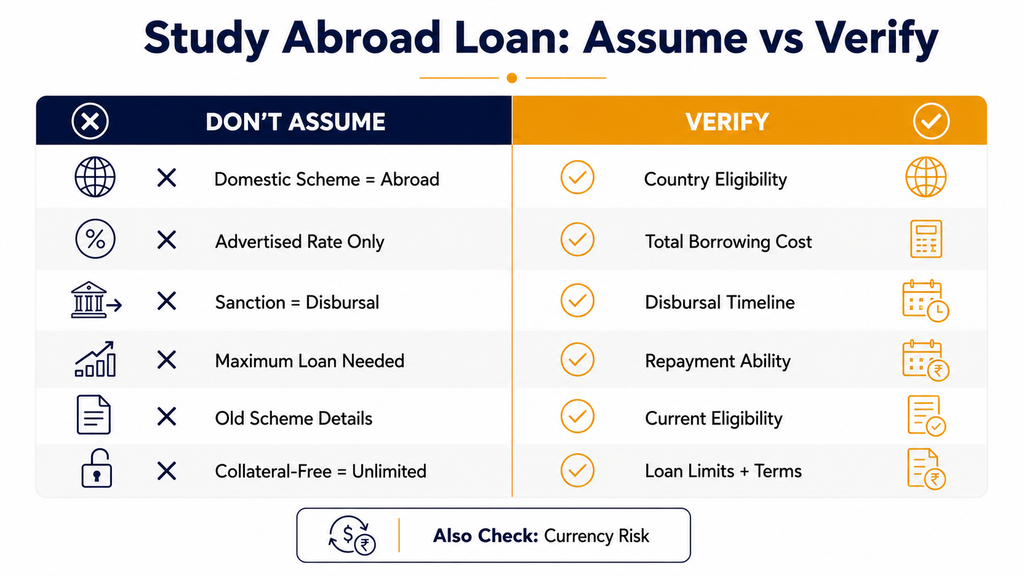
This can cause families to fail to save by ignoring the fluctuations in currencies, at a time when they will be required to pay tuition and living costs overseas in the future.
The way Foreign Edu Loans can assist.
Foreign Edu Loans may assist students to compare appropriate foreign financing in cases when the PM Vidyalakshmi scheme 2026 is not applicable.
- Pre-qualify for secured and unsecured education loans.
- Discuss possibilities other than collateralised government loans to study abroad.
- Get to know the difference between an international financing and a PM Vidyalakshmi education loan.
- Compare the government loans to study overseas with any other appropriate loans.
- Get information regarding documents, co-applicants, terms of repayment, and application requirements.
The ultimate approval, amount of loan, and terms to be issued are at the lender’s discretion.
FAQs
Is it possible to use PM Vidyalakshmi Scheme 2026 to study abroad?
No. PM Vidyalakshmi Scheme 2026 only applies to students having distinctive qualifications pursuing their education in QHEIs in India, rather than abroad in foreign universities.
Does PM Vidyalakshmi claim that it is hassle-free with the education loan?
Yes. A PM Vidyalakshmi education loan is a type of loan that includes no collateral nor any guarantors to students studying in specified Indian QHEIs.
Who will be able to apply via the Vidyalakshmi portal?
Eligible students based on receiving merit admission to certain QHEIs have a chance to apply through the Vidyalakshmi portal based on the requirements of the scheme, based on which they receive an offer.
Does it provide a foreign education loan to overseas students?
Students who are interested in taking a government education loan in a foreign country can look into any external support of government and foreign education-loan facility by itself, as PM-Vidyalakshmi does not cover foreign universities.
Can I get one of the free government loans under security of study in other nations?
One does not necessarily have a collateral-free government loan when studying overseas. The eligibility will vary according to the scheme, the lender, the size of the loan and the profile of the borrower.
Under PM-Vidyalakshmi, what is the interest rate to be?
There is no standard rate for all applicants. The interest rate charged may differ depending on the bank, amount of loan, profile of the borrower and the current lender policies.
Do I need to go to PM-Vidyalakshmi?
Students will be able to compare, in terms of the amount, security and collateral of the loans, co-applicants, terms of repayment and total cost of getting the loans, the available amounts of eligible secured and unsecured overseas educational loans.
Conclusion
The PM Vidyalakshmi scheme 2026 is a worthy financing scheme; this time around, the scope should be interpreted properly. It promotes admission to specific Quality Higher Educational Institutions in India due to their merits as opposed to abroad universities.
Students anticipating international education must thus determine their entire shortfall in funding and compare appropriate overseas education-loan programs individually. An education loan provided by PM Vidyalakshmi must not be used as an alternative to international education funding, and any government education loan to overseas or a scholarship must be verified against current official eligibility requirements.
Depending on the lender and profile of applicants, rates of loans may change, and also loan amounts and final terms may be changed. Consider all-inclusive borrowing costs and repayment obligations prior to engaging.