A simple question every student and parent poses to us is the following: what can be the real cost of studying abroad, and how can we afford that? This is overwhelming with increasing tuition, changes in the currency and unknown loan documentation.
Throughout the years, we have assisted thousands of students in the process of education loans, and one trend is unchanging. Families with early knowledge of the real cost of studying abroad and who have used it in their planning have much more certainty in their applications.
This guide is divided into country-specific costs, scholarships and all you need to know about education loan eligibility to study abroad, in order to ensure that you organise your finances before you organise your suitcase.
Why the Cost of Studying Abroad Feels Confusing in 2026?
A majority of students just plan on tuition. It is there that the misconception of the affordability of studying abroad can arise.
- The real cost of studying abroad in fact encompasses multiple layers to the university fee arrangement:
- Tuition fees that are different according to country, course and ranking of the university.
- Monthly living costs such as rent, food, transportation and utility bills.
- Visa applications, medical insurance and pre-departure medical tests.
- Flights, document notarisation and security deposits are one-time expenses.
- Currency conversion fees that can easily slip into thousands during a complete course.
It is this big picture realisation that makes the real beginning of any study abroad budget calculator exercise.
Country-Wise Breakdown: Cost of studying abroad
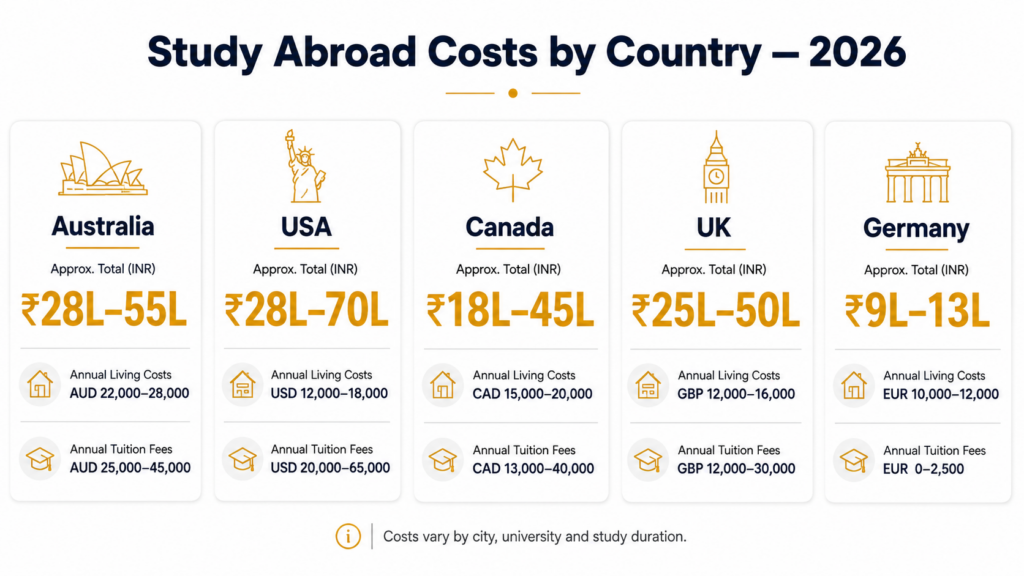
Cost of studying abroad can be very high, and this variance is determined by where you wish to study. The following is a realistic 2026 projection of the popular study destinations.
| Country | Approximate Total (INR) | Annual Living Costs | Annual Tuition Fees |
| Australia | ₹28L – 55L | AUD 22,000 – 28,000 | AUD 25,000 – 45,000 |
| USA | ₹28L – 70L | USD 12,000 – 18,000 | USD 20,000 – 65,000 |
| Canada | ₹18L – 45L | CAD 15,000 – 20,000 | CAD 13,000 – 40,000 |
| UK | ₹25L – 50L | GBP 12,000 – 16,000 | GBP 12,000 – 30,000 |
| Germany | ₹9L – 13L | EUR 10,000 – 12,000 | EUR 0 – 2,500 |
These statistics are representative and change according to the city, university, and the time of studies. Two-year degrees in the US may have the same annual fees, but a one-year UK master’s may appear to be cheaper on the overall outlay.
Hidden Costs Students Often Forget
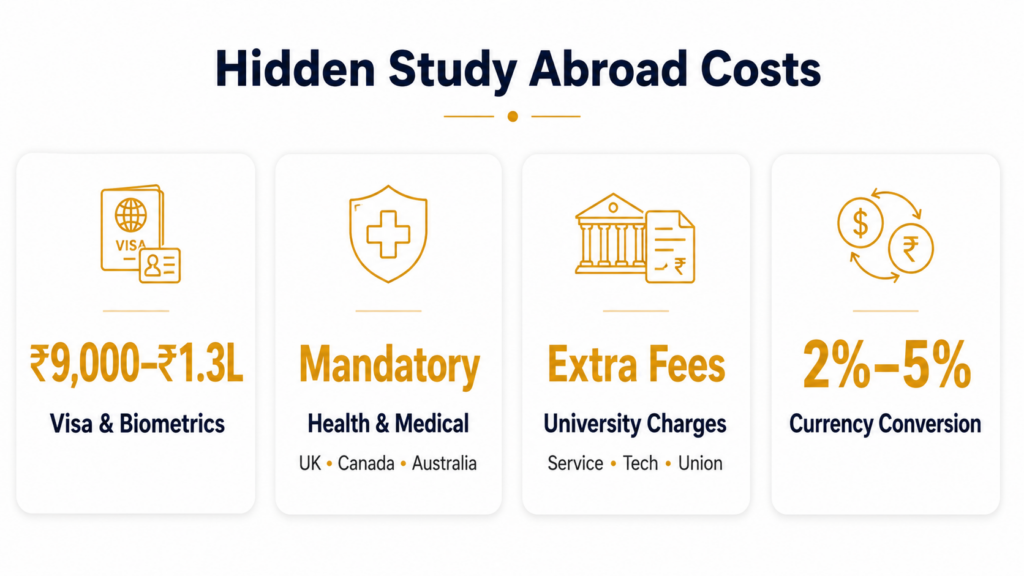
Most families work on the cost of studying abroad based on tuition fees only, only to get caught off-guard in the future.
- The costs of visa and biometrics range between 9, 000 and 130,000 based on the country.
- In the UK, Canada and Australia, health insurance and medical screening are mandatory.
- Service fees, technology fees and student union fees accumulate in no time at the university.
- The conversion fees on international transactions are 2% to 5%.
These extra costs will only be realised in the latter half of your first semester when you are under tremendous financial pressure and will cost you a much more realistic study abroad cost on the very first day.
Use the Study Abroad Budget Calculator Before You Apply.
Ahead of the shortlisting of universities, we will always advise taking the numbers through the study abroad budget calculator. It provides a realistic estimate of the overall cost of studying abroad, and not the headline tuition figure.
An excellent study abroad budget calculator includes tuition, housing, insurance, transportation and anticipated part-time income. This assists students in making comparisons of a USD 40,000 program in the US with a program in the UK at GBP 28,000, on an equal basis.
I believe it would be difficult to get an education loan, yet when students went through this exercise, they would often hear things like, “I thought getting an education loan would be a difficult task, yet when going to Gateway International, they explained everything and helped me decide which bank to go to.
Conducting a study abroad budget calculator in advance will also inform you of the exact amount of the loan that you should borrow rather than excessively borrow or plan less.
Affordable Countries to Study Abroad Without Compromising Quality
In case the overall cost is a significant factor, some of the cheap countries to study abroad have good degrees at a fraction of the prices in the US and the UK.
- Germany has little to no fees in the government-run universities, and all that is almost equal to living standards.
- France and Italy have globalised programs with a Fee of less than EUR 3,000 per annum in the public universities.
- Ireland and some universities in New Zealand strike a golden mean between moderate charges and excellent after-study employment rights.
- Dubai has lower living expenses and proximity to home, therefore attracting Indian students.
The selection of these low-cost countries to study abroad has the potential to hugely drop the total cost of studying abroad and the total amount of loan that must be organised by the family. We often assist students to contrast low-cost and high-cost countries to go abroad, based on career objectives and not merely due to cost.
Scholarships to reduce the cost of study abroad.
One of the least exploited opportunities by Indian applicants is scholarships to reduce the cost of studying abroad.
Some scholarships to manage cost of studying abroad:
- Fulbright-Nehru, Chevening, Commonwealth Scholarships, and DAAD are some Scholarships funded by governments
- Scholarships given by universities based upon a student’s merit, automatically upon admission.
- Needs-based assistance by the top universities in the US and UK.
- Indian student scholarships provided by State and private trusts.
Qualifying as the most frequent pattern of financing, a partial scholarship with an educational loan that finances the rest of the balance to the extent necessary is prevalent with us. The most financially sound choices are often to layer a scholarship reduction of the cost of studying abroad with a loan and not either, as the former is usually less expensive than the latter.
Eligibility of a loan to study abroad.
After knowing your budget and scholarship plan, the next thing is to know the eligibility for education loans for studying abroad. Until we clarified to many students that they were eligible to borrow a loan, many had assumed that they would not qualify.
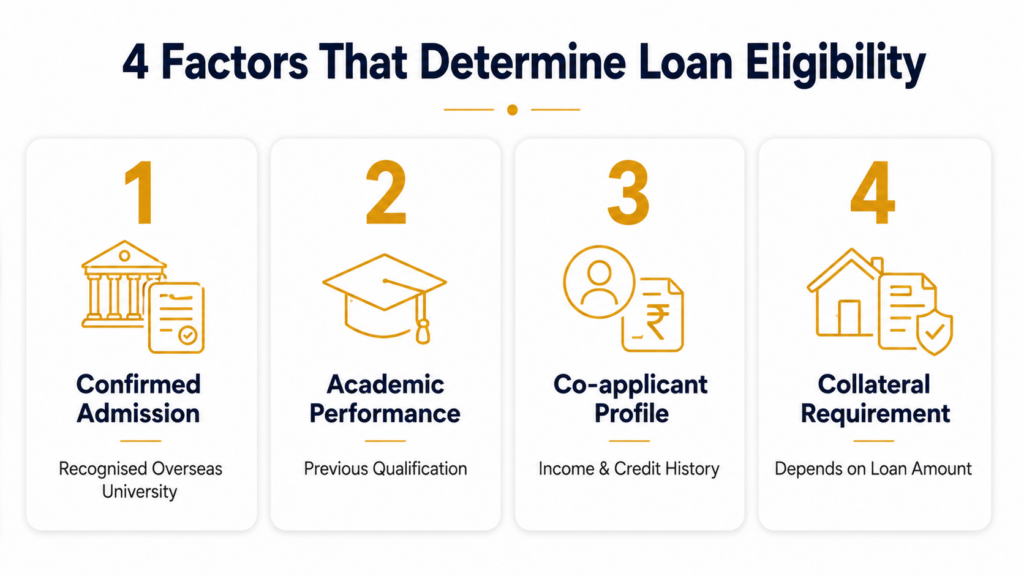
Generally, to qualify to study abroad, one should have four factors:
- The confirmation of admission to a recognised university overseas in a course of study.
- Academic performance of the student, such as regular performance in the previous qualification.
- Parent/Guardian Co-applicant income and credit history.
- Collateral Requirement: the amount of loans that need collateral of a certain amount.
Secured vs unsecured education loans
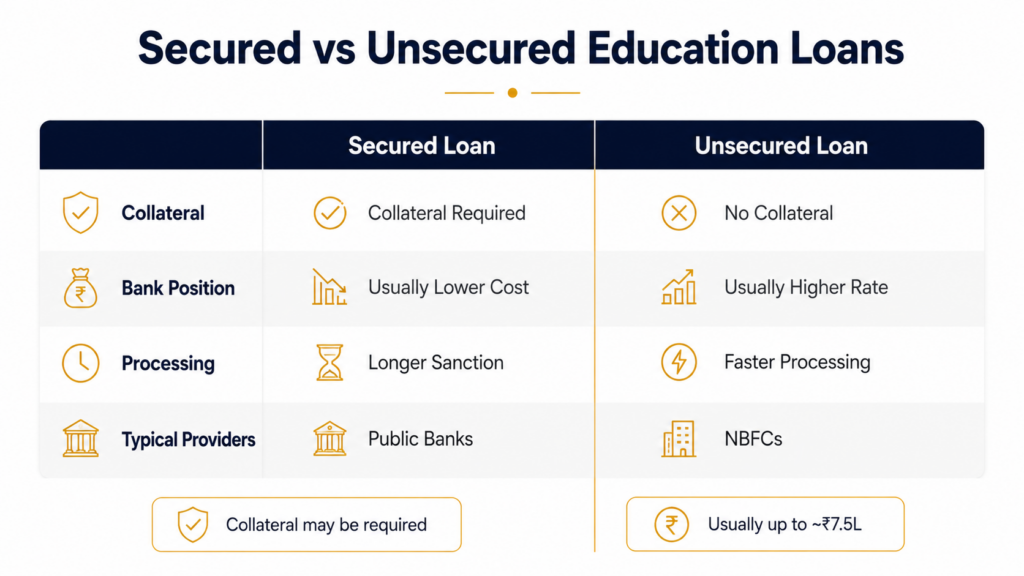
Unsecured loans usually do not require any collateral and are usually up to around 7.5 lakhs. Additionally, most banks will demand collateral of 50 or more of the approved amount.
NBFCs have faster processing of unsecured loans, which are typically at a higher rate of interest. Public banks offer secure loans which are cheaper over the course of the loan period but are sanctioned over a longer period.
Documents That Strengthen Your Application
- Admission or offer letter of the university, and fee structure.
- Documents of school and standardized test scores like or GMAT, IELTS, or GRE
- Co-applicant’s past 2-3 years’ income evidence, and IT returns.
- Any collateral documents, where there would be such, such as property papers or fixed deposit receipts.
To enhance your eligibility in terms of education loans.
- Parents usually view us as saying that reading the procedure about loans was much simpler after our talk with our experts.
- Apply with a co-applicant who has a good income and a clean credit score.
- Select a reputable university, as the confidence of lenders is increased with institutional rank.
- Provide security where feasible, as it tends to open lower interest rates.
- Position yourself to a greater number of lenders, as opposed to approaching banks individually.
Banking Partners: Compare Banking Partners to finance your education.
There is a significant difference in interest rates among the lenders, and this has a direct bearing on the overall cost of studying abroad after the interest is charged over the years.
- SBI is also among the lowest starting rates of the public banks, usually around 8.65 to 10.65%.
- HDFC Bank and HDFC Credila are quicker and have a rate ranging between 10-12%.
- Bank of Baroda and IDBI Bank provide competitive rates with the government in the form of the public sector, combined with average processing time.
- Axis Bank/ InCred is offered to students who require more flexible and speedy disbursal services without security.
Recently, one of our students was able to get funding from SBI after comparing its lenders using our site. The best of these was comparing several banks at once, without going to any, as she explained to us.
A difference in a percentage of interest rates can alter the total amount repaid in a tenure of 15 years by several lakhs, and thus it is more important to compare a lender than the cost of studying abroad country itself.
Step-by-Step Loan Application Process to Manage the Cost of Studying Abroad
It is so simple that you can apply for an education loan in order. Early planning also assists you in making the correct estimate of the cost of studying abroad and not being held up in paying the fees.
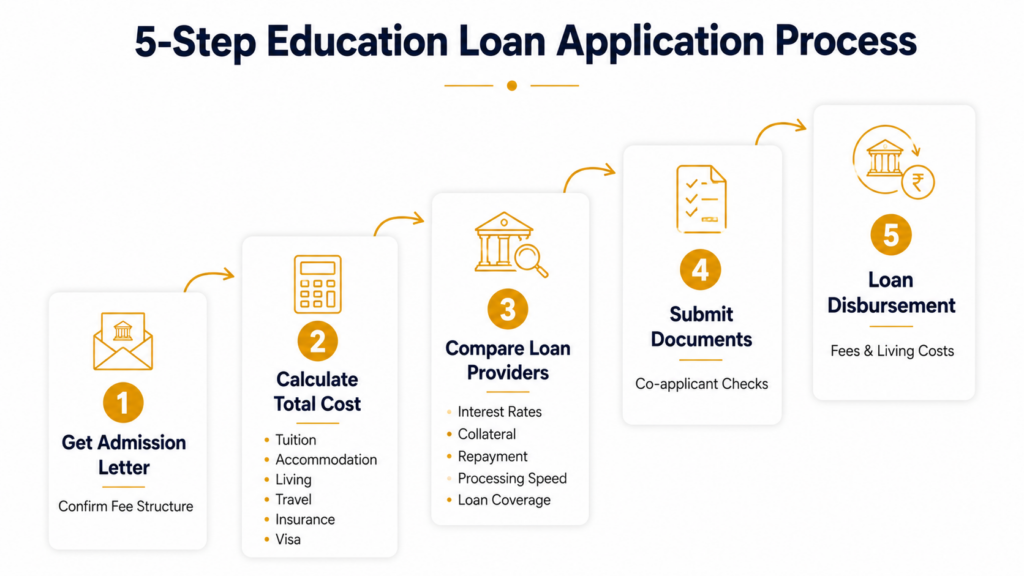
- Get an admission letter from the university and receive the real fee structure.
- Compare the cost of studying in the international country with the costs of tuition, accommodation, living costs, travel, insurance, costs of visa application and other necessary expenses.
- Compare providers of education loans on the basis of interest rates, collateral needs, flexibility in repaying, speed in processing and coverage of the loan.
- Present the needed information and undergo co-applicant checks with your preferred lender.
- After sanctioning your loan, the money will be released to you based on the schedule to pay fees in your university and also based on the allowable amounts in living expenses.
Common Mistakes That Increase the Cost of Studying Abroad
A huge number of students pay even more than is needed due to preventable mistakes in financial planning. Knowledge of these can assist you in managing the cost of studying abroad in general better.
- Submitting an application to a single lender rather than a variety of education loans.
- Calculating the cost of studying abroad as less than it should be due to the omission of accommodation, food, travel, health insurance, visa fees and emergency costs.
- Missing school assignments, which may save you a lot of money on school fees.
- Repaying your loan over a period of time and not thinking of your future income and career after graduation.
- Borrowing under-financing will cause funding gaps, and/or borrowing excessively will cause higher interest charges in the long run.
How to plan your repayment to the cost of studying abroad?
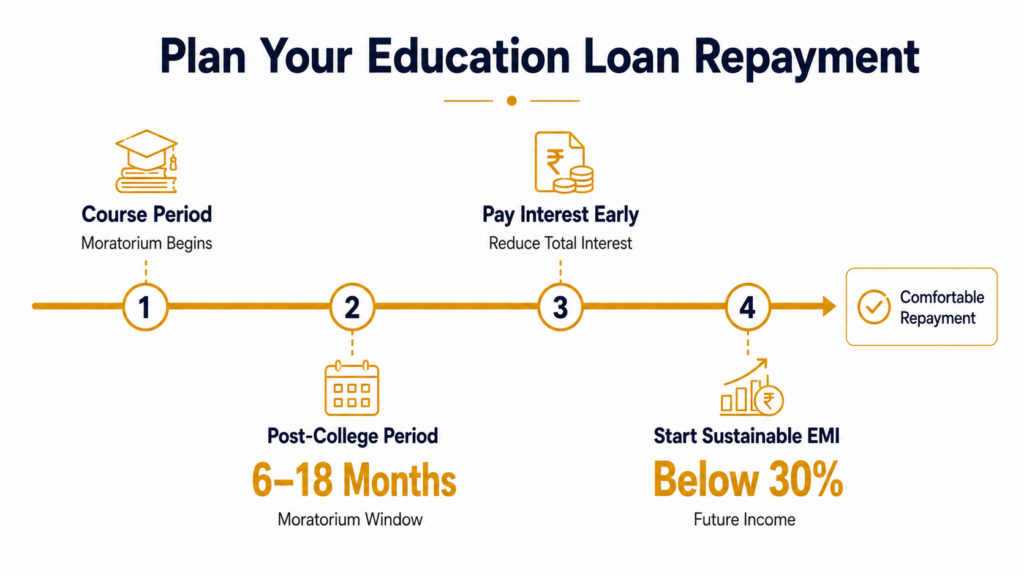
The importance of a thought-out repayment plan is no less than that of the appropriate choice of education loan. It will assist you to control the cost of studying abroad without straining your finances unnecessarily.
A large percentage of education loans have a moratorium that deals with your course time and a period of six to one and a half years after college. The repayments may be postponed through this period, though any payments of the accruing interest should be made where possible, as they may significantly decrease the amount of overall interest payable over the life of the loan.
As a rule of thumb, you should aim to pay less than 30% of your future post-graduate income in the form of an EMI. This will enable you to repay your loans at a comfortable rate without restriction of your finances in the initial years of your career. By planning ahead how to pay back the costs, the general cost of going to study abroad can be more affordable and less stressful than the cost of graduating, which can be a significant burden.
How Gateway International can help you plan confidently.
Gateway International has been providing direction to over 23,000 students in the USA, UK, Canada, Australia, Germany, France, Italy, Ireland, Dubai, New Zealand and Europe over the past 15 years.
We assist students in finding out the actual cost of studying in a foreign country and juxtapose it with the scholarships, and then select the correct lender based on his/her profile all over a single application.
- Compare with a variety of education loans using a single application and save a few weeks of time standing in lines.
- Discover tailored lender suggestions according to your university, course, and financial background.
- Get fully documented and assisted to obtain eligibility at no service charge.
- Get end-to-end instructions, eligibility evaluation, and ultimate certification of the loan being disbursed.
Today, check your eligibility for an education loan, or make a free appointment with our advisors to plan a budget appropriately.
FAQs
Eligibility for a study abroad education loan?
Students who have been assured entry into a recognised university, a co-applicant, having a steady way of earning income and necessary academic grades are mostly self-qualified to receive a study abroad education loan.
Would it be possible to obtain an education loan without collateral?
Yes, there are unsecured education loans of up to 3007.5 lakh, and in NBFCs, there are higher unsecured education loans of over 7.5 lakhs, depending on the university ranking and the profile of co-applicants.
What banks offer education loans to study overseas?
Some of the best banking partners which provide education loans to study abroad include SBI, HDFC Bank, Bank of Baroda, Axis Bank, Intracred, intracred and IDBI Bank.
Approximately what is the time required to approve education loans?
This usually takes four to eight weeks in public banks, whereas in most cases, it probably takes the NBFCs and private lenders a maximum of one or two weeks to approve loans.
Will the scholarships decrease the amount of my education loans?
Yes, one of the most popular and efficient methods of financing academia is a combination of scholarships and a loan for the rest of the money to study overseas.
Which forms do you supply to apply for an education loan?
The most important documents required are an admission letter, academic transcripts, co-applicant income proof, IT returns, and collateral documents where applicable.
Conclusion
Even in 2026, the cost of studying abroad is beyond comprehension, especially the tuition, but the right budgeting, scholarships and loan planning will make it manageable as opposed to overwhelming. Being knowledgeable of the costs country-by-country, finding out which countries are affordable to study abroad, and learning about your study abroad eligibility to get an education loan will put you squarely in charge of your endeavour.
Need the clear and comfortable funding of your study abroad dream? Compare loans, scholarships and lenders and speak about it to our experts at Gateway International with the help of one simple free consultation.
Pingback: Education loan for New Zealand