With the assistance of policies by the lenders, an education loan for study in Europe from India can help finance qualified tuition, accommodation, travel, equipment and other approved education costs, among other possible education costs.
Non-European countries like France, Germany, Italy, Poland and the Netherlands offer various cost and funding models as part of a plan for a European student loan India. Indian students who are contrasting the European countries with low cost should not simply look at the tuition.
Borrowing can also be severely impacted by living expenses, visa funds, insurance, the duration of the programme and exchange-rate fluctuations. This guide includes the costs of studying in Europe, the considerations for education loans in France, the Netherlands, and Italy, evaluation of lending companies, the types of loans, documents and sound borrowing.
Accuracy Note: Education-loan rates, amount, collateral, fees and terms of repayments differ between lenders. Final conditions may be based on the amount of loan, university, course, security, co-applicant funds, credit evaluation and Lender regulations.
Why Consider Europe Instead of the US and UK?
Europe offers Indian learners some options in places where the total cost of education can be controlled.
- France has relatively average tuition at some of its public institutions among a number of international students.
- There are numerous tuition-free public programmes in Germany, with possible exceptions and semester fees.
- Italy and Poland can give cost-effective alternatives based on university and choice of programme.
- Reduced costs of studies will lead to less money students have to borrow in order to get foreign education.
When looking at an education loan for study in Europe from India, look at the cost of complete programmes, not just the tuition.
Check out: Education loan for abroad
Europe Study Funding at a Glance
| Country | Current cost indicator | Loan-planning point |
| Netherlands | Study amount 2026 university/HBO: €1,130.77 per month | Amount is a measure of living requirements, but not tuition fees. |
| France | 2026–27 differentiated public tuition: €2,902 Bachelor’s; €3,950 Master’s | There may be exemptions and various institutional fees. |
| Italy | Recent 202627 visa policy: the annual financial resources of €10,179.85 | Other expenses and tuition are independent. |
| Poland | Tuition fee is typically around €2,000–€6,000 a year | Real fees are dependent on the institution and programme. |
| Germany | Many state Bachelor’s and Master’s programmes have no tuition | Semester contributions and important exceptions are involved. |
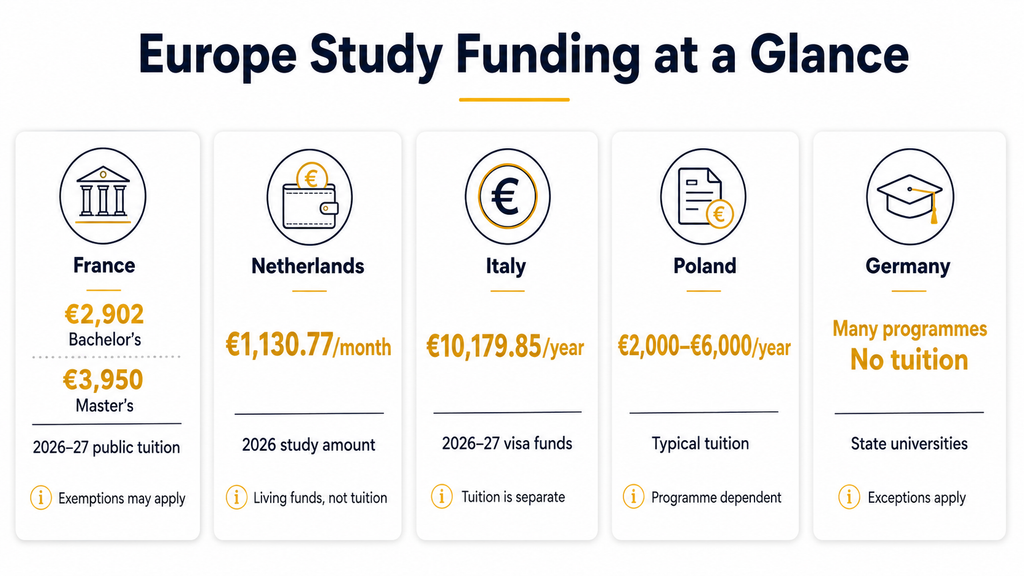
Campus France supports the said 2026-27 differentiated tuition of non-EU students in pertinent state institutions. The Netherlands IND charges a fixed amount of 2026 university/HBO study of €1,130.77 a month. The latest Italian consular instructions in India stipulate €10,179.85 of yearly financial assistance.
An education loan for study in Europe from India must not be based on a single headline cost, but represents the entire programme budget.
Why Europe Can Reduce the Borrowing Requirement?
A possible solution in this case is the discovery of low-cost countries in Europe that Indian students can study in so as to manage their funds in terms of their tuition or general cost of studying, which is relatively reasonable.
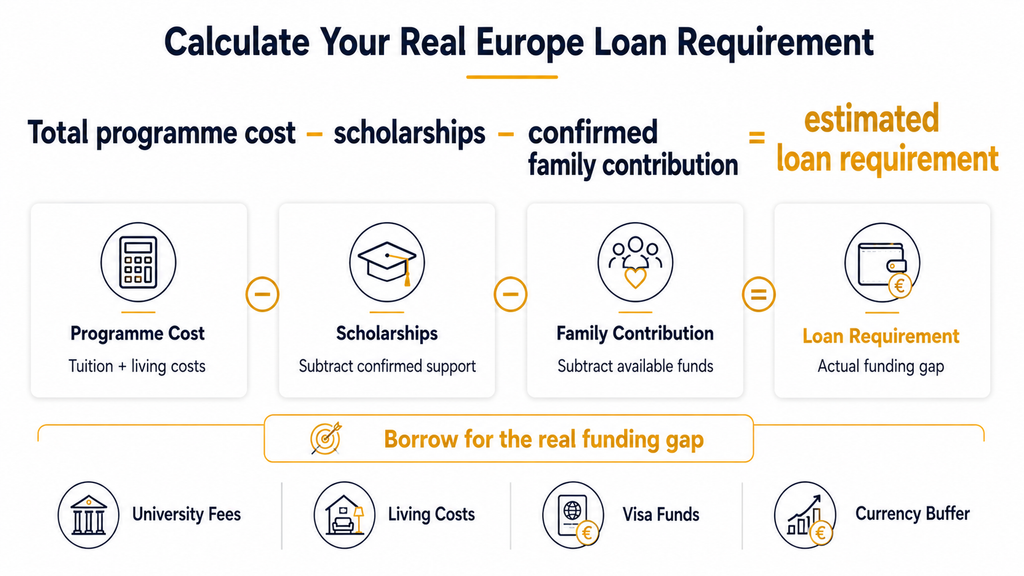
From this basic formula:
Total programme cost − scholarships − confirmed family contribution = estimated loan requirement
- Incorporate tuition and compulsory university fees in the entire programme budget.
- Establish accommodation, food, insurance, and transportation for the whole programme.
- Note financial requirements related to the check visa separately from university tuition.
- Accommodate travel, equipment and preliminary settlement costs.
- Have a sensible margin of potential currency depreciation.
An education loan for study in Europe from India ought to be based on the real gap in funding and not the maximum one can access.
What are the Expenses that an Education Loan can cover?
Education loan for study in Europe from India can include a few possible education-related costs approved by the lender and product.
- Tuition and fees and any other charges that are payable at the university.
- Fitting in and reasonable living expenses.
- Textbooks, computers, and other necessary learning materials.
- Travel and insurance expenses (where not prohibited).
- Any other programme-related funding, which is approved by lenders.
Note: There is a difference in expense coverage among lenders. Make sure to verify eligible costs and then compute your end loan need.
France: Public Education Can Lower the Funding Gap
Campus France gives a differentiated tuition for non-students of EU nationality at a Bachelor’s or Master’s level in 2026-27 in yearly fees: €2,902 and €3,950, respectively. Various rates, exemptions and institutional arrangements may be involved.
In the case of an education loan for study in Europe from India, France can thus entail comparatively palatable tuition costs for some government programmes.
Make sure you calculate your requirement before:
- Confirm the university fees and compulsory fees of the university chosen.
- Coverage of accommodation, insurance, food, travel, and academic expenses.
- Confirm scholarships or exemptions; ensure that you have them before lowering your funding demand.
- Take into consideration the potential currency changes prior to final payment.
A student comparing the education loan in France, the Netherlands, and Italy should always be comparative to the costs of the universities.
Netherlands: Plan Carefully for Living-Fund Requirements
According to the Netherlands IND, the amount for 2026 study is 1130.77 a month in the case of university and higher professional education students. This is a sum that is associated with living expenses and not tuition.
In case of education loan for study in Europe from India, then students must calculate the cost of university fees and the cost of living separately.
- Get the entire tuition schedule to determine the amount of loan.
- Budget the money needed to live and the money needed to study at the university.
- Avoid living on tenuous part-time incomes.
- Total borrowing should take into account the duration of the programme.
To plan a European student loan in India, a bigger budget may be required in the Netherlands based on the university and course.
Italy: Take University-Specific Costs.
Attention should be paid to university-level comparison, especially in Italy, since the tuition fees and other concessions may differ.
As per current Italian consular directions to India, financial resources of at least one year (plural: it is annually based) in India: at least €10,179.85 to cover the pertinent 202627 study-visa procedure. The identical guidance acknowledges that an educational loan will be one of the potential documents that confirm the financial stance of an applicant.
Compared to the education loan France Netherlands Italy:
- Get the tuition schedule for the university and then compute the borrowing.
- Inquire about the scholarship or reduction of fees.
- Accommodation, insurance, travel, food and other expenses.
- Confirm the most current visa regulations prior to making arrangements on demonstrating funds.
The cost of studying in Europe in Italy is therefore supposed to be based on the actual cost of the university of choice.
Germany: Lower Tuition Does Not Mean Zero Study Cost
Germany is still of interest to Indian students with a low cost of studying in Europe since the state-owned institutions offer no fee for the study of most Bachelor courses and the majority of Master courses.
There are, however, significant exceptions. Baden-Württemberg would impose one thousand five hundred dollars per semester on international students, whereas colleges in Bavaria would be allowed to impose tuition on international students. DAAD also records semester fees ranging between €70–€430 and estimates living expenses ranging between €900–€1,200 monthly according to location.
An education loan for study in Europe from India, including Germany, can therefore cover many living costs and other allowable expenses.
Budgeting Rule: Not-so-free tuition is not free tuition. Add up the programme cost.
Poland: Moderate Tuition Can Keep Borrowing Lower
Another low-cost European country worth considering by Indian students is Poland.
According to the official site Study.gov.pl, tuition fees may be approximately €2,000–€6,000 yearly, depending on the school and the course.
In the case of an education loan for study in Europe from India, make use of the real fee structure of your selected university and not just national averages.
Accommodation, food, insurance, transport, and travel, among other costs that are essential in the education process, should also be budgeted by students.
How Lenders Assess European Education Loans?
Financing is not necessarily provided by the same institution. Education loan for study in Europe from India could be evaluated in various aspects.
| Assessment Area | What Lenders will be thinking of. |
| University | Programme, lender eligibility, Institution |
| Student | Qualification, academics, and course, admission |
| Co-applicant | Employment, Income, debts, credit record |
| Destination | Lender policies and Country eligibility |
| Loan | Loan expenses, Required loan amount, repayment ability, security |
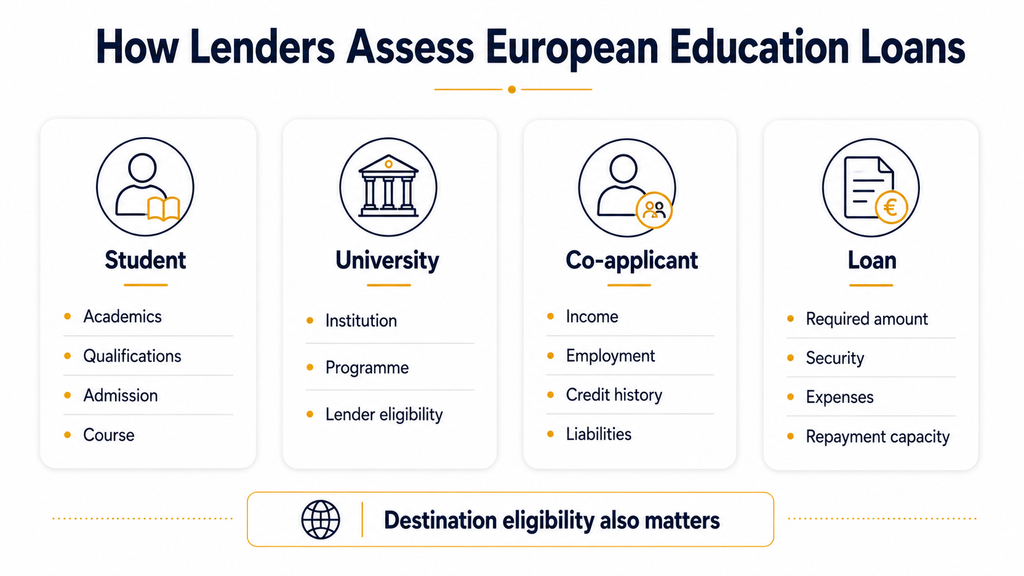
When students study education loans in France, the Netherlands, and Italy, they should ensure that their specific university and course meet the current lending requirements, considering their specific university and course.
Underwriting can also be determined by the amount of required loans. Smaller and larger applications might vary in their requirements in terms of eligibility or security.
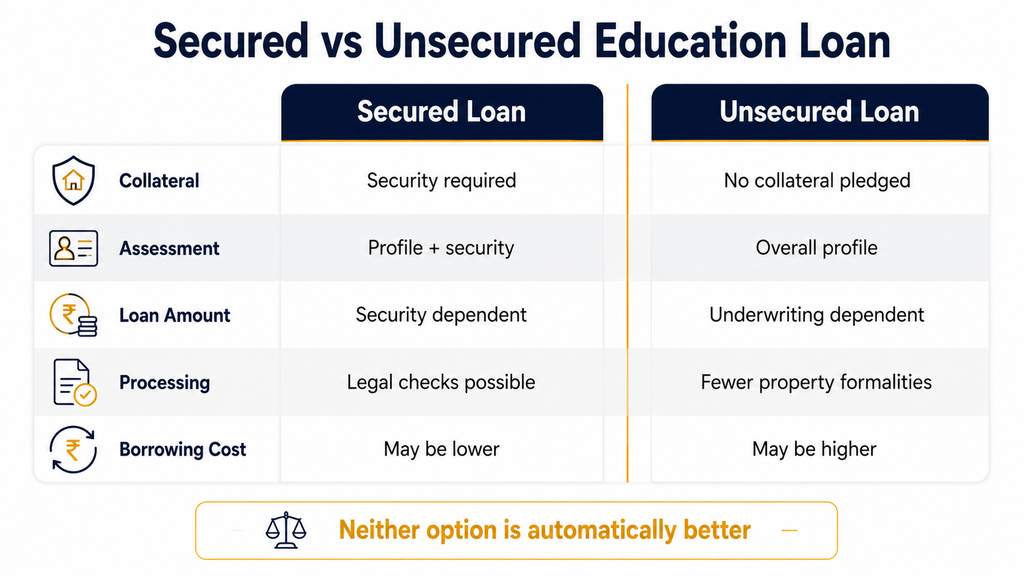
Unsecured or Secured Education Loan?
Education loan for study in Europe from India could be either secured or unsecured, according to the policies of various lenders and the eligibility of the applicant.
| Factor | Secured Loan | Unsecured Loan. |
| Collateral | Lender-approved security required | No collateral pledged |
| Assessment | Profile, co-applicant, and security | Increased reliance on overall profile. |
| Loan amount | Based on security and lender policies | Based on underwriting. |
| Processing | Law and valuation tests can be made | Fewer formalities for properties. |
| Borrowing cost | Can be relatively low | Can be relatively high. |
The two structures are not necessarily superior in the case of European student loan applicants in India. Compare full terms and repayment charges.
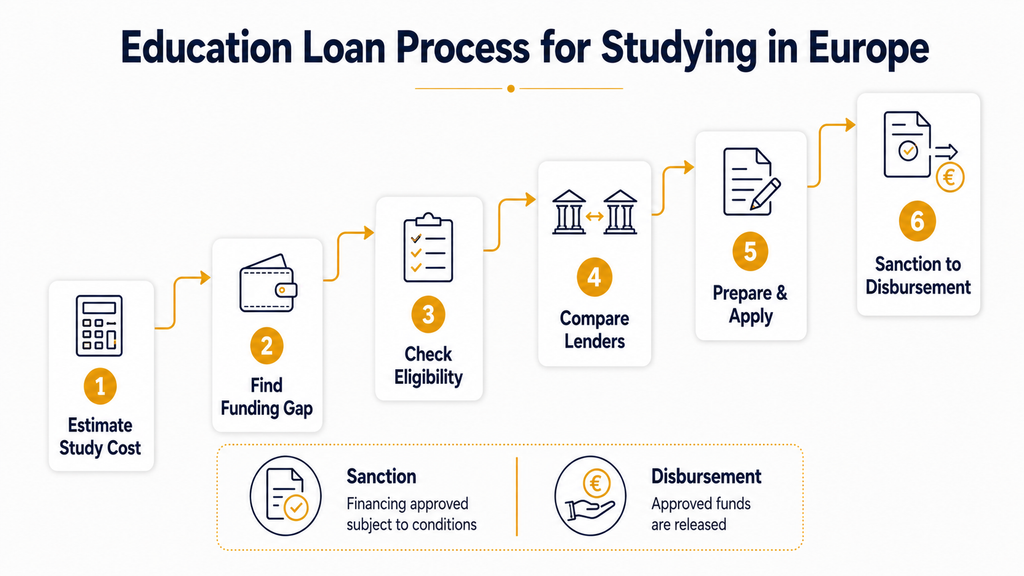
Education Loan Process for Studying in Europe
Education loan for study in Europe from India typically entails:
Estimate the cost of the study/ Determine a gap in financing the study/ Check eligibility/ Compare lenders/ Prepare documents/ Apply/ Review sanction terms/ Complete disbursement requirements.
The lender can determine the student, university, course, amount required, co-applicant and collateral where necessary.
Significant: Financing is approved by Sanction, under specified conditions. Disbursement is actually made when approved money is paid off.
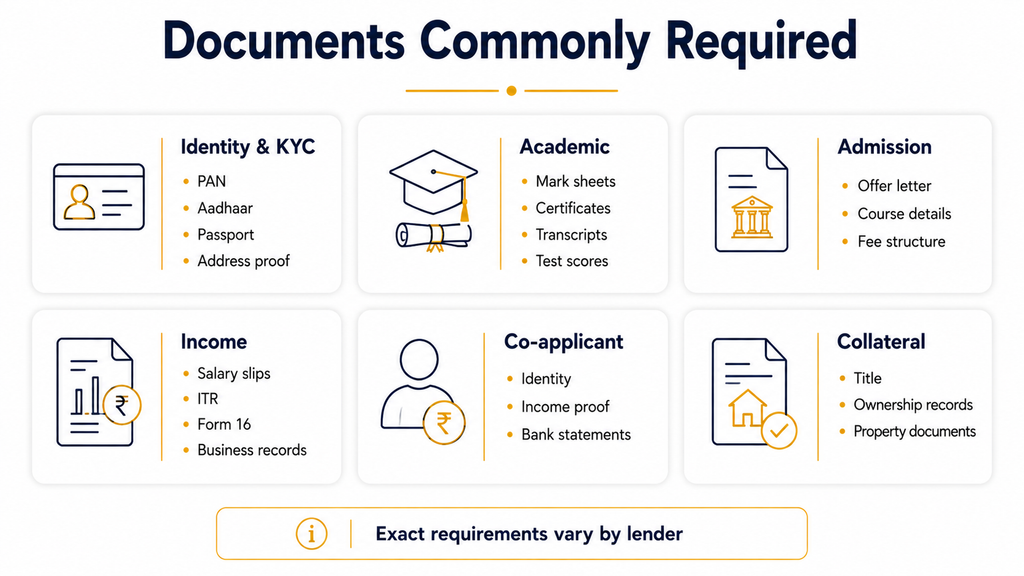
Documents Commonly Required
In an education loan for study in Europe from India, the lenders usually demand:
| Type of document | Purpose | Ordinary Documents |
| Scholarly | Reviews academic background | Test scores, transcripts, certificates, mark sheets. |
| Identity & KYC | Verifies identity | PAN, Aadhaar (where required), passport, address proof. |
| Admission | Details admission and costs. | Provisional letter, course information, official fee plan. |
| Income | Assesses repayment capacity | ITR, Form 16 or business records, salary slips. |
| Co-applicant | Supports financial assessment | Identity, provenance of income, bank statements |
| Collateral | Supports secured applications | Title, ownership and other relevant property documents. |
Caution: Precise reporting depends on the lender and the loan structure, and there is a difference depending on the profile of the applicant.
Common Mistakes to Avoid
In selecting an education loan for study in Europe from India, never commit typical financing errors:
- Comparing tuition without considering accommodation and other programme expenses.
- Borrowing in excess of what is required, plus family contributions.
- Choosing financing according to the interest rates of those advertised.
- Neglecting moratorium conditions, fees, and tenure of repayment.
- Relying on unpredictable part-time or post-study income.
- Entering old information regarding university, visa or lender.
It is important to compare carefully to make borrowing more affordable.
Responsible Borrowing for Europe
Determine the funding need before borrowing an education loan for study in Europe from India.
- Add tuition, living expenses, insurance, travel, and necessary expenses.
- Lessen scholarships, savings and assured family contributions.
- Know collateral, moratorium, tenure of repayment and co-applicant duties.
- Take into account currency risk and post-study employment opportunities.
Borrowing requires real financial requirements and should not explore artificial maximised debt.
How can Foreign Edu Loans help?
India: It can help Foreign Edu Loans simplify the lender search and application package of students desiring an education loan for study in Europe from India.
- Evaluate the appropriate financing options based on the university, course, destination and the amount of funding needed by the student.
- Compare qualified banks, NBFCs and foreign lenders based on the complete financial profile of the applicant.
- Knowledge of what kind of financing is possible with the type of loan amount and collateral available (secured or unsecured).
- Compare key aspects including the applicable rates, charges, moratorium, repayment term and the condition of the lender.
- Know the documents that are needed in an education loan for study in Europe from India.
- Get help in preparing documentation and coordination in the process of education-loan application.
Foreign Edu Loans eases the process of loan guidance and comparison. The given lender will have a final approval and terms regarding the applicable loans.
FAQs
Is there an education loan for study in Europe from India?
Yes. Eligible European programmes may be financed by an education loan for study in Europe from India. Their approval is determined based on the university, course, amount of loan, co-applicant, collateral where applicable and policies by the lender.
Which European nations will be lower in terms of study costs?
France, Germany, Poland and Italy have the potential to offer relatively cheap alternatives to some programmes. Make sure to compare the total programme costs as opposed to tuition alone.
Is it possible to use an education loan to live your life?
Education loan for study in Europe from India will be able to fund accommodation and living costs. Precise coverage is contingent on the lender and product.
Do I necessarily require collateral?
No. There can be secured and unsecured financing depending on the amount of the loan, the applicant’s profile, the university, the course, and lender restrictions.
What should I compare in terms of Europe student loan India?
Compare rates, charges, collateral, moratorium, tenure, eligible expenses, requirements of co-applicants and disbursement conditions.
Will a European country with cheaper costs ensure a smaller loan?
No. Borrowing can be significantly impacted by accommodation, insurance, travel, visa funding, programme duration and other charges.
Conclusion
Indian students can get alternatives in Europe, where tuition fees or the cost of education in general can be more affordable, though the affordability and cost of living vary tremendously across countries and universities.
To get education loan for study in Europe from India, determine the total funding gap before choosing an education loan, ensure that the university and visa requirements are available, secured or unsecured, and the repayment liability. Indian students who have been considering the low-cost European countries ought to compare the overall costs of the programmes and not just the tuition fees.
To plan an education loan for France, the Netherlands, Italy, or other European destinations, consider existing lender conditions before entering into a financial agreement.