An actual Avane education loan review of the Indian students and their parents based on rates, eligibility, fees and funding and the repayment and borrower risks.
The answer to the question of whether or not Avanse is worth it should not be a yes or no; now Avanse boasts international student loans at rates of 10.25 p.a. with secured and unsecured funding, and published funding of various costs in education. But it all depends on the rate, charges, term, structure and your repayment which will be extended subject to the rate, fees and other provisions of the borrowing.
So, Avanse can be in the list of options to consider in the case when your personal proposal has good comparisons with others. Students are supposed to compare the full repayment burden instead of opting to use Avanse due to one of the rates advertised or part of the funding consideration.
On 31 August 2026, this Avanse education loan review was fact-checked. There can be changes to the interest rates, fees and lending policies. Check other official pages that it is connected with prior to loan acceptance.
What Does This Avanse Education Loan Review Show at a Glance?
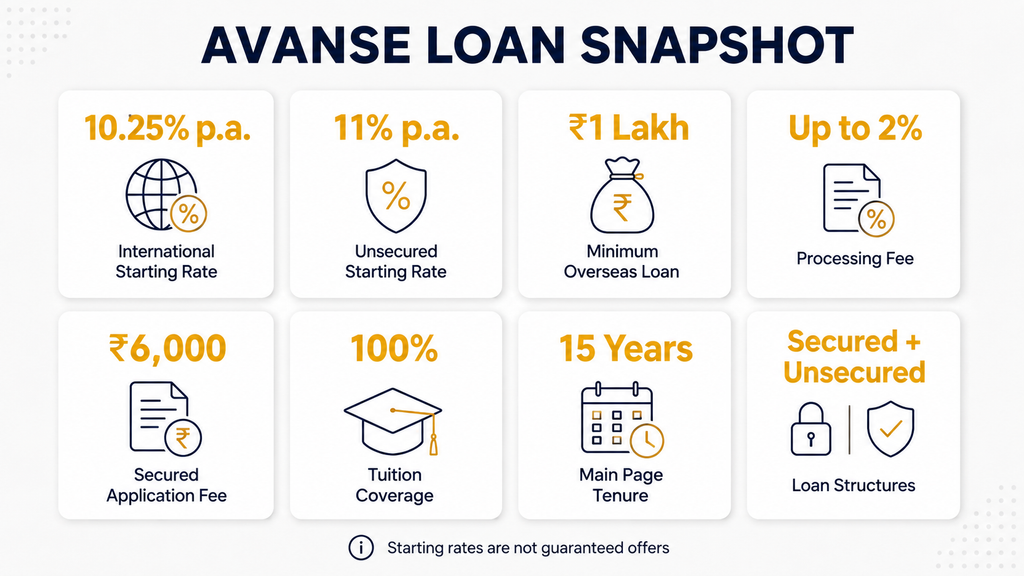
Avanse Study-Abroad Loan Snapshot
| Factor | Current published position |
| International starting rate | 10.25% p.a. onwards |
| Unsecured starting rate | 11% p.a. onwards |
| Loan structure | Secured and unsecured |
| Minimum overseas loan | ₹1 lakh |
| Universal maximum | No single cap stated on general study-abroad page |
| Tuition coverage | Up to 100% |
| Processing fee | Up to 2% |
| Secured application fee | Up to ₹6,000 |
| Margin | Avanse states no margin contribution |
| International tenure | Up to 15 years on main interest-rate page |
| Final rate | Applicant-specific |
Interpretation: This Avanse education loan review shows attractive headline features, but the final sanction terms determine the actual value.
What Are Avanse Interest Rates in 2026?
According to the official Avanse interest-rate page, the currently advertised indicative rates include:
- Domestic education loans starting at 10% p.a.
- International student loans starting at 10.25% p.a.
- Unsecured loans starting at 11% p.a.
These are starting rates, not guaranteed rates.
Avanse specifically says the rate for an international applicant depends on factors such as the university, loan amount and applicant circumstances. The final rate is determined case-by-case.
For that reason, this Avanse education loan review does not treat 10.25% as the rate every international borrower receives.
Students searching for Avanse interest rates 2026 should compare the rate written in their individual offer with competing lender offers.
Is the Avanse rate fixed or floating?
This point requires caution.
Avanse’s current main interest-rate page says it offers both fixed and floating education-loan interest rates. However, other Avanse material describes its student-loan rate as floating and linked to its base rate plus a spread.
Because Avanse’s published material is not completely consistent on this point, confirm whether your individual loan is fixed or floating before accepting it.
How Much Can You Borrow From Avanse?
The general Avanse study-abroad loan page states that the minimum overseas loan amount is ₹1 lakh and that Avanse does not place a universal cap on the maximum amount on that page.
The actual amount depends on funding requirements and financial assessment.
This is important because some destination-specific Avanse pages advertise specific maximum amounts. For example, current Singapore and Canada pages contain their own product-specific limits.
Therefore, this Avanse education loan review does not present one destination-specific amount as Avanse’s universal maximum.
Students should confirm the maximum applicable to their country, university, course and borrower profile.
Does Avanse Offer Secured and Unsecured Education Loans?
Yes. Avanse provides secured and unsecured education financing.
A secured education loan involves collateral accepted by the lender. Property-related legal, administrative and valuation expenses may consequently apply.
An unsecured education loan does not require pledged collateral. However, collateral-free does not mean assessment-free.
Avanse can still consider:
- Academic profile.
- Selected institution.
- Course.
- Requested amount.
- Co-applicant profile.
- Creditworthiness.
- Repayment capacity.
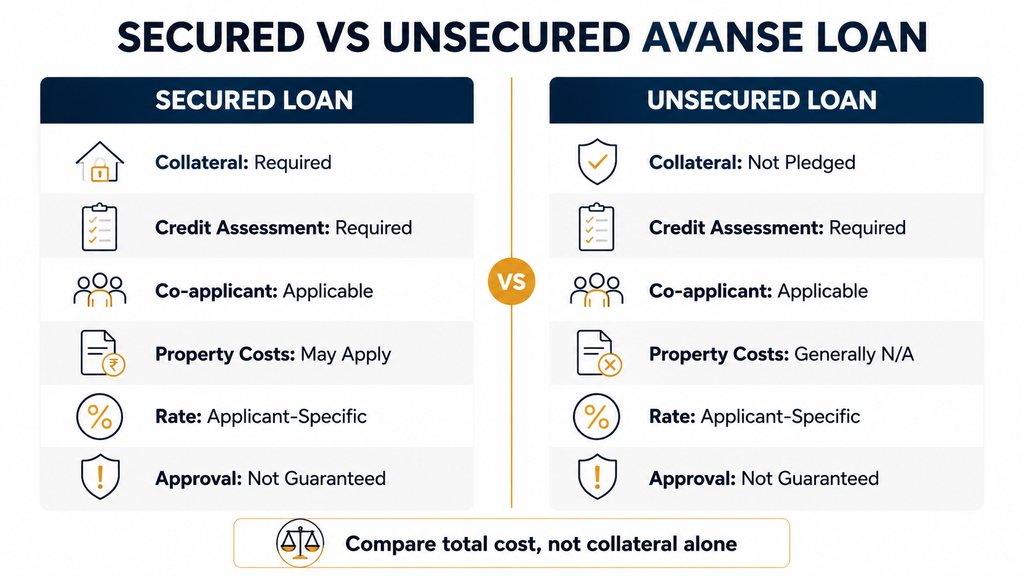
The Avanse education loan review therefore finds that students should compare secured and unsecured offers on total cost, not collateral alone.
Secured vs Unsecured Avanse Loan
| Factor | Secured | Unsecured |
| Collateral | Required | Not pledged |
| Credit assessment | Required | Required |
| Co-applicant assessment | Applicable | Applicable |
| Property-related expenses | May apply | Generally not applicable |
| Rate | Applicant-specific | Applicant-specific |
| Guaranteed approval | No | No |
Avanse eligibility India for Education Loan
Avanse eligibility India depends on the product, programme and borrower circumstances.
The official Avanse education-loan FAQ states that financing may be available for several types of study, including:
- Graduate programmes.
- Postgraduate programmes.
- Professional degree programmes.
- Diploma programmes.
- Recognised foreign-university courses.
- Technical and professional courses.
- Executive programmes.
- Certain vocational programmes.
Avanse also says part-time, correspondence and online courses can be financed when they meet its requirements.
This makes the Avanse education loan review relevant beyond conventional Master’s programmes, although eligibility must still be checked for the applicant’s specific course.
Does Avanse Require a Co-applicant?
A co-borrower/co-applicant forms part of Avanse’s overseas education-loan assessment.
Destination-specific Avanse pages state that a co-borrower can include a parent, guardian, sibling or close relative, subject to applicable requirements.
For example, the current Canada page requires a co-applicant who is an Indian resident with a stable source of income.
The co-applicant can affect:
- Eligibility.
- Credit assessment.
- Offered rate.
- Repayment assessment.
- Documentation requirements.
This Avanse education loan review found no reliable universal minimum co-applicant income figure that should be applied to every borrower.
Students should therefore avoid unofficial websites claiming one fixed income threshold unless Avanse confirms it for their application.
What Expenses Can an Avanse Study-Abroad Loan Cover?
Avanse’s official study-abroad FAQ currently provides detailed expense limits.
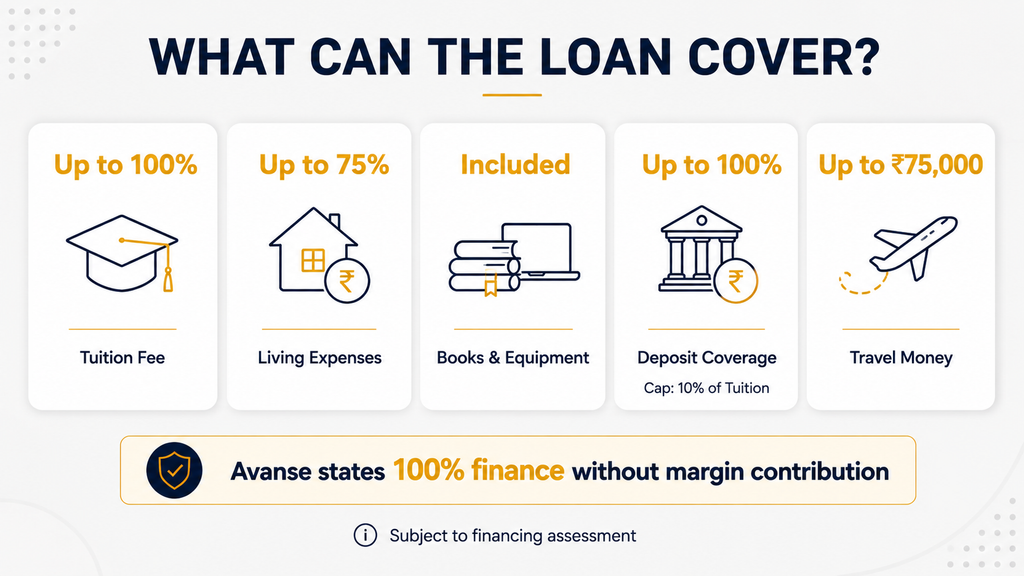
Education Expenses Published by Avanse
| Expense | Published coverage |
| Tuition fee | Up to 100% |
| Living expenses | Up to 75%, subject to stated conditions |
| Books/computer/equipment | Included within stated living-expense conditions |
| Building/caution/refundable deposit | Up to 100%, capped at 10% of tuition with valid bills/receipts |
| Travel/passage money | Up to ₹75,000 |
Avanse also states that its overseas loan can provide 100% finance without margin contribution, subject to its financing assessment.
The key lesson from this Avanse education loan review is that “100% finance” should not be interpreted as guaranteed approval for every requested expense or amount.
Always check your sanction and disbursement conditions.
What Fees Does Avanse Charge?
Interest is only part of education-loan cost.
According to the current Avanse Schedule of Charges, the following charges apply to the education-loan category.
Avanse Education-Loan Charges
| Charge | Current published amount |
| Application fee | Up to ₹6,000 for secured cases |
| Processing fee | Up to 2% |
| Cheque/ECS bounce | ₹1,000 per bounce |
| Penal charge on overdue EMI/interest | 2% per month |
| Other specified default charge | ₹5,000 per month until cured, subject to stated conditions |
| Collection pickup | ₹500 per visit |
| Additional statement of account | ₹1,000 |
| Self-service statement | Nil |
| Document retrieval/maintenance | ₹1,000 for unsecured loans |
| Legal, valuation and stamp-related costs | As applicable/actual |
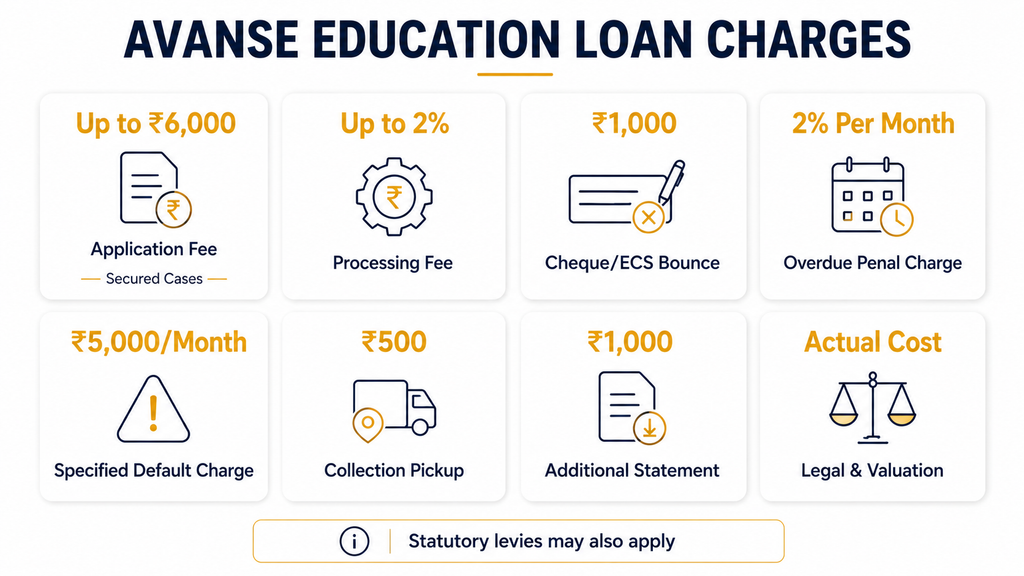
Applicable statutory levies may also apply.
This is an important finding in the Avanse education loan review because comparing only interest rates can hide other borrowing costs.
A processing fee of up to 2% also does not mean every borrower pays exactly 2%.
How Do Avanse Moratorium and Repayment Work?
A moratorium should not be confused with an interest-free period.
Avanse’s published study-abroad information describes a repayment holiday of up to:
- Six months after course completion, or
- Three months after securing employment,
whichever occurs earlier.
Students should understand how interest is treated during their course and repayment holiday before accepting the loan.
This Avanse education loan review recommends asking Avanse for a repayment illustration showing:
- Original principal.
- Interest treatment during study.
- Interest during the applicable moratorium.
- Balance when regular EMI starts.
- Monthly EMI.
- Repayment tenure.
- Total expected repayment.
That calculation is more useful than comparing starting rates alone.
What Is the Avanse Repayment Tenure?
Avanse’s official pages contain different tenure disclosures.
The current Avanse interest-rate page lists up to 15 years for Student Loan International.
However, other Avanse pages contain different maximum-tenure descriptions. For example, its USA page currently describes a tenure of up to 17 years including course duration.
This Avanse education loan review therefore cannot responsibly state that one maximum tenure applies to every Avanse overseas education loan.
Confirm:
- Product-specific tenure.
- Whether course duration is included.
- Moratorium treatment.
- EMI commencement.
- Prepayment conditions.
The sanction letter and repayment schedule should control your personal comparison.
Avanse vs NBFC Competitors: Which Could Cost Less?
The comparison of Avanse vs NBFC competitors is misleading when the lenders are only ranked in terms of advertised starting rates.
Avanse, however, is already advertising international student loans at 10.25% p.a. or opt for benchmark-plus-spread pricing with other NBFC education lenders.
That does not establish which lender will cost less for you.
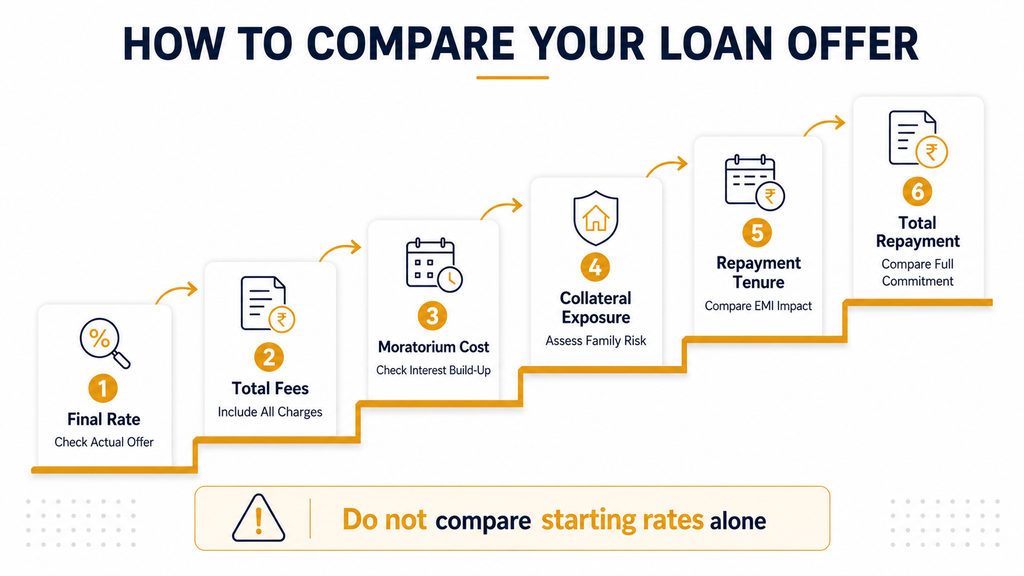
What Should You Compare?
| Factor | Question to ask |
| Interest rate | What rate am I actually being offered? |
| Rate structure | Is it fixed or floating? |
| Processing fee | What will I actually pay? |
| Collateral | What family asset is exposed? |
| Margin | How much must my family contribute? |
| Moratorium | What interest builds before EMI? |
| Tenure | How does it affect EMI and total interest? |
| Prepayment | Can I repay early without material charges? |
| Expenses | What part of my funding gap remains? |
| Disbursement | When and how will funds be released? |
This Avanse education loan review recommends comparing actual offers using the same principal and repayment assumptions.
Do not select a lender because its website displays the smallest percentage.
Is Avanse Worth It?
This is the central question of the Avanse education loan review.
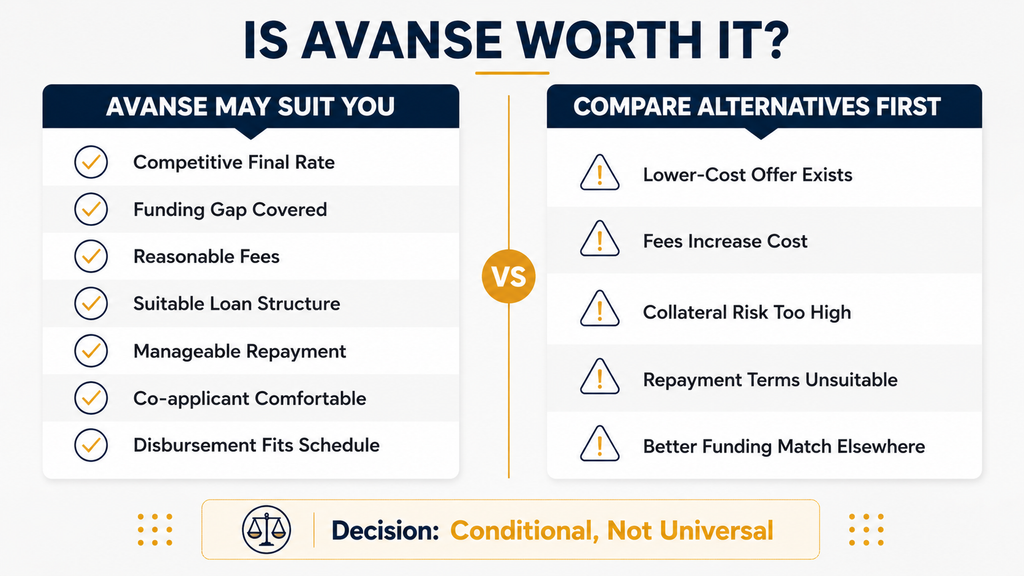
Avanse may be worth considering when:
- Your final offered rate is competitive.
- The loan adequately covers your genuine funding gap.
- Fees remain reasonable against competing offers.
- The secured or unsecured structure suits your family.
- Repayment terms match your financial circumstances.
- The co-applicant understands the liability.
- Disbursement terms work with the university’s payment schedule.
Avanse may be less suitable when:
- Another eligible lender produces a lower total borrowing cost.
- Fees materially increase your cost.
- Collateral exposure is unacceptable.
- The repayment structure does not suit your circumstances.
- Another offer better matches your funding requirements.
So, Avanse education loan review is conditional, not universal.
Some Common Mistakes You Should Avoid
- Choosing only by starting rate. Your final rate can differ.
- Treating sanction as disbursement. Approval and release of funds are different stages.
- Ignoring fees. Processing and other applicable charges affect borrowing cost.
- Assuming moratorium means free borrowing. Understand interest treatment during this period.
- Borrowing the maximum available. Borrow according to the genuine funding gap.
- Ignoring collateral risk. Secured borrowing can expose family assets.
- Comparing unequal offers. Use equivalent principal and repayment assumptions.
- Ignoring floating-rate risk. Understand how your applicable rate can change.
These issues are central to a responsible Avanse education loan review, not minor details.
How Much Should Students Actually Borrow?
The highest amount available is not automatically the right amount to borrow.
Start with:
Funding gap = Verified education cost − scholarships − grants − affordable family contribution − other confirmed funding
Then assess:
- Total principal.
- Interest during study.
- Moratorium cost.
- Expected EMI.
- Repayment tenure.
- Co-applicant liability.
- Collateral exposure.
- Currency risk.
- Career uncertainty.
- Prepayment implications.
Borrowing Rule: Students and parents should compare the complete repayment commitment, not only the sanctioned amount or advertised interest rate.
This responsible-borrowing test is one of the most important conclusions of this Avanse education loan review.
Is Education-Loan Interest Tax Deductible?
The interest deduction on higher-education-loans is found in Section 129 of the Income-tax Act, 2025.
Under statutory requirements, a person can claim an eligible amount of interest paid on an eligible higher-education loan in the first tax year and in the seven successive tax years, or until the eligible interest has been completely paid, which happens earlier of the two options.
However, the Act defines the type of financial institution from which a qualifying loan must be taken.
This Avanse education loan review therefore does not claim that every Avanse loan automatically qualifies for this deduction. Borrowers should confirm the applicable tax treatment before claiming it.
How Can Foreign Edu Loans Help?
Foreign Edu Loans is an education-loan facilitation and guidance platform for students pursuing international education.
Foreign Edu Loans can help students:
- Explore suitable education-loan options.
- Compare eligible lenders.
- Understand competing loan structures.
- Coordinate documentation.
- Navigate the application process.
A useful comparison should examine the applicant-specific rate, fees, secured or unsecured structure, moratorium implications, repayment conditions and overall borrowing commitment.
Final credit decision is not made by the lender of the Foreign Edu Loans. The ultimate approval is at the discretion of the respective lender based on its underwriting, documentation, eligibility requirements and existing policies.
FAQs
Are loans to buy Avanse without collateral?
Yes. Avanse also provides education-loan opportunities to deserving applicants on unsecured basis. It features interest rate page that offers unsecured loans as low as 11% p.a., although its actual rates are on a case-to-case basis.
What does this Avanse education loan review say about processing fees?
The current Avanse Schedule of Charges lists a processing fee of up to 2% for education loans. Other applicable charges should also be checked before accepting an offer.
Does Avanse require margin money?
Avanse’s study-abroad information states that it provides 100% finance and does not require margin contribution under that published proposition. Actual sanctioned funding remains subject to assessment.
What is the maximum Avanse education-loan tenure?
The main interest-rate page currently states up to 15 years for Student Loan International, but other Avanse pages publish different product-specific tenure information. Confirm the tenure applicable to your sanction.
Is Avanse better than other NBFC education lenders?
Not automatically. The conclusion of this Avanse education loan review is that actual rate, fees, collateral, moratorium, tenure, expense coverage and total repayment should determine the decision.
Conclusion
This Avanse education loan review finds that Avanse can be a credible option for Indian students who need overseas education financing, including secured or unsecured structures. Its current international starting rate is 10.25% p.a., while its published study-abroad proposition includes broad education-expense financing and no margin contribution.
Nevertheless, none of these headline features determine whether Avanse is the lowest priced or most appropriate lender to you. Look at the applicant-related rate, fees, the time of repayment terms, the cost of the moratorium, collateral exposure and repayment as opposed to other offers. Specifically, look at terms mentioned in products as on Avanse, various tenure and loan-limit disclosures can be found. Check Your Education Loan Eligibility