Education loan repayment in advance can save more interest at a later stage in life but not necessarily the correct financial plan. Before paying, check the outstanding principal, remaining tenure, emergency savings, tax position and applicable education loan prepayment & foreclosure charges. Under the Reserve Bank of India Pre-payment Charges on Loans Directions, 2025, qualifying floating-rate, non-business loans to individuals sanctioned or renewed on or after 1 January 2026 receive protection from prepayment charges. Fixed-rate loans, older loans and other structures require separate checks. Understanding education loan prepayment and foreclosure charges before transferring money can help you avoid unexpected costs.
Accuracy Note: Regulatory and tax information was fact-checked on 2 September 2026. Loan terms can change, so check your sanction letter, loan agreement, Key Facts Statement and current lender terms before repayment.
Education Loan Prepayment and Foreclosure Charges at a Glance
| Situation | What to Check |
|---|---|
| Part-prepayment | You repay part of the outstanding loan early. |
| Full foreclosure | You repay the outstanding amount and close the loan. |
| Qualifying floating-rate loan | RBI’s current protection may prohibit prepayment charges. |
| Fixed-rate loan | Check lender-specific terms before paying. |
| Older loan | Review the rules and contract applicable to that loan. |
| Secured loan | Complete collateral-release formalities after closure. |
| Section 80E | Eligible interest, not principal, may qualify subject to tax rules. |
Key point: Do not evaluate education loan prepayment and foreclosure charges without checking the structure and date of your own loan.
What Is the Difference between Prepayment and Foreclosure?
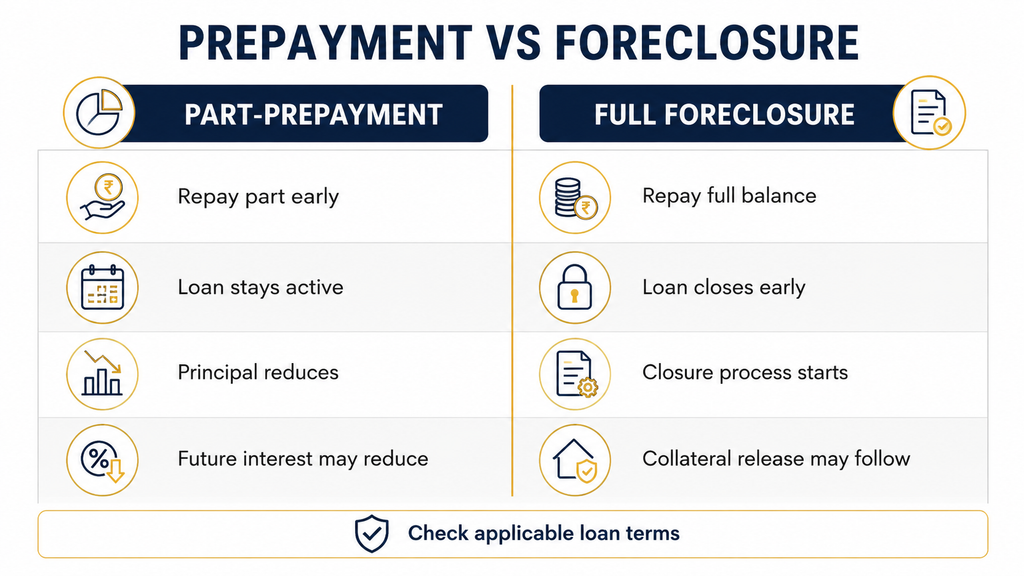
Part-prepayment refers to making payments of a part of the prevailing principal before the date without losing the loan.
A foreclosure or full prepayment is the settlement of the outstanding loan and closure of the loan in advance of the scheduled date.
The difference matters because education loan prepayment and foreclosure charges can depend on the loan structure and applicable lender terms.
The RBI Pre-payment Charges on Loans Directions, 2025 state that, for qualifying covered loans, the protection applies to prepayment in part or in full.
Read out: Study Abroad Without Loan: Scholarships & Funding Options
When Can You Prepay Without Foreclosure Charges?
Current RBI rules are central to understanding education loan prepayment and foreclosure charges.
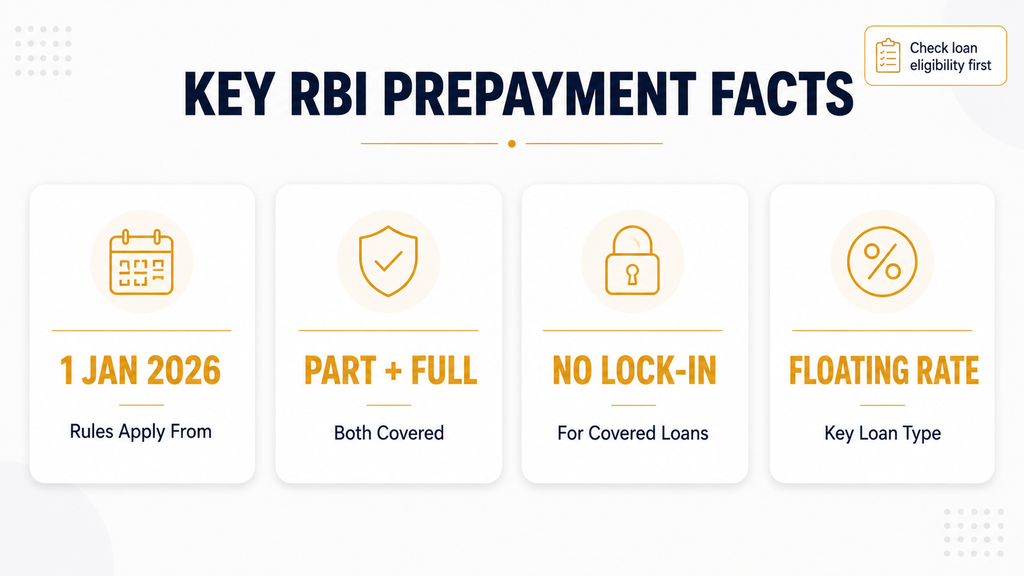
For covered regulated entities, RBI states that prepayment charges cannot be levied on qualifying floating-rate loans granted to individuals for purposes other than business, whether or not there is a co-obligant.
The Directions apply to loans and advances sanctioned or renewed on or after 1 January 2026.
For qualifying covered loans:
- The protection applies to part and full prepayment.
- It applies irrespective of the source of prepayment funds.
- There is no minimum lock-in period for this protection.
- Applicability or non-applicability of charges must be disclosed.
- Charges waived earlier cannot be imposed retrospectively at prepayment.
Education loans are not separately named in the provision. Therefore, education loan prepayment and foreclosure charges should be assessed according to the loan’s regulatory classification rather than treating all education loans as automatically exempt.
Does Every Education Loan Have Zero Foreclosure Charges?
No.
The RBI Directions do not support a blanket statement that every education loan has zero education loan prepayment and foreclosure charges.
Check these factors first:
| Question | Why It Matters |
| Is it fixed or floating? | The particular RBI coverage is on eligible floating-rate mortgage. |
| In what year was it approved or re-approved? | Relevant loans are covered by the Directives of 2025 that come into effect 1 January 2026. |
| Is it in the category of protection? | Other loans can be under lender approved policy. |
A fixed-rate education loan, older loan or another non-covered structure may require lender-specific verification of education loan prepayment and foreclosure charges.
Never assume one lender’s rule applies to another bank or NBFC.
Where Should You Check the Applicable Charges?
Before paying a large amount, verify education loan prepayment and foreclosure charges from your own documents.
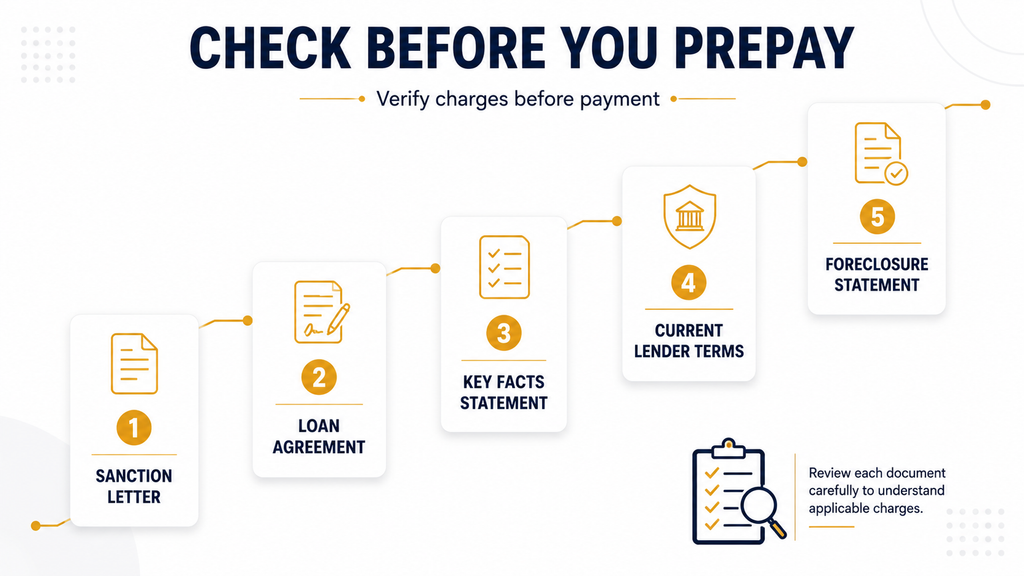
Check:
- Sanction letter: Review the approved structure and disclosed charges.
- Loan agreement: Check clauses covering part-payment and foreclosure.
- Key Facts Statement: Review applicable charges where a KFS is required.
- Current lender terms: Check whether relevant terms have changed.
- Foreclosure statement: Obtain the current amount payable before full closure.
Under the RBI Pre-payment Charges on Loans Directions, 2025, the applicability or non-applicability of prepayment charges must be disclosed appropriately in relevant borrower documents.
What Are the Early Repayment Benefits?
The primary financial benefit is simple: reducing outstanding principal can reduce future interest.
However, early repayment benefits depend on:
- outstanding principal;
- applicable interest rate;
- remaining tenure;
- prepayment amount;
- timing of payment;
- accumulated moratorium interest;
- repayment structure;
- permitted education loan prepayment and foreclosure charges, if any.
Do not compare only the charge. Compare the total interest that could potentially be avoided against any applicable education loan prepayment and foreclosure charges and your need to preserve cash.
Illustrative Example: How Prepayment Can Affect Interest
Consider this simplified example.
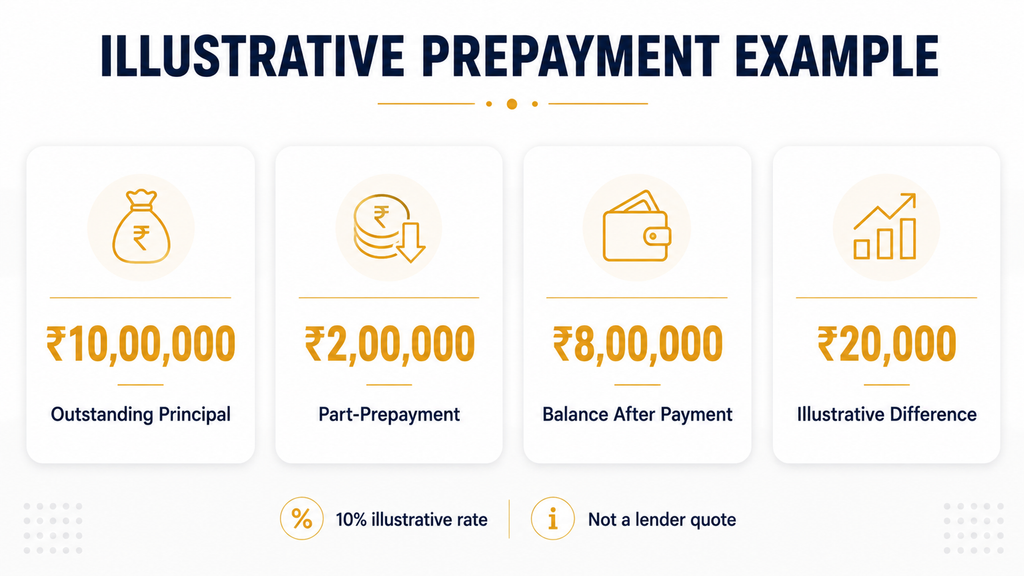
Assumptions:
- Outstanding principal: ₹10,00,000
- Illustrative annual rate: 10%
- Remaining tenure: 5 years
- Immediate part-prepayment: ₹2,00,000
- Monthly reducing-balance loan
- No moratorium interest included
- No fees or education loan prepayment and foreclosure charges included
- Rate assumed unchanged
- Not a lender quote
Before prepayment
₹10,00,000 × 10% = ₹1,00,000
After ₹2,00,000 prepayment
Remaining principal:
₹10,00,000 – ₹2,00,000 = ₹8,00,000
Simplified annual interest:
₹8,00,000 × 10% = ₹80,000
Difference:
₹1,00,000 – ₹80,000 = ₹20,000
This is not to say that the borrower will save ₹20,000 all through the loan.
Actual savings depend on changing outstanding balances, rate movements, repayment treatment and any applicable education loan prepayment and foreclosure charges.
Should You Use All Your Savings to Foreclose?
Not necessarily.
Even if education loan prepayment and foreclosure charges do not apply, using all available savings may create liquidity problems.
Before paying, consider:
- emergency reserves;
- future tuition expenses;
- family obligations;
- upcoming essential costs;
- other liabilities;
- remaining loan cost;
- secured collateral exposure.
Borrowing Rule: Students and parents should compare the complete repayment commitment, not only the sanctioned amount or advertised interest rate.
The same principle applies to early repayment.
Does Section 80E Affect the Decision?
Tax treatment should be considered alongside education loan prepayment and foreclosure charges.
According to the Income Tax Department’s Section 80E guidance, eligible interest paid on a qualifying higher-education loan can be deducted subject to applicable conditions.
The deduction applies to interest, not principal.
It can apply for the initial assessment year and seven immediately succeeding assessment years, or until eligible interest is fully paid, whichever is earlier.
The Income Tax Department deductions guidance should also be checked when evaluating Section 80E under your applicable tax regime.
Paying less future interest may reduce the future interest available for deduction. However, a deduction does not make unnecessary interest financially beneficial.
Compare the actual tax impact with the interest avoided and any education loan prepayment and foreclosure charges.
Check out: Section 80E Tax Benefit on Education Loan — Complete Guide
What Happens to Collateral After Loan Closure?
Borrowers with secured education loans should complete collateral-release formalities after repayment.
Under the RBI directions on release of property documents, regulated entities must release original movable or immovable property documents and remove registered charges within 30 days after full repayment or settlement, where the directions apply.
If a lender-attributable delay occurs beyond the prescribed period, RBI provides compensation of ₹5,000 per day of delay.
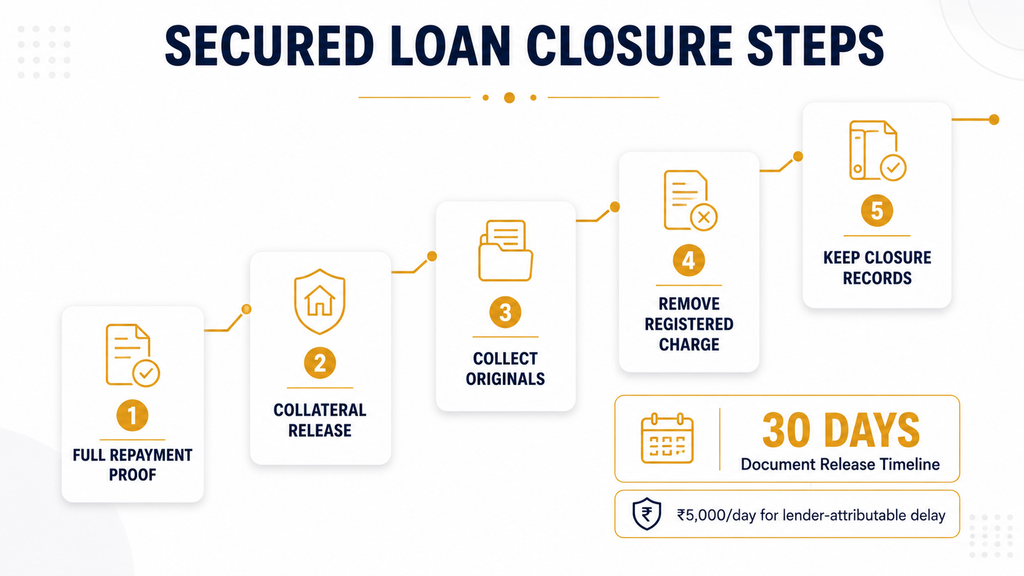
After closure:
- Obtain proof of full repayment.
- Complete the lender’s collateral-release process.
- Collect original documents.
- Confirm removal of registered charges.
- Retain closure records.
Checking education loan prepayment and foreclosure charges is only one part of a secured-loan closure.
What Happens to Your Credit Report?
Loan closure should eventually appear in the credit-reporting system, but the update may not be immediate.
RBI’s current framework requires credit information to be updated fortnightly, as of the 15th and last day of each month, or at shorter agreed intervals.
After closure:
- keep your closure documents;
- check your credit report after the reporting cycle;
- verify the account information;
- dispute incorrect information.
You can use TransUnion CIBIL’s official support channels if information is incorrect.
Under the CIBIL compensation framework, eligible credit-information complaints have a 30-calendar-day resolution framework. Subject to applicable conditions, delays can attract compensation of ₹100 per calendar day.
7 Mistakes to Avoid Before Prepaying
1. Assuming every loan has zero charges
Never assume education loan prepayment and foreclosure charges are zero without checking applicability.
2. Looking only at the interest rate
Compare outstanding principal, remaining tenure and applicable charges.
3. Ignoring the loan agreement
Your sanction letter, agreement and KFS may contain key repayment conditions.
4. Emptying emergency savings
Do not sacrifice essential liquidity simply to close the loan.
5. Assuming part-payment automatically reduces tenure
Ask how the lender will revise your repayment schedule.
6. Keeping the loan only for tax deductions
The Section 80E deduction does not make unnecessary interest a financial benefit.
7. Forgetting closure formalities
After dealing with education loan prepayment and foreclosure charges, verify collateral release and credit-report updates.
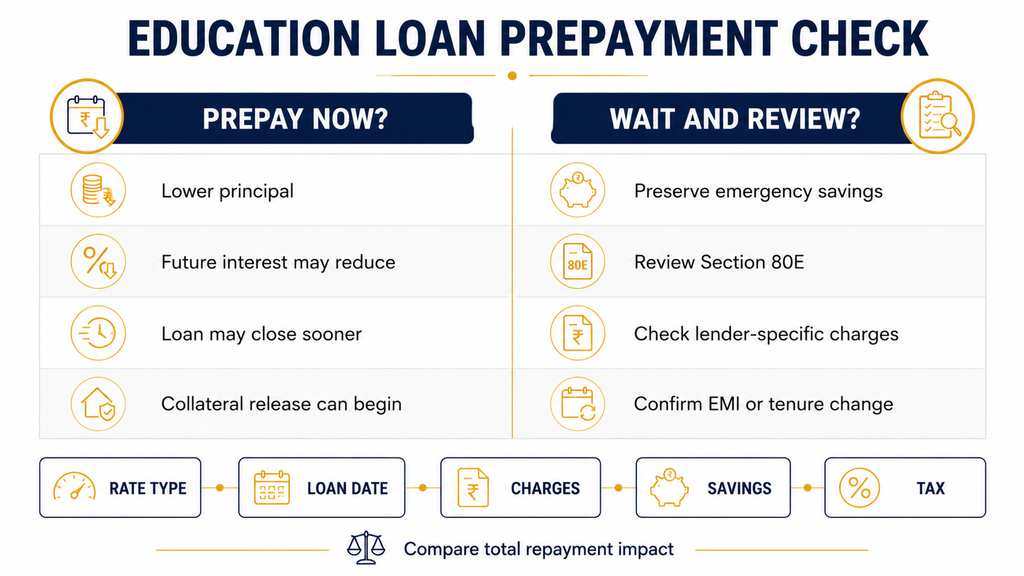
Education Loan Prepayment Decision Checklist
| Check | Question |
| Rate type | Is my loan fixed or floating? |
| Loan date | When was it sanctioned or renewed? |
| RBI protection | Does the no-charge provision apply? |
| Charges | What education loan prepayment and foreclosure charges apply? |
| Documents | What do the agreement and KFS state? |
| Interest | How much future interest might I avoid? |
| Savings | Will adequate emergency funds remain? |
| Tax | Is Section 80E relevant to me? |
| Repayment | Will EMI or tenure change? |
| Security | What collateral-release steps remain? |
| Credit | How will I verify loan closure? |
What If You Disagree With a Charge?
If unexpected education loan prepayment and foreclosure charges appear, ask the lender to explain:
- why the charge applies;
- which contractual clause supports it;
- whether the loan is fixed or floating;
- how the amount was calculated;
- where the charge was disclosed.
If the issue remains unresolved, eligible borrowers may use the RBI Complaint Management System subject to the applicable grievance framework.
How Foreign Edu Loans Can Help
Foreign Edu Loans is an education-loan facilitation and guidance platform for students pursuing international education.
It can help students explore suitable education-loan options and assist with documentation and application coordination.
Understanding education loan prepayment and foreclosure charges before selecting a loan can also help borrowers compare repayment flexibility.
Foreign Edu Loans is not the lender. Final approval, interest rate, loan amount, tenure, security requirements and charges are determined by the respective bank or NBFC.
FAQs
Do all education loans have foreclosure charges?
No. The RBI Pre-payment Charges on Loans Directions, 2025 provide protection for qualifying floating-rate non-business loans to individuals. Other loan structures need separate verification.
What is the cost of education loan prepayment and foreclosure fee?
Education loan repayment and foreclosure fees are fees that can be charged when a loan borrower decides to repay some or all of a loan prior to its maturity. It requires applicability based on RBI rules, the structure of the loan and terms unique to the lender.
Can I part-prepay without closing the loan?
Yes. Part-prepayment is different from full foreclosure. Still check whether education loan prepayment and foreclosure charges apply and how the remaining schedule changes.
Are fixed-rate education loans free from prepayment penalties?
Not universally. Check your lender’s sanction letter, agreement, KFS and current terms.
Is early repayment always beneficial?
No. Even if education loan prepayment and foreclosure charges are zero, consider emergency savings, remaining tenure, tax impact and other obligations.
Does Section 80E continue after early closure?
Section 80E concerns eligible interest actually paid. Closing the loan early can reduce future interest and therefore future eligible interest deductions.
Conclusion
The benefits of paying early to cover your education loan include less interest payments further on, although this should depend on your loan and financial status. Check whether the loan is fixed or floating, its sanction or renewal date, contractual terms, remaining principal and available emergency savings. The RBI prepayment framework protects qualifying floating-rate loans, but it should not be generalised to every borrower. Understanding education loan prepayment and foreclosure charges helps students and parents compare the actual cost and benefit of early repayment before making a large financial commitment.