The education-loan experience turns borrowing to repayment when you get your first salary after studying abroad. Present right education loan repayment strategies after abroad studies begins with knowing your actual outstanding balance, EMI date, interest scheme, the period of repayment and terms of prepayment. No standard formula of repayment applies to all graduates since all lenders have their conditions and individual economics vary. Rather than scurrying to clear the loan and just paying the minimum EMI without a thought, develop a repayment plan based on your incomes and necessities, emergency savings, loan terms, and long-term financial obligations. Proper repayment planning can make you aware of what is required of you, prevent any skip payments, make sense with prepayment and establish a step-by-step progress towards getting out of the step-by-step way of debt.
Education Loan Repayment Strategies After Abroad Studies: At a Glance
| Repayment stage | What to check | Practical action |
| Before EMI starts | Moratorium, accrued interest, outstanding balance | Obtain the repayment schedule |
| First salary | Income and essential commitments | Build a realistic EMI budget |
| Regular repayment | EMI date and account balance | Avoid missed instalments |
| Income increases | Surplus cash and loan terms | Evaluate part-prepayment |
| Tax planning | Section 80E eligibility and tax regime | Verify deduction eligibility |
| Financial difficulty | Repayment capacity | Contact the lender early |
| Final repayment | Closure balance and documents | Complete formal loan closure |
Interpretation: Effective education loan repayment strategies after abroad studies should cover the complete repayment cycle, not just monthly EMI payment.
Check out: Study Abroad Without Loan: Scholarships & Funding Options
1. When Does Your Education Loan Repayment Actually Start?
Do not assume your EMI starts on a universal date after graduation.
Repayment commencement depends on your lender, loan product and contractual terms. For example, SBI Global Ed-Vantage currently provides a repayment holiday comprising the course period plus six months. Indian Bank’s IBA Educational Loan describes the course period plus a holiday period of up to one year.
These examples demonstrate why education loan repayment strategies after abroad studies must begin with your own loan documents.
Before planning your first EMI:
- Check your EMI commencement date.
- Confirm the outstanding balance.
- Download or request your repayment schedule.
- Check the applicable repayment tenure.
- Review whether your loan carries a fixed or floating rate.
- Verify prepayment and foreclosure conditions.
Never substitute another student’s repayment schedule for your own.
2. Does Interest Continue During the Moratorium?
A moratorium should not automatically be understood as an interest-free period.
Official SBI Global Ed-Vantage and Indian Bank education-loan information indicates that interest can continue during the course and moratorium periods for these products. SBI also states that accrued moratorium interest can be added to principal when EMI is fixed.
That makes moratorium interest important when creating education loan repayment strategies after abroad studies.
Why does this matter?
Suppose you originally borrowed a particular principal amount. If interest accrues during your study and moratorium period and remains unpaid, the amount used for subsequent repayment calculations may be higher than the amount originally borrowed.
Therefore, do not build your repayment budget only from your sanction amount.
Check the lender’s current statement for the actual outstanding amount when repayment begins.
Some products also allow borrowers to service interest during the course or moratorium period. Whether doing so suits you depends on your available funds and lender terms.
3. How Should You Plan EMI After Graduation?
Good EMI planning after graduation starts with cash flow, not optimism.
Your first salary may also need to cover rent, food, transportation, insurance, family commitments and other essential expenses. Therefore, education loan repayment strategies after abroad studies should balance timely repayment with basic financial stability.
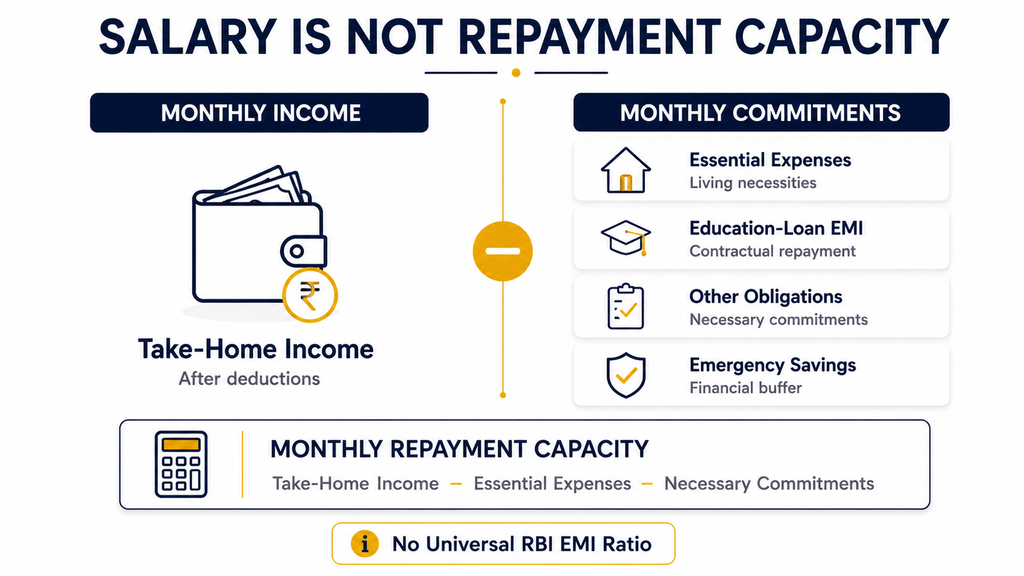
Use this monthly planning structure:
| Monthly cash-flow item | What to assess |
| Take-home income | Money actually received after deductions |
| Essential expenses | Housing, food, transport, utilities and insurance |
| Education-loan EMI | Contractual monthly repayment |
| Other obligations | Existing legitimate financial commitments |
| Emergency savings | Buffer for unexpected expenses |
| Surplus | Amount potentially available for additional repayment |
Interpretation: Your salary alone does not determine repayment comfort. What remains after essential commitments matters.
What is the ideal salary vs EMI ratio education loan borrowers should use?
There is no verified RBI rule establishing one universal salary vs EMI ratio education loan borrowers must follow.
That distinction matters.
Using an unsupported statement such as “your education-loan EMI should always remain below 30% of salary” would turn a budgeting assumption into a supposed financial rule.
Instead, calculate:
Monthly repayment capacity = Take-home income minus essential expenses minus necessary financial commitments
Then compare that capacity with your contractual EMI.
This approach makes education loan repayment strategies after abroad studies personal and evidence-based without inventing a universal affordability percentage.
4. What Should You Do With Your First Salary?
Do not automatically send every available rupee towards prepayment.
Start by making sure the contractual EMI can be paid consistently.
A practical first-salary sequence is:
- Confirm the EMI amount and due date.
- Maintain sufficient money in the repayment account.
- Review essential monthly expenses.
- Establish a reasonable financial buffer based on your circumstances.
- Check whether moratorium interest has affected the outstanding balance.
- Review prepayment conditions.
- Use genuine surplus for additional repayment only after considering other obligations.
These repayment tips for abroad loan borrowers prioritise repayment consistency before aggressive debt reduction.
A higher salary can create more repayment flexibility, but that does not automatically mean the entire surplus should go towards the loan. Your financial circumstances should determine that decision.
5. Should You Prepay Your Education Loan?
Prepayment can be an important part of education loan repayment strategies after abroad studies, particularly when income increases and genuine surplus becomes available.
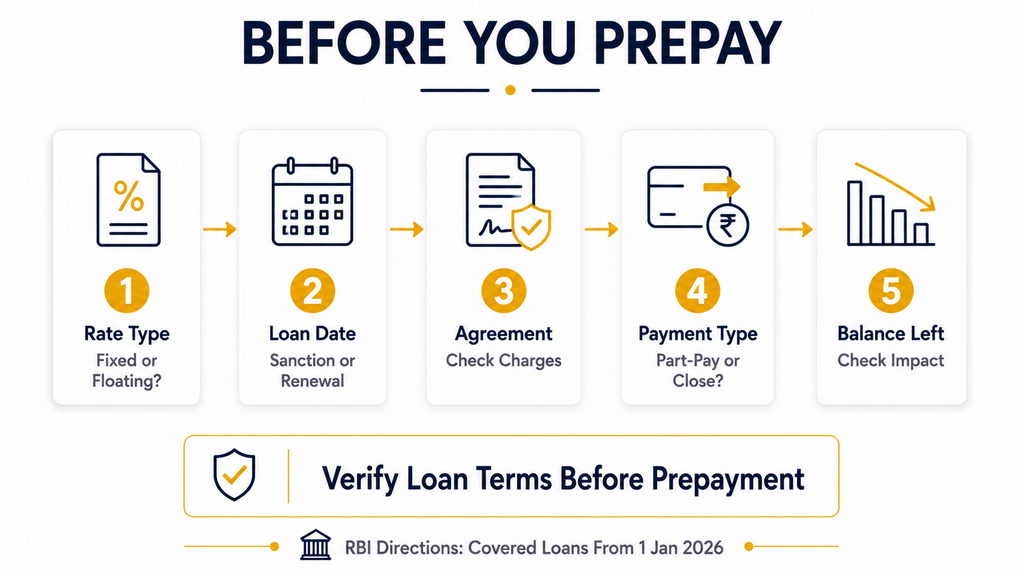
But check the rules first.
The RBI Pre-payment Charges on Loans Directions, 2025 apply to covered loans and advances sanctioned or renewed on or after 1 January 2026.
Under the Directions, regulated entities cannot levy prepayment charges on covered floating-rate loans granted to individuals for purposes other than business. The protection applies to part or full prepayment under the conditions specified by RBI.
Do not convert this into the claim that every education loan has zero foreclosure charges.
The applicable rate structure, sanction or renewal date, lender category and contractual conditions still matter.
Before prepaying, check:
| Question | Why it matters |
| Is the loan fixed or floating? | Prepayment treatment may differ |
| When was it sanctioned or renewed? | RBI applicability can depend on date |
| Does the agreement mention charges? | Product-specific terms still matter |
| Is it part-prepayment or closure? | Procedures may differ |
| What balance remains afterwards? | Helps assess repayment impact |
Interpretation: Prepayment decisions should follow verified loan terms, not assumptions.
RBI also requires applicable prepayment charges to be disclosed through relevant loan documentation, including the sanction letter and loan agreement, and the Key Facts Statement where required.
6. Illustrative Example: How Can Extra Repayment Help?
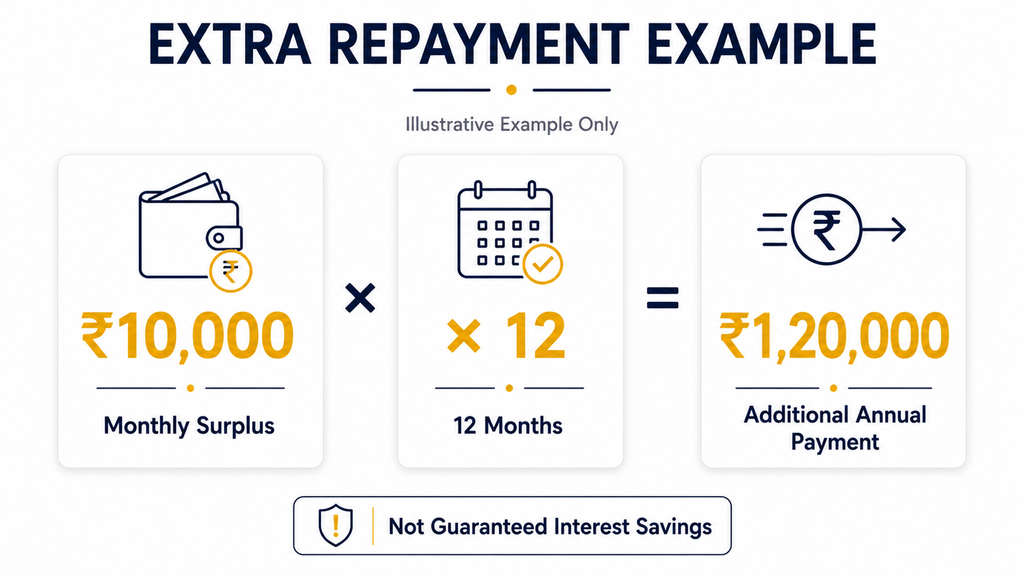
Illustrative Example only. This is not a lender quote.
Assume a graduate has a regular contractual EMI and receives a salary increase. After essential expenses, required EMI payments and an appropriate personal financial buffer, the graduate has an additional ₹10,000 per month available.
If the lender permits part-prepayment without an applicable charge, the borrower could consider using some or all of this genuine surplus towards principal.
Annual additional payment calculation:
₹10,000 × 12 = ₹1,20,000
This example deliberately does not calculate interest savings because doing so would require an assumed interest rate, outstanding principal, remaining tenure, compounding method and treatment of accrued moratorium interest.
The lesson is simple: education loan repayment strategies after abroad studies should use reproducible calculations and never advertise imaginary savings.
7. Can Section 80E Help During Repayment?
Tax planning can form part of education loan repayment strategies after abroad studies, but eligibility must be checked carefully.
Section 80E of the Income-tax Act concerns qualifying interest paid on an eligible education loan. It does not provide the same deduction for principal repayment.
The deduction can apply for a maximum period covering the initial assessment year and seven subsequent assessment years, or until qualifying interest is fully paid, whichever occurs earlier.
However, there is another crucial consideration.
Under the new tax regime governed by Section 115BAC, deductions under Sections 80C to 80U are generally unavailable except specified exceptions. Section 80E is not among those specified exceptions.
Therefore, do not assume that paying education-loan interest automatically produces a tax benefit.
Check your tax regime and eligibility before relying on Section 80E in your repayment calculations.
Read out: Section 80E Tax Benefit on Education Loan — Complete Guide
8. What If You Are Struggling to Pay the EMI?
The most important repayment tips for abroad loan borrowers facing financial difficulty are to recognise the problem early and communicate with the lender.
Do not assume restructuring, EMI reduction or payment suspension is automatically available.
Instead:
- Review the upcoming repayment obligation.
- Calculate the genuine monthly shortfall.
- Contact the lender before repeated missed payments.
- Ask what options are available under your specific loan.
- Obtain any agreed change in documented form.
- Continue monitoring your loan and credit records.
RBI’s framework on penal charges also distinguishes penal charges from additional penal interest. However, the actual charges applicable to your account require lender-specific verification.
These education loan repayment strategies after abroad studies are designed to prevent a temporary cash-flow problem from being ignored until it becomes more difficult to manage.
9. Why Should You Monitor Your Credit Report?
Loan repayment information contributes to your credit history.
RBI’s credit-information reporting framework requires more frequent reporting by credit institutions. This makes accurate repayment records important throughout the loan lifecycle.
If information is incorrect, RBI has also established a framework for delayed correction of credit information. Covered complaints have an overall 30-calendar-day resolution framework, with compensation provisions for qualifying delays beyond that period.
That does not mean every payment will appear instantly.
As part of education loan repayment strategies after abroad studies, periodically check whether your loan account and repayment history are being reported accurately.
If you identify an error, raise it through the lender and relevant credit-information company rather than ignoring it.
Check out: Co-Applicant in an Education Loan — Who Can Be One & Why It Matters
10. What Mistakes Should You Avoid During Repayment?
Several mistakes can weaken otherwise sensible education loan repayment strategies after abroad studies:
- Assuming moratorium means interest-free borrowing.
- Budgeting EMI using the original sanction amount instead of current outstanding balance.
- Using an invented salary-to-EMI percentage as a universal rule.
- Missing EMI dates despite having sufficient funds.
- Prepaying without checking contractual conditions.
- Assuming every education loan has zero foreclosure charges.
- Ignoring tax-regime eligibility while calculating Section 80E benefits.
- Waiting through repeated repayment difficulties before contacting the lender.
- Ignoring credit-report errors.
- Treating loan sanction, disbursement and outstanding principal as interchangeable figures.
- Aggressively prepaying without considering essential financial commitments.
- Forgetting formal loan-closure requirements after the final payment.
11. What Should You Do When the Loan Is Fully Repaid?
The final EMI does not necessarily complete every administrative step.
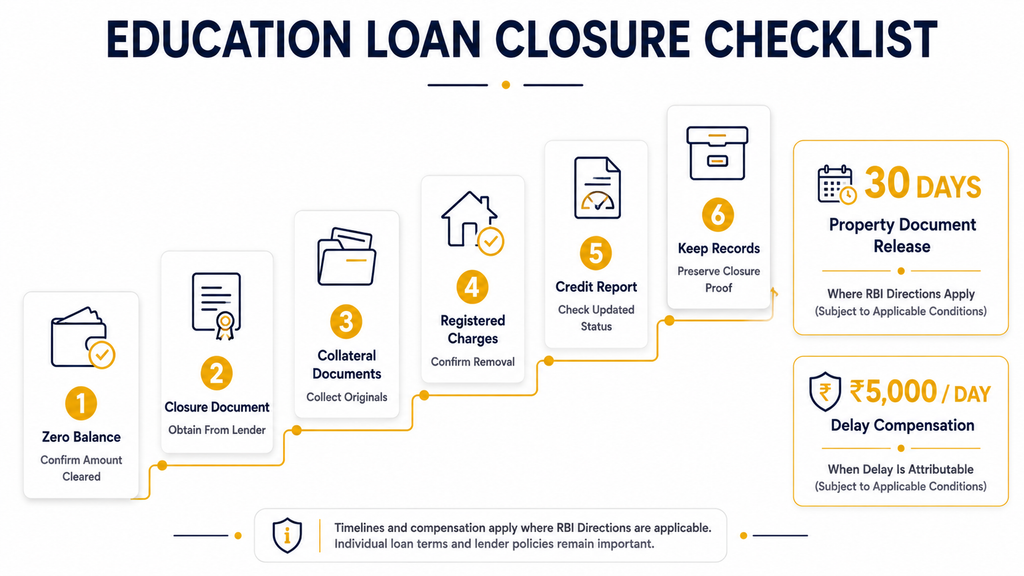
For secured loans involving property documents, RBI’s Responsible Lending Conduct directions require covered regulated entities to release original movable or immovable property documents and remove registered charges within 30 days after full repayment or settlement where the directions apply.
Where delay is attributable to the regulated entity, RBI provides compensation of ₹5,000 per day beyond the applicable period.
After final repayment:
- Confirm that no outstanding amount remains.
- Obtain the lender’s loan-closure documentation.
- Collect applicable original collateral documents.
- Confirm removal of relevant registered charges.
- Review your credit report for updated loan status.
- Preserve repayment and closure records.
Loan closure should therefore be included in education loan repayment strategies after abroad studies, rather than treated as an afterthought.
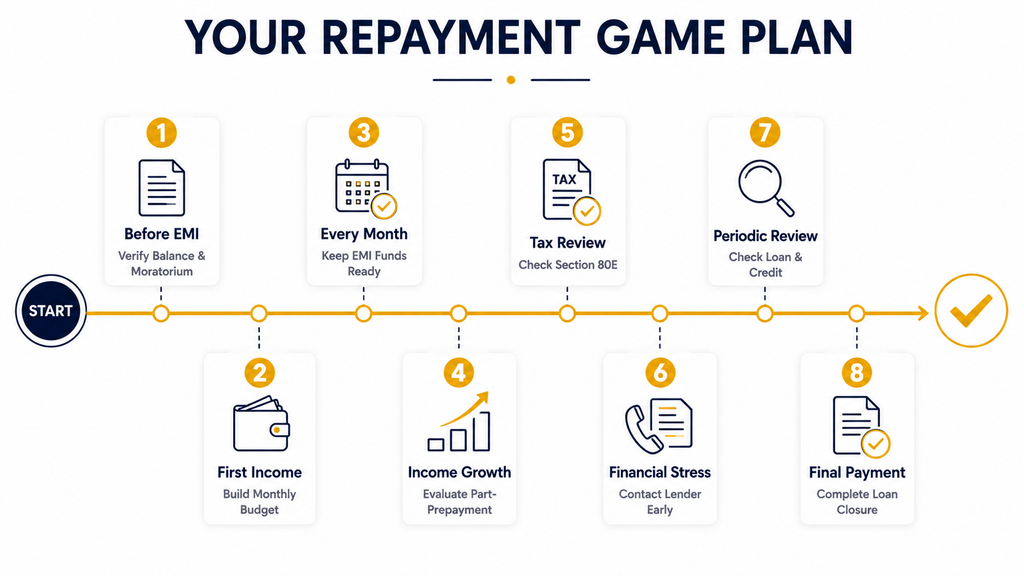
12. A Practical Repayment Game Plan
Use this sequence to organise your repayment:
| Stage | Action |
| Before EMI | Verify balance, moratorium and EMI schedule |
| First income | Build a sustainable monthly repayment budget |
| Every month | Maintain funds before the due date |
| Income growth | Evaluate responsible part-prepayment |
| Tax review | Check Section 80E and tax-regime eligibility |
| Financial stress | Contact the lender early |
| Periodically | Review loan statements and credit information |
| Final payment | Complete formal closure and document recovery |
Interpretation: The strongest education loan repayment strategies after abroad studies adapt as income, outstanding balance and financial responsibilities change.
13. Responsible Borrowing Does Not End After Disbursement
Receiving the loan solved the original funding requirement. Repayment creates a different responsibility.
Before making aggressive additional payments, evaluate your actual outstanding balance, essential expenses, contractual EMI, financial buffer, co-applicant obligations where applicable, and other legitimate commitments.
Borrowing Rule: Students and parents should compare the complete repayment commitment, not only the sanctioned amount or advertised interest rate.
Likewise, a longer tenure can change the repayment structure, while faster repayment requires sufficient cash flow. Neither option should be treated as automatically correct for every borrower.
Effective education loan repayment strategies after abroad studies should therefore focus on sustainable repayment rather than simply clearing debt as quickly as possible.
14. How Foreign Edu Loans Can Help
Foreign Edu Loans is an education-loan facilitation and guidance platform for students pursuing international education. It is not a bank, NBFC or direct lender, and it does not make the final credit decision.
Foreign Edu Loans can help students explore suitable education-loan options, compare eligible lenders, and assist with documentation and application coordination. Final approval, applicable interest rates and loan conditions remain subject to the respective lender’s eligibility criteria, underwriting, documentation and current policies.
Students who are still evaluating education finance can use Foreign Edu Loans to better understand available options before taking on a repayment commitment.
FAQs
1. When should I start planning education-loan repayment?
Start before the first EMI becomes due. Good education loan repayment strategies after abroad studies require you to verify the moratorium, outstanding balance, EMI commencement date and repayment schedule early.
2. Is there an ideal salary vs EMI ratio education loan borrowers should follow?
No universal RBI percentage was verified for education-loan borrowers. Instead of relying on an unsupported ratio, compare your take-home income, essential expenses, financial commitments and contractual EMI.
3. Should I prepay my education loan after getting a job?
It depends on your surplus cash and loan terms. Check the applicable prepayment rules first. Education loan repayment strategies after abroad studies should not sacrifice essential financial stability merely to repay faster.
4. Can I claim Section 80E for education-loan repayment?
Eligible interest may qualify under Section 80E subject to statutory conditions and the taxpayer’s applicable tax regime. Principal repayment does not receive the Section 80E deduction. Verify current Income Tax Department rules before claiming it.
5. What should I do if I cannot afford my EMI?
Contact your lender early, explain the repayment difficulty, and ask what options are actually available for your loan. Do not assume an EMI reduction, restructuring or repayment holiday is guaranteed.
6. What happens after my final education-loan payment?
Confirm the account has no outstanding balance, obtain closure documentation, recover applicable collateral documents, ensure relevant charges are removed, and review your credit report for the updated status.
Conclusion
Education loan repayment strategies after abroad studies that were incurred abroad successful education loan process can only start with having an understanding on what you have borrowed as opposed to following another borrowers repayment plan. Check your current balance, moratorium interest, EMI plan, term and prepayment conditions to decide on the degree of aggressiveness in repayment. When your income varies, reevaluate your ability to pay and spend authentic surplus thoughtfully. You should not base on an imagined salary-to-EMI ratio; and you should not presume that all prepayments, tax benefits or restructuring options invariably go off by default. Maintain records of repayment, track credit and finalize closure of formal repayment process. Strict regulations on debt repayment must provide good balance between the ability to repay debt and financial obligations. In case you are yet to make the decision of education-finance, Check Your Education Loan Eligibility with Foreign Edu Loans.