For Indian students and parents who want to understand co-applicant rules, documentation and lender assessment when only one parent is available.
When you apply to education loan for single parent applicants, the fact that you were raised by one parent does not automatically form a separate loan category and it may be rejected. The official lender sources examined are more about who can be a co-applicant, the academic and admission strength of the student, the financial capability of the co-applicant and his or her credit records as well as collateral where applicable. The secret is Lender fit: the parent/legal guardian may be taken by one lender and a larger group of relatives by another or an alternate income-testing in use.
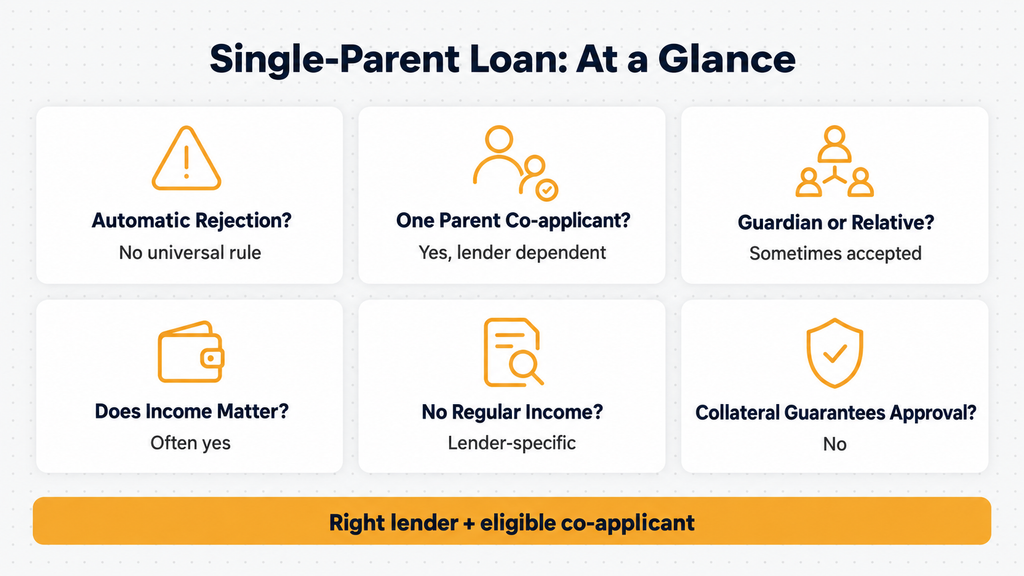
Education loan for single parent applicants: at a glance
| Question | Practical answer |
| Does one-parent family status automatically disqualify a student? | None of the reviewed lender sources states that single-parent status itself automatically causes rejection. Approval still depends on lender assessment. |
| Can one parent be the co-applicant? | Yes under lender frameworks reviewed, subject to the specific product rules. |
| Can a guardian or relative be used instead? | Sometimes. Permitted relationships vary by lender. |
| Does co-applicant income matter? | Often yes, but treatment is not identical across lenders. |
| What if the parent has no income? | There is no universal answer. |
| Does collateral guarantee approval? | No. Security may support a secured application, but underwriting still applies. |
Bottom line: For an education loan for single parent applicants, the strongest application starts with the right lender and an eligible co-applicant, not assumptions about family structure.
Does having a single parent reduce your eligibility?
No confirmed industry regulation among the lender sources that we reviewed which indicated that, a student has to have co-applicants (two parents). Avanse specifically shows a parent or legal guardian as one of its authorized co-borrowers and Credila states that a co-applicant is frequently optional but not necessarily always helpful and that a policy can differ depending on the lender.
That does not mean every education loan for single parent applicants will be processed identically. Lenders may differ on acceptable relationships, income requirements, credit assessment and security.
For a broader explanation of how the co-borrower relationship works, read Foreign Edu Loans’ guide to a co-applicant in an education loan.
What do lenders actually assess?
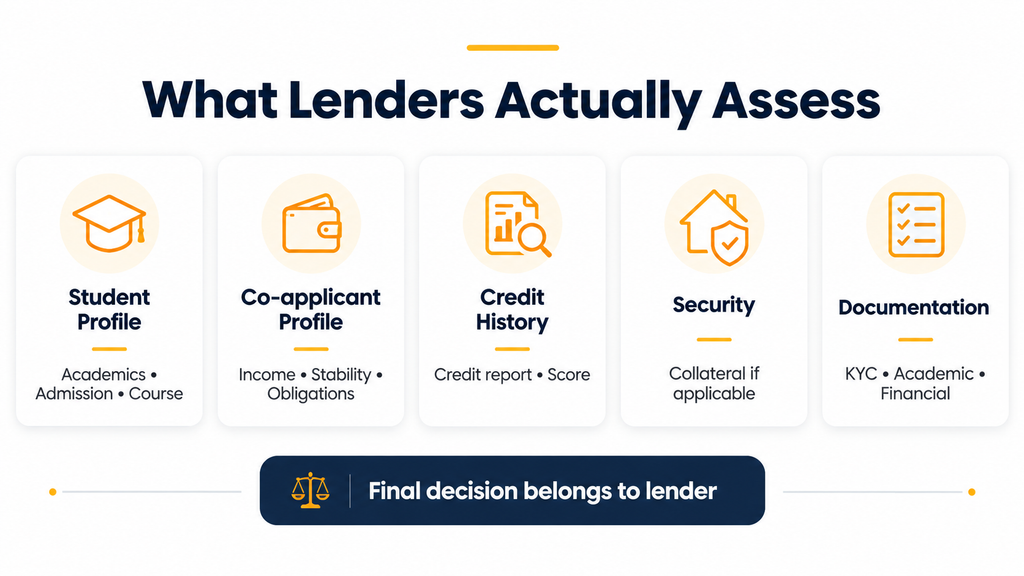
A single-parent situation is only one part of an education-loan application. Lenders can examine several areas together:
- Student profile: academics, admission, course and institution.
- Co-applicant profile: income, employment or business stability, existing obligations and repayment capacity.
- Credit history: credit report and score.
- Security: collateral where the loan is secured.
- Documentation: KYC, admission, academic and financial evidence.
TransUnion CIBIL states that lenders use the CIBIL Score and Report while evaluating loan applications, but the decision to lend belongs to the lender. You can also review the official CIBIL explanation of credit scores and loan assessment.
This is why an education loan for single parent applicants should not be evaluated only on family status. The complete application still needs to satisfy the lender’s product and credit criteria.
Who can be the co-applicant?
A co-applicant shares legal and financial responsibility under the lender’s loan agreement. The acceptable relationship can vary substantially.
| Official source | Published position |
| Avanse | Lists a parent, legal guardian, sibling or other blood relative and says the co-borrower should have stable income. |
| Credila | Describes a financial co-applicant as typically a parent or legal guardian and notes that lender requirements can vary. |
| CIBIL | Describes how lenders apply credit information when evaluating loans and the lender decides whether to lend. |
According to Avanse, its co-borrower (notably an Indian citizen) is also required to be a parent, a legal guardian, a sibling or other blood relative and has also to fulfill its financial requirements. The current official Avanse education-loan eligibility page contains the wording.
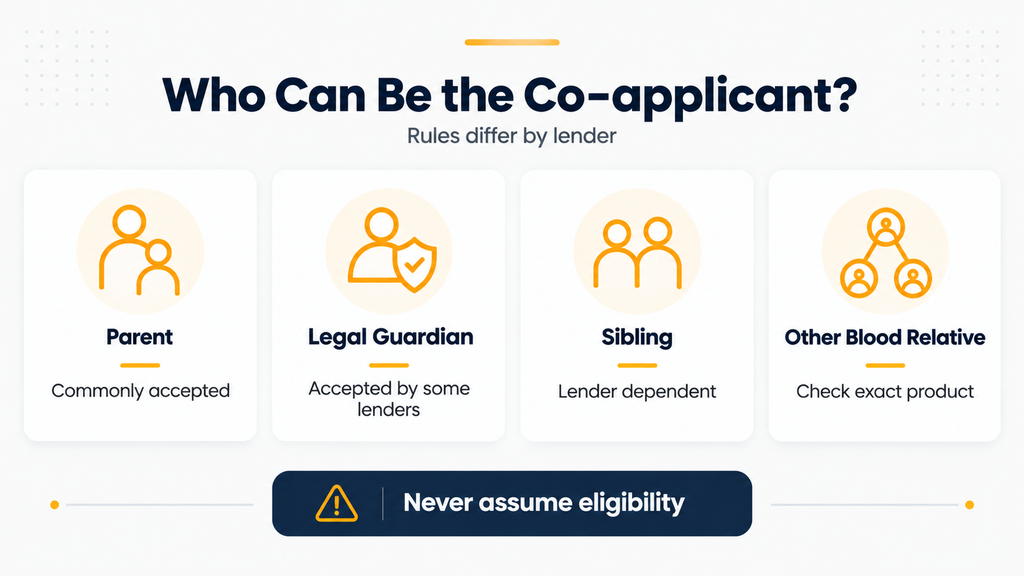
Credila separately explains that lender policies determine whether a co-applicant is required and who may qualify.
So, for an education loan for single parent applicants, do not assume that an uncle, sibling, grandparent or guardian will automatically be accepted simply because another lender permits that relationship. Check the exact product.
What if the single parent has no regular income?
This is where blanket advice becomes risky.
Avanse says its co-borrower should have a stable income. Credila, however, publishes an education-loan document checklist containing a separate “No-Income Co-Applicant” category and asks for six months of savings-account statements for that category.
That does not mean one applicant will automatically be approved while another will automatically be rejected. A documentation category simply shows that the lender has a process for that profile.
If your education loan for single parent applicants case involves a non-earning parent, ask these questions before applying:
- Does this particular product permit a non-earning co-applicant?
- Is an additional financial co-applicant allowed or required?
- Which relationships are accepted?
- What financial documents are required?
- If collateral is used, whose asset can be offered under the product rules?
This matters because lender criteria, not assumptions about household structure, determine how the file progresses.
What if the other parent is deceased, divorced, separated or estranged?
The approved research did not establish one universal document rule covering all lenders.
Do not assume that every lender automatically requires the same death certificate, divorce decree, custody order, affidavit or NOC.
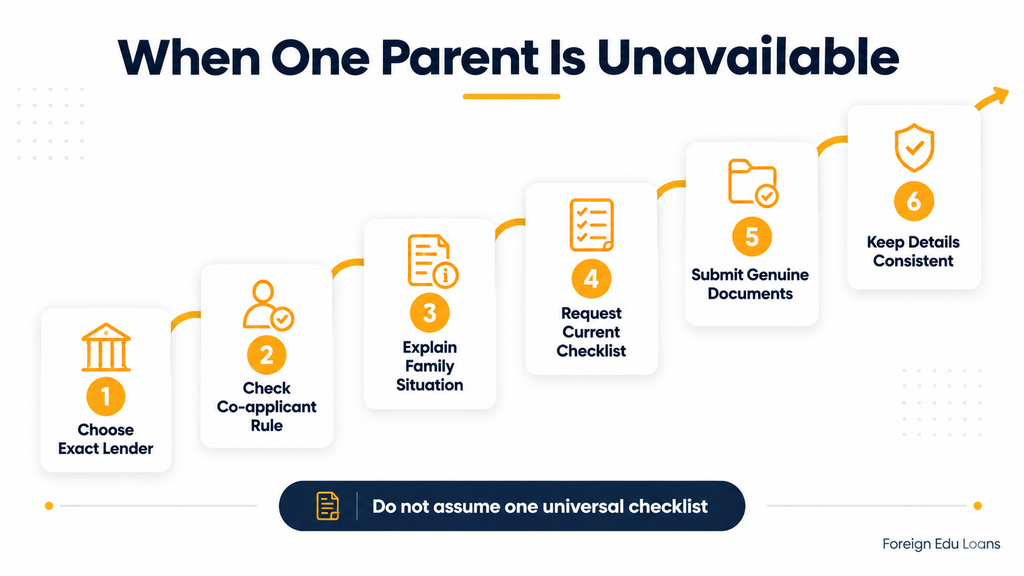
Use this process instead:
- Choose the lender and exact product.
- Confirm who may act as co-applicant.
- Explain the family situation accurately.
- Request the lender’s current situation-specific checklist.
- Submit only genuine documents that are actually required.
- Keep names, relationships and financial information consistent throughout the application.
For an education loan for single parent applicants, this lender-specific approach is safer than copying a generic “special case” checklist from another website.
What documents should you prepare?
Exact document requirements differ, but official lender pages show a common structure.
| Document area | Examples lenders may request |
| Student KYC | Identity and address proof |
| Academic records | Marksheets, transcripts and relevant test records |
| Admission | Admission or offer documentation |
| Co-applicant KYC | Identity and address proof |
| Co-applicant finances | Bank statements, salary proof, tax returns or business records depending on profile |
| Relationship evidence | Proof showing the relationship where required |
| Collateral | Security documents for secured education loans |
Avanse’s education-loan guidance lists student KYC, academic and admission documents together with co-applicant income proof, bank statements and relationship proof.
Credila publishes different financial-document requirements for salaried, self-employed, no-income and pensioner co-applicants. You can check the official Credila education-loan document checklist before preparing a lender-specific file.
For an education loan for single parent applicants, prepare the normal application documents first, then ask the lender what additional evidence applies to your family situation.
Secured or unsecured: does the choice matter?
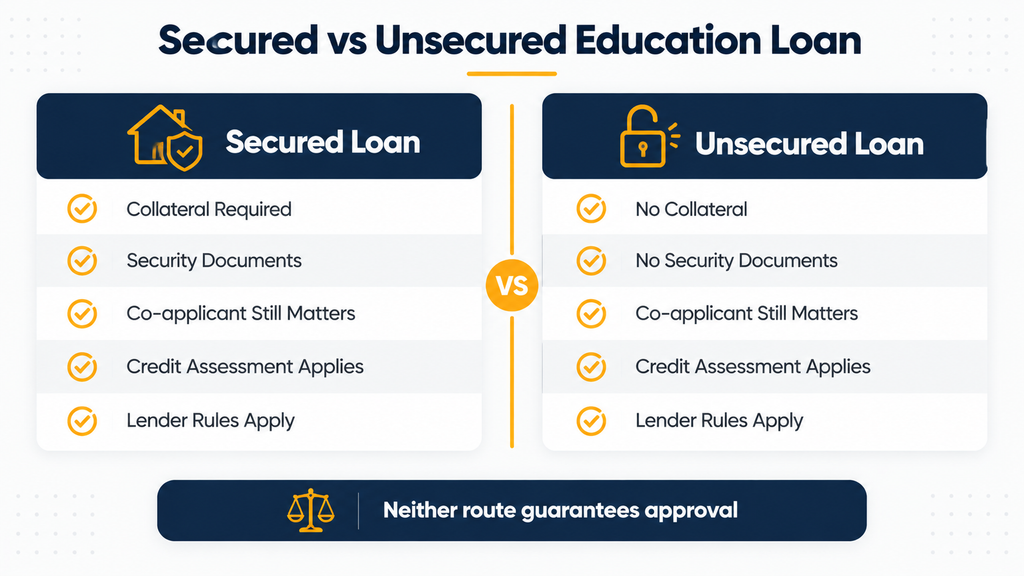
Yes. A secured education loan uses acceptable collateral, while an unsecured loan does not. That changes the structure of the lender’s risk assessment, but it does not automatically remove co-applicant, documentation or credit requirements.
Foreign Edu Loans has separate guides explaining collateral vs non-collateral education loans and education loans without collateral. These can help you understand the basic financing structures before comparing individual products.
For an education loan for single parent applicants, the appropriate route depends on the funding requirement, available security, co-applicant profile and lender eligibility.
Do not choose an unsecured loan simply to avoid discussing a weak co-applicant profile. Equally, do not pledge collateral assuming that security guarantees sanction.
Pre-application checklist
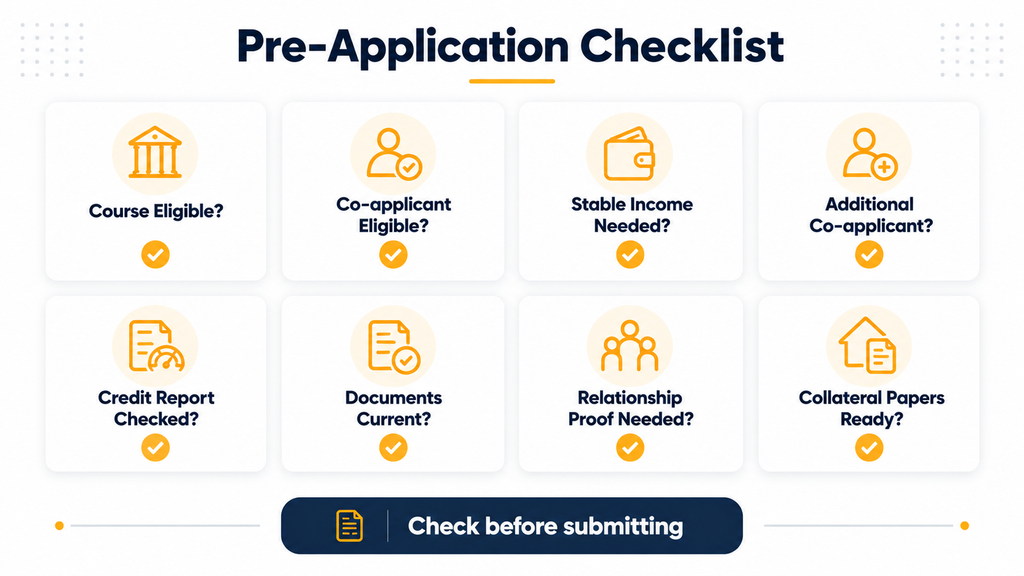
Before submitting your application, check:
- Is the institution and course acceptable to the lender?
- Is the available parent or guardian an eligible co-applicant?
- Does the lender require stable income from that co-applicant?
- Is another eligible co-applicant permitted if needed?
- Have you checked the co-applicant’s credit report for errors?
- Are the KYC, admission, academic and financial documents current?
- Is relationship proof required?
- If collateral is involved, are ownership and security documents ready?
You can also review the Foreign Edu Loans loan-products overview to understand broad secured, unsecured and international financing categories before shortlisting lenders.
Mistakes to avoid
1. Assuming two parents are mandatory
The reviewed sources do not support that as a universal market rule.
2. Assuming single-parent status gives special approval
No verified general concession or approval preference was established solely because a student comes from a single-parent household.
3. Treating a no-income category as guaranteed eligibility
A lender publishing a no-income documentation category does not mean every applicant in that category will qualify.
4. Using a random “minimum CIBIL score”
No universal education-loan CIBIL cut-off was verified for this article. Lender underwriting remains product- and applicant-specific.
5. Assuming collateral guarantees approval
A secured education-loan structure can only be supported by collateral, although the lender will consider the entire application.
Such errors are important since a search on single-parent education loans tends to confuse the valid rules of lenders with baseless generalisations.
Single-parent responsible borrowing.
Just because it has been approved is just a decision. The other is affordability.
Before borrowing, calculate the funding gap after scholarships, savings and reliable family contributions. Then review:
- expected borrowing amount;
- interest treatment during study and moratorium;
- future EMI and total repayment;
- co-applicant liability;
- collateral exposure, if any;
- currency risk for overseas education;
- uncertainty around post-study income.
A longer repayment tenure may reduce the monthly EMI but can increase the total interest paid.
For deeper repayment planning, see Foreign Edu Loans’ guide to education-loan moratorium and EMI planning.
Borrowing Rule: Compare the complete repayment commitment, not only the amount a lender is willing to sanction.
How Foreign Edu Loans can help
Foreign Edu Loans is a study-abroad education-loan facilitation platform, not a bank or NBFC. Its website states that final loan decisions rest with the relevant bank or NBFC.
For an education loan for single parent applicants, Foreign Edu Loans can help students explore financing routes, understand co-applicant requirements and prepare documentation for shortlisted lenders.
Final approval, interest rate, sanctioned amount and other loan terms remain subject to the respective lender’s eligibility criteria and assessment.
FAQs
Can I get an education loan if I have only one parent?
Yes, a single-parent household is not shown in the reviewed lender sources as an automatic disqualification. An education loan for single parent applicants still depends on the selected lender’s co-applicant rules and complete assessment.
Can my mother or father be the only co-applicant?
Official lender material reviewed lists a parent or legal guardian among possible co-applicants. Confirm the selected lender’s exact rules before applying.
Can a legal guardian be the co-applicant?
Some lenders explicitly permit this. Avanse currently lists a legal guardian among eligible co-borrowers, subject to its other eligibility requirements.
What if my parent has no income?
There is no universal answer. Avanse publishes a stable-income requirement for its co-borrower, while Credila publishes a no-income co-applicant documentation category. Final treatment remains lender-specific.
Do I always need a death certificate or divorce decree?
No universal requirement was verified across lenders. Ask the selected lender what evidence it requires for your particular family situation.
Conclusion
An education loan for single parent applicants is not governed by one special approval rule across the Indian lending market. What matters is whether the available parent, guardian or other permitted person qualifies as co-applicant, whether the financial and credit profile meets the lender’s requirements, and whether the documentation is complete. If the parent has no income or the other parent is deceased, divorced, separated or estranged, verify the exact lender process instead of relying on generic advice. Compare secured and unsecured options carefully, understand the repayment responsibility, and borrow according to the genuine funding gap rather than the highest possible sanction.