One of the most significant choices made in studying abroad is to select between a collateral vs non-collateral education loan. The decision taken in the right direction will influence your interest rate, loan amount, and the speed of processing. The bewilderment between secured and unsecured loan possibilities in education, especially in the initial days, gets many students perplexed, leading to postponement in applying.
While at Gateway International, we have led thousands of students in the education loan process. We have experienced firsthand how the collateral vs non-collateral education loan option can either succeed or fail in the funding schedule of a student. This article disaggregates the distinction between the collateral and non-collateral type of loan, whereby you make an informed choice on which type of education loan is more beneficial to your case.
The difference between a collateral vs non-collateral education loan?
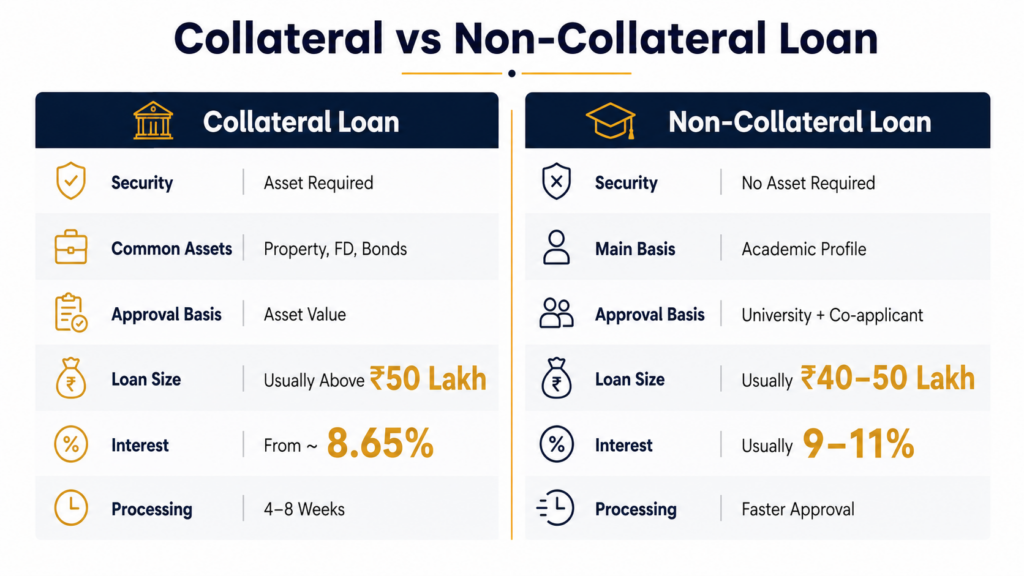
Before proceeding to compare the lenders, it is best to see how the collateral vs non-collateral education loan structure works out. It is also often termed as the secured vs unsecured education loan decision, as collateral merely represents a promised asset that collateralises the loan.
Collateral (Secured) Education Loans.
- In a collateral education loan, you promise a security on the loan sum.
- Some of the common assets are residential property, fixed deposits, insurance policies, or government bonds.
- The asset is appreciated by banks, and a loan amount is granted accordingly.
- Secured loans are normally cheaper in terms of interest rates since the risk that the bank has is low.
Non-Collateral (Unsecured) Education Loans.
- A non-collateral education loan does not need any asset as security.
- The entry requirement is largely dependent on academic profile, target university, and co-applicant income.
- Loans are usually limited to smaller amounts in comparison with the secured loans.
- Interest rates would be a bit higher because of the risk to lenders.
A lot of students thought that they would not get a loan at all until we made it clear to them that they would get a loan under both secured and unsecured terms.
Secured vs Unsecured Education Loan
The four factors in the debate on secured vs unsecured education loans can be reduced to ownership of assets, size of the loan, interest rate and the time taken in processing the loan. These factors are much easier to grasp early and therefore make the decision between collateral vs non-collateral education loan much easier to comprehend.
| Factor | Collateral (Secured) Loan | Non-Collateral (Unsecured) Loan |
| Asset Required | Property, FD, or bonds must be pledged | No asset pledge needed |
| Loan Amount | Greater, usually over 50 lakh | 40-50 lakh or so in most cases. |
| Interest Rate | Usually lower, beginning at about 8.65% | A little higher, usually 9-11. |
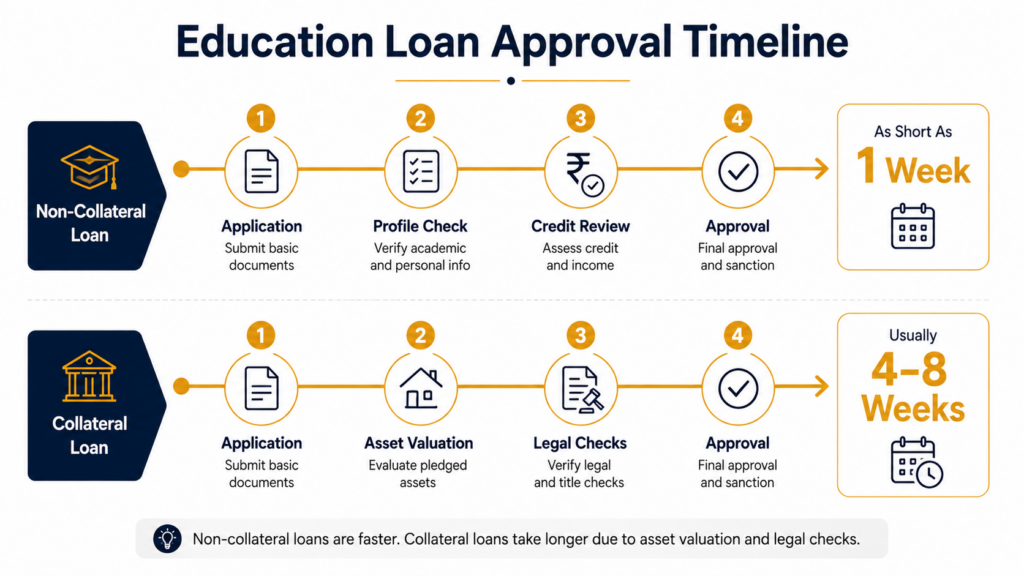
| Duration of processing | Longer since it has to be valued and checked by the law courts | Faster, and sometimes in a couple of weeks. |
| Best Suited To | Families with property or fixed deposits | Students without property who have good academic records. |
| Approval Criteria | Asset value and co-applicant background | University rankings, school record, co-applicant income. |
Such a table illuminates the practical distinction between collateral vs non-collateral education loan. Neither is universally better; the appropriate choice can be determined by the financial capabilities of your family. When learners request us to resolve the debatable issues of secured vs unsecured education loans, we would always begin by comparing them in this table.
Considerations of Interest Rate in collateral vs non-collateral education loan.
The factor that usually determines the choice between secured and unsecured education loans is the interest rate.
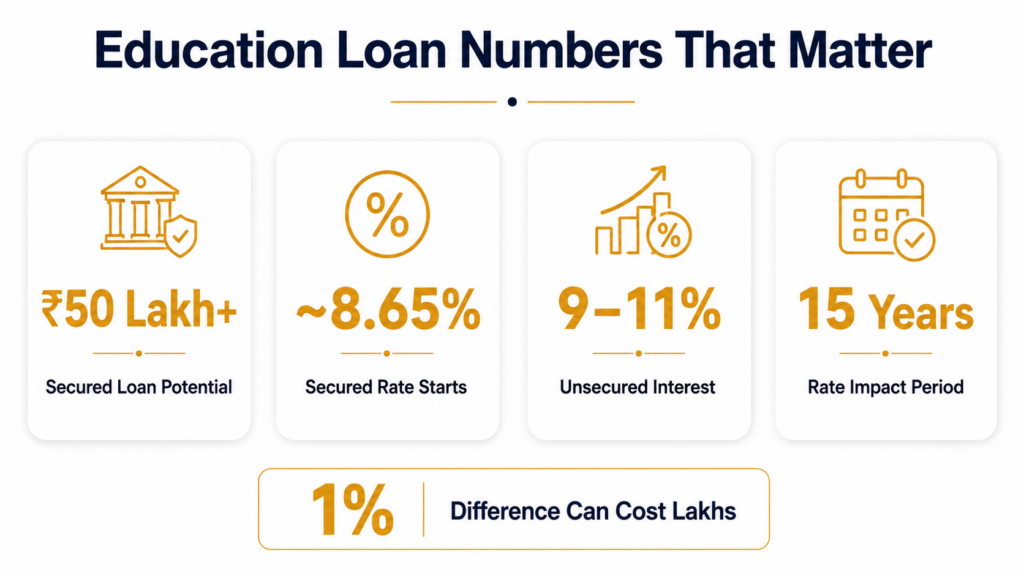
- Collateral education loans normally begin at a lower rate; usually around 8.65 per cent for qualified borrowers.
- Typical non-collateral education loans have interest rates of between 9 and 11 per cent depending on the loan provider.
- A one per cent change in rate can cost lakhs of rupees in a tenure of 15 years.
- The floating rates vary according to RBI policy; therefore, check your EMI schedule after some time.
And this is the very reason that the interest rate must never be used as a basis of the comparison between the collateral vs non-collateral education loan. As important are the speed of approval, amount of loans, and the repayment flexibility.
Collateral vs Non-Collateral Loan: Eligibility Requirement.
Being able to comprehend the distinction between collateral vs non-collateral education loan eligibility for a loan will aid you in making a better application towards a secured or unsecured education loan.
The secured education loans may be open to those requiring the following:
- The student has to have ensured that he has been accepted in a foreign university.
- There must be a stable source of income by a co-applicant, who is typically a parent or a guardian.
- The titled asset should be legal and valuable.
- Past competence in the form of past qualifications must be recorded in academic records.
To qualify for unsecured education loans, the following are usually required:
- Acceptance at a university that is in the list of premier institutions of the lender.
- Good academic achievement and standardised test performances where it is possible.
- A co-applicant who has a healthy credit history and is financially stable.
- There are no major loans outstanding that may potentially impact repayment.
Parents have been telling us that it became a lot easier to comprehend the loan process once they talked to our experts about which eligibility route was appropriate to them.
Which Education Loan Is Better for You?
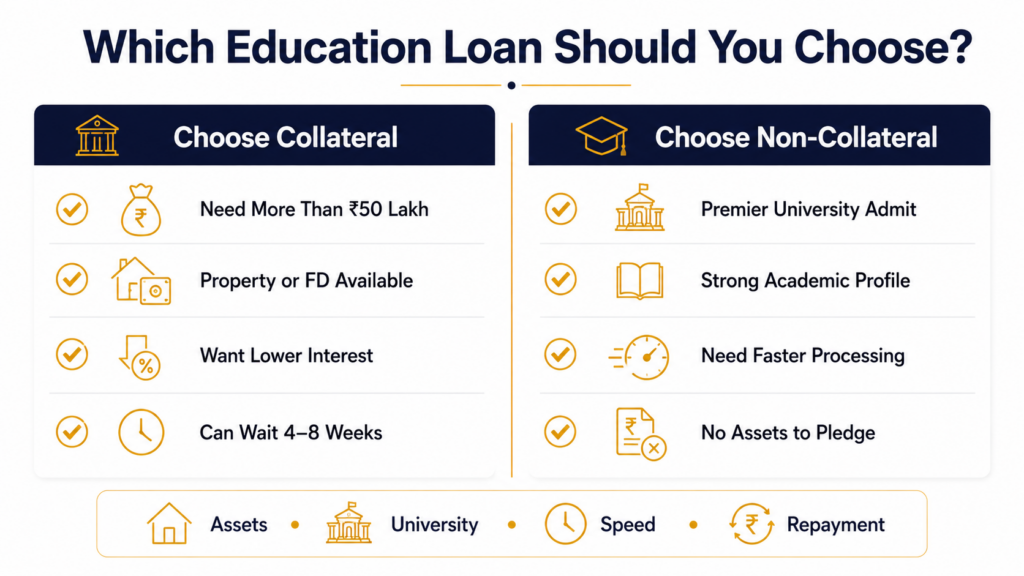
Does it properly depend on your assets, university, and comfort of repaying your loan to determine which education loan, collateral or non-collateral, is better than the rest? There is no definite answer to the question of what kind of collateral vs non-collateral education loan, is better than the rest, as it all depends on your assets, university and your comfort level with repayment.
Select a Collateral Loan When
- A high-cost destination will require you to take a loan of more than ₹50 lakh.
- The property or the fixed deposits of your family can be pledged safely.
- You wish the interest rate to be as low as possible within a 15-year period of time.
- You wish to wait four to eight weeks to be approved and paid.
Choose a Non-Collateral Loan If
- Your admit is in an approved list of a premier university of a lender.
- You possess a good academic profile and an accepted letter of admission.
- You need it processed quicker, perhaps in a week or two.
- Your family has neither property nor fixed deposits to pledge.
Whenever students enquire of us whether this type of student loan is better than the other, our advice would always be to compare between different lenders instead of going to one bank. A student of ours just obtained suitably low-cost capital in a loan granted by SBI after comparing several lenders with our service, saving time and interest.
The influence of collateral on the approval of loans and interest rates.
There is a direct correlation between collateral and the speed of approval, as well as the interest rate, in the comparison of collateral vs non-collateral education loan. It is the only major consideration that lenders consider before approving a secured or unsecured loan.
- Pledging an asset cuts down on the risk for the lender, and you end up paying less interest.
- Secured loans have a higher borrowing limit; they can be used in places with high costs, such as the USA or UK.
- Non-collateral loans depend more on the income and credit score of the co-applicant.
- Limits with collateral limits of up to ₹4050 lakh will be offered by public sector banks to select university admits without collateral.
- Most banks demand a partial or full pledging of assets beyond that collateral-free limit.
I imagined that obtaining an education loan would be a pain, but one student who compared secured and unsecured paths with our team told me that Gateway International clarified all the possibilities and assisted me in the selection of the appropriate bank.
Documents Necessary for Collateral vs Non-Collateral Education Loan.
Documentation varies in a few ways, based on the direction you take in the collateral vs non-collateral education loan procedure.
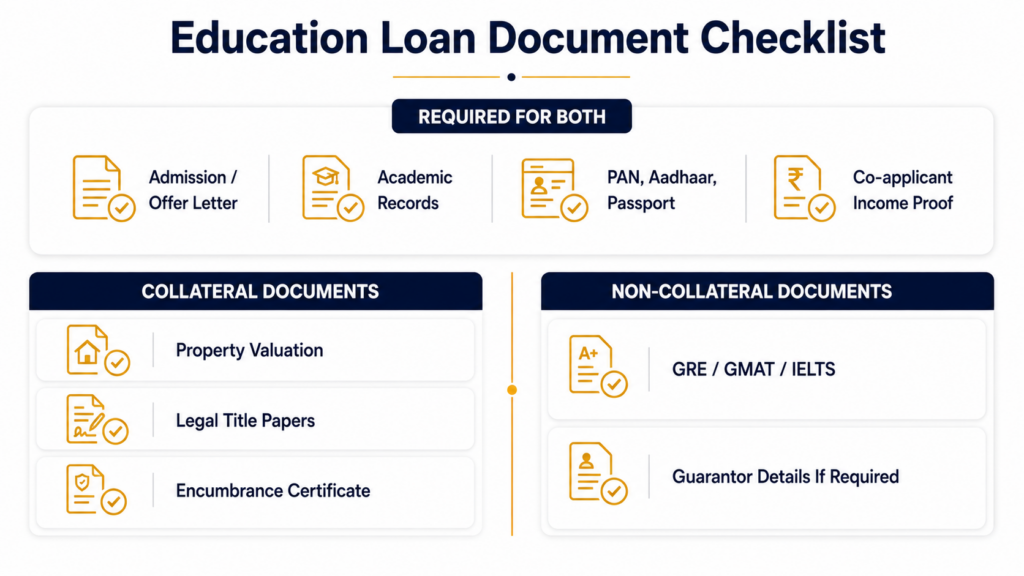
Documents that are similar in both types of loans:
- University in the foreign country: admission letter or offer letter.
- Past qualification academic mark sheets and certificates.
- KYC documentation will consist of PAN card, Aadhaar, and passport copy.
- Evidence of the source of income of co-applicant spouse, in the form of salary slip, income tax, etc.
Other forms of papers required as collateral for education loans:
- Appraisal of property by a bank valuer approved by the bank.
- Legal title papers that indicate that the asset is clear.
- Encumbrance certificate showing that there are no loans on the property.
Other documents relating to non-collateral education loans:
- Normalised test scores like GRE, GMAT or IELTS where necessary.
- Additional details of co-applicant or guarantor in case requested by the lender.
One of the greatest reliefs was that of comparing several banks without actually going to each one of them so as to apply for their child, which is in the documentation process.
Common Mistakes Students Make When Choosing Between Secured and Unsecured Loans
Such errors should be avoided to get a far better loan approval irrespective of whether you are on the secured or unsecured side of the education loan deal.
- Submitting to a single bank rather than going through and comparing offers by various lenders.
- Disregarding the overall moratorium interest that accrues over the study phase.
- Applying a low valuation of the property granting collateral education loans.
- Ignoring the collateral-free options for admission to top universities.
- Filing incomplete documentation, which greatly postpones sanction and disbursement.
Loans and Scholarships: A Smart Combination
Scholarships will substantially abate your reliance on either side of your collateral vs non-collateral education loan equation.
- A partial scholarship helps you have less loan amount and overall interest.
- There are lenders with more favourable terms in case a part of tuition is a scholarship.
- Taking a non-collateral loan in combination with a scholarship will reduce the overall cost of EMI.
- Always inform your lender about scholarship details in the process of applying.
Financial Planning Pre-Application.
No matter which way your collateral vs non-collateral education loan choice will end up, good preparation will enhance approval opportunities as well as long-run repayment comfort.
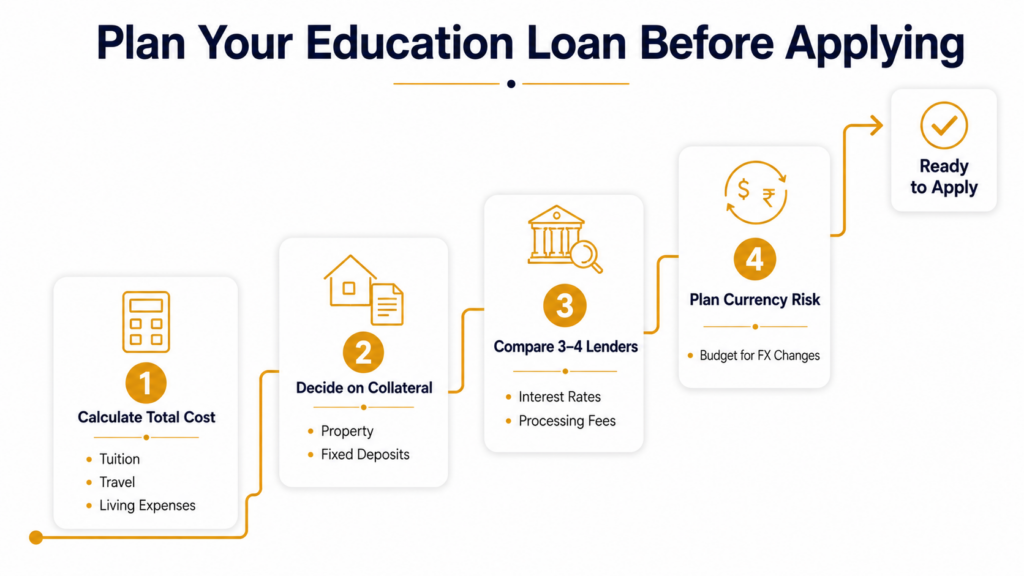
- Divide your total cost of education (tuition, travel, and living expenses).
- Make a decision at an early stage on whether your family will provide an asset in the form of collateral.
- Chase at least three to four lenders in terms of interest rates and processing fees.
- These are the changes in currency that you must consider in budgeting your loan and repayment.
At Gateway International, it is precisely in these areas that we offer our loan eligibility service, documentation, and repayment planning with no extra service fee charged to students.
FAQs
Who can avail a study abroad education loan?
Students who have a confirmed acceptance of university admission, as well as a co-applicant who is financially well off, are usually able to receive both collateral vs non-collateral education loan.
Which is the best collateral vs non-collateral education loan?
This is based on assets and requirements in funding. Collateral loans are more appropriate for larger sums at reduced rates, whereas non-collateral loans are best in the case of students who have no pledged assets.
Is it possible to get a loan without collateral?
Yes, there are numerous banks and NBFCs which provide non-collateral education loans up to 40-50 lakh to those students who are admitted to top foreign universities.
Which bank offers education loans to study overseas?
Other top lenders which provide secured and unsecured options include SBI, HDFC Bank, Bank of Baroda, Axis Bank, InCred, and IDBI Bank.
How long is the loan approval process?
Non-collateral loans can be approved within a short period of time, as short as one week, whereas collateral education loans may take four to eight weeks to be approved because of asset valuation.
Will scholarships decrease my education loan?
Yes, scholarships reduce the total funds you need to borrow and may add to your overall comfort of repaying the loan during the loan term.
What do we need in terms of documents?
Both types of loans require an admission letter, academic record, KYC documents and proof that you have co-applicant income, and also will require property papers in case of secured loans.
Conclusion
The choice between collateral vs non-collateral education loan depends on the assets your family holds, the university of your choice and the speed at which you require your money to come through. The right choice of both secured and unsecured education loans can sustain an excellent study abroad experience. It is usually not a case of either collateral vs non-collateral education loan, but one that best suits your particular situation. Talk to our specialists to discover the proper loan to finance your study abroad plans, and allow Gateway International to make the entire financing process a lot easier.
Pingback: Education loan for Singapore university India
Pingback: education loan for study in Europe from India
Pingback: Explore education loan for MBA abroad from India