Thousands of Indian students pose the same question before they submit an application to a foreign university each year: will a bank grant me a loan? Eligibility to take an education loan is based on your educational history, the income of your co-applicants, collateral and the course of study you select, and most of the rejections occur because families never bother to look at them at the right time. We have been helping thousands of students to do the education loan process at Gateway International over the years, and one trend has been evident: most students will assume that they will not qualify long before they even check. This guide breaks down education loan eligibility bank by bank, clarifies who can get an education loan for abroad support and provides you with a practical self-check so that you can apply with confidence rather than go by guessing.
Why Education Loan Eligibility is More Than Ever.
Indian students are borrowing to an extent never before to finance international degrees. Indian students overseas are estimated to be more than a million by the Ministry of External Affairs, and the NBFC loan books are estimated to increase by about 20% this fiscal year. The result has been a tightening of banks in their evaluation of the education loan eligibility.
There are several students who we have had to help realise that they are eligible to obtain a loan; otherwise, they thought that they would not qualify at all. According to one of the students:
I believed that an education loan would be hard to get; however, Gateway International clarified all the possibilities and assisted me in selecting the appropriate bank.
The sooner you know your status, the more time you have to seal existing loopholes, introduce a more solid co-applicant, or consider collateral-free solutions, before your visa runs out.
What makes you eligible to have an Education Loan?
Lenders do not consider a single factor. A number of moving components collaborate to influence the final decision.
Academic Profile and Course.
- The regularity of the school history is an indicator of payment discipline to a majority of lenders.
- The visa to a recognised, full-time course in a foreign country is a precondition which cannot be negotiated.
- University loans at globally ranked universities are more readily approved and in more substantial quanta.
- Most banks are favourable towards STEM, business and healthcare courses.
Co-Applicant and Income
- Most education loans require a co-applicant (typically a parent or guardian).
- An increase in co-applicant income that is more stable directly increases the education loan eligibility.
- An excellent co-applicant credit score will help open the door to lower interest rates and quick approval.
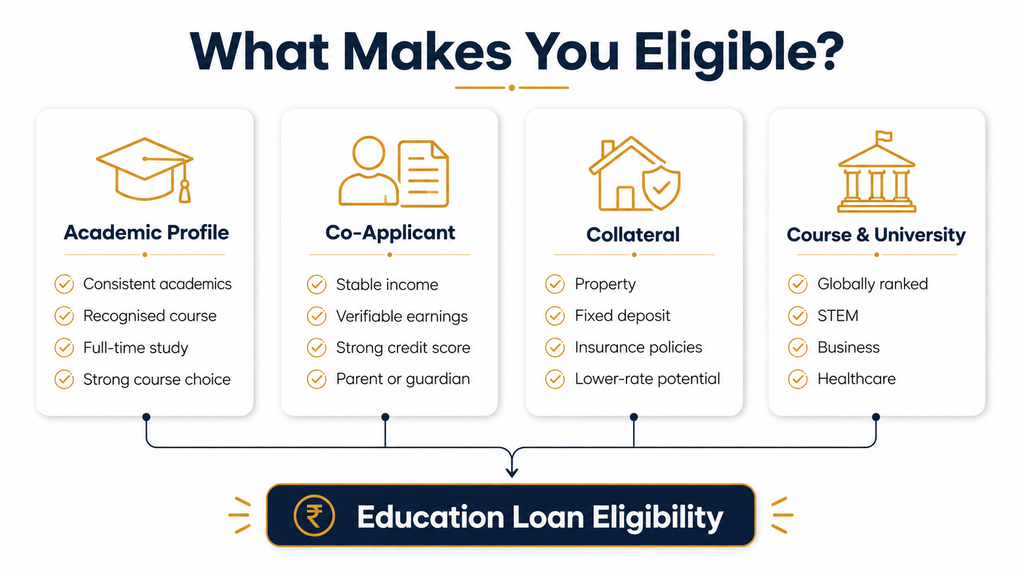
Collateral vs Non-Collateral
- Secured loans that are secured with property or fixed deposit are normally of a lower interest rate.
- Loans without any collateral can be offered, but they are usually limited to a smaller loan amount.
- As an example, SBI provides loans without collateral up to a specified limit, after which it secures the loan.
Education Loan Eligibility Criteria: Bank-wise overview.
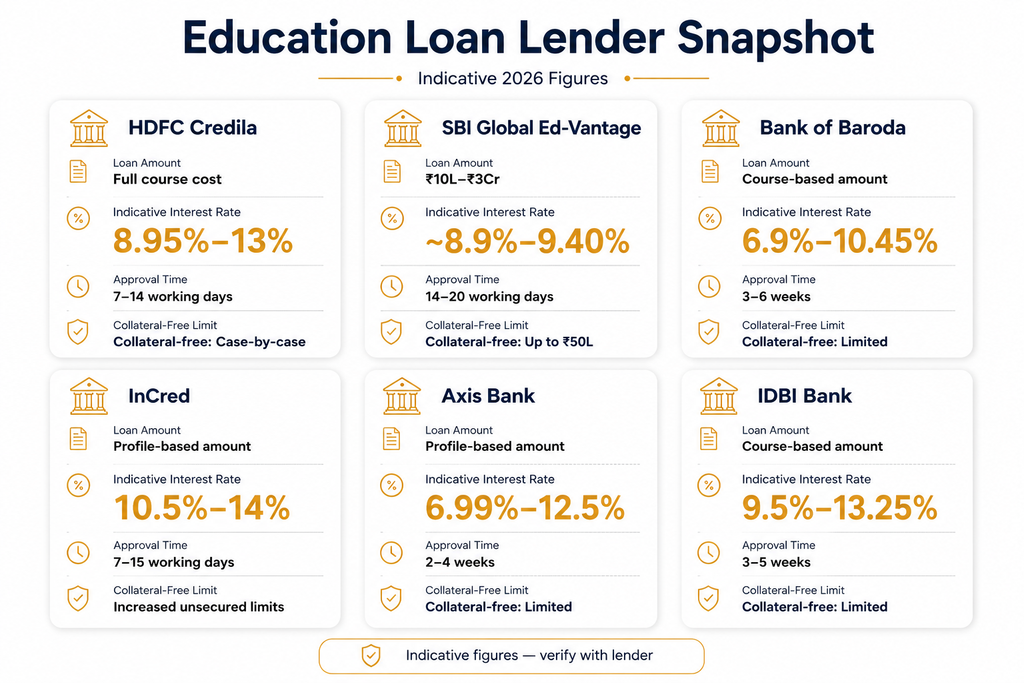
The quickest method to comprehend where you are being by contrasting lenders. The following is estimated comparison of published rates as of 2026; never assume that the current rates are the same as shown here without checking them with the bank itself.
| Bank / Lender | Loan Amount Range | Indicative Interest Rate (Estimated) | Normal Approval Time | Collateral-Free Limit |
| HDFC Credila | Up to full course cost | 8.95 – 13 % | 7- 14 working days. | Case-by-case |
| SBI (Global Ed-Vantage) | ₹10 lakh – ₹3 crore | ~8.9%–9.40% p.a. | 14–20 working days | Up to ₹50 lakh |
| Bank of Baroda | Varies by course | 6.9 – 10.45 % | 3–6 weeks | Limited |
| InCred | Depends on profile | 10.5 – 14 % | 7- 15 working days. | Increased unsecured limits |
| Axis Bank | Depends on the profile of the bank | 6.99 – 12.5 % | 2-4 weeks. | Limited |
| IDBI Bank | Depends on the course taken | 9.5 – 13.25 % | 3-5 weeks | Limited |
A student of ours recently had a funding done by SBI after comparing various lenders on our site and ended up with a considerable amount of money saved in terms of overall interest paid over the tenure of the loan.
Secured vs Unsecured Education Loans.
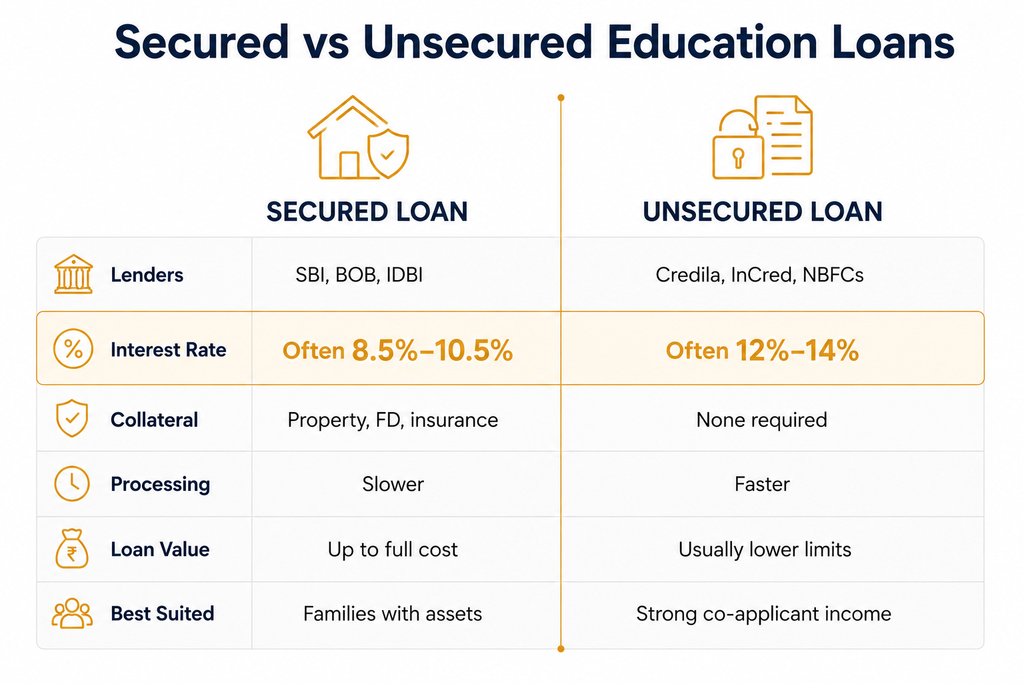
Pursuing secured and unsecured loans directly influences your education loan eligibility result, as each option fits a specific financial profile.
| Factor | Secured Education Loan | Unsecured Education Loan |
| Normal Lenders | Bank of Baroda, SBI, IDBI Bank | HDFC Credila, InCred, other non-bank financial corporations. |
| Typical Interest Rate | Lower, often 8.5%–10.5% p.a. | Higher, often 12%–14% p.a. |
| Collateral | Property, fixed deposits or insurance policies | None required. |
| Processing Time | Slow, because of collateral valuation | Quick, little paperwork. |
| Value of the Loan | Greater, to full cost of the course | Generally limited by a lower limit. |
| Best Suited To | Families having property or FDs to pledge | Students who have no assets but have good incomes on co-applicants. |
Comparing several banks without going to each individual one is the greatest relief we have ever heard of, and we have heard it more than once, with families setting their scales between the secured and the unsecured.
Do I qualify to take an Education Loan? Self-Check and Ways to Improve It
These two areas can be used to determine your education loan eligibility and where your profile needs to be improved before applying.
Determine Your education loan eligibility
- Co-applicant: Stable and verifiable source of income.
- Admission: Accepted invitation of a recognised foreign university or college.
- Repayment: Collateral or a high-income-based repayment scheme.
- Schoolwork: No significant gaps or failures in schoolwork history.
- Course & tenure: The course should be of the length needed by the lender for the loan.
When the majority of them are met, you can probably be eligible to apply for education loans. The ultimate choice will be based on the criteria of the lender and your financial and academic profile.
Enhance Your Loan Eligibility
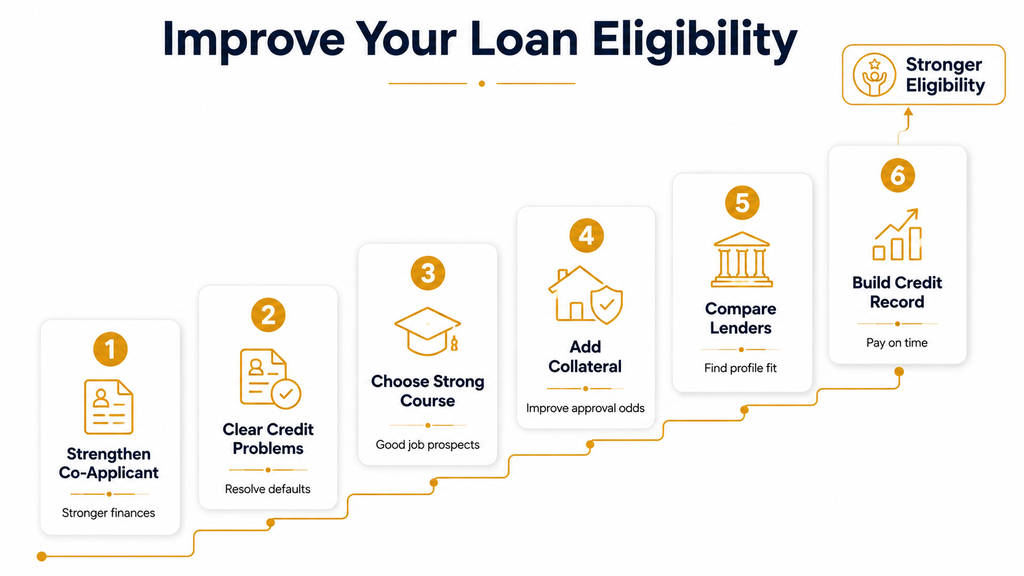
- Include a co-applicant with more solid finances and earnings.
- Clear credit problems or current defaults prior to application.
- Select a course that has good employment prospects.
- Use collateral to enhance the chances of approval and get lower rates.
- Compare lenders to identify eligibility criteria that fit your profile.
- Establish a good credit record by making payments on time.
Early checking of these factors can assist in enhancing your education loan eligibility, filling in any gaps and having a higher likelihood of getting the right terms of the loans.
Who Can Get an Education Loan to Study Abroad?
Another myth is that it is only students in the top percentile who do. In the real world, the people who can find an education loan for overseas assistance are not as limited as most people think.
- Students who were accepted into full-time undergraduate, postgraduate or diploma programmes in foreign countries.
- Active employees who have additional education and have evidence of admission and earnings.
- Uncollateralized students, as long as they present good co-applicant income and credit.
- Students who have applied to other countries such as the USA, UK, Canada, Australia, Germany, and Ireland.
- Parents usually explain to us how it has now become much easier after talking to our experts, especially on who can get an education loan for abroad support versus one who believes that he can not.
Mandatory Documents to check your Eligibility.
Among the most frequent reasons that make applications delayed or questioned during the process are documentation gaps, despite meeting the education loan eligibility criteria.
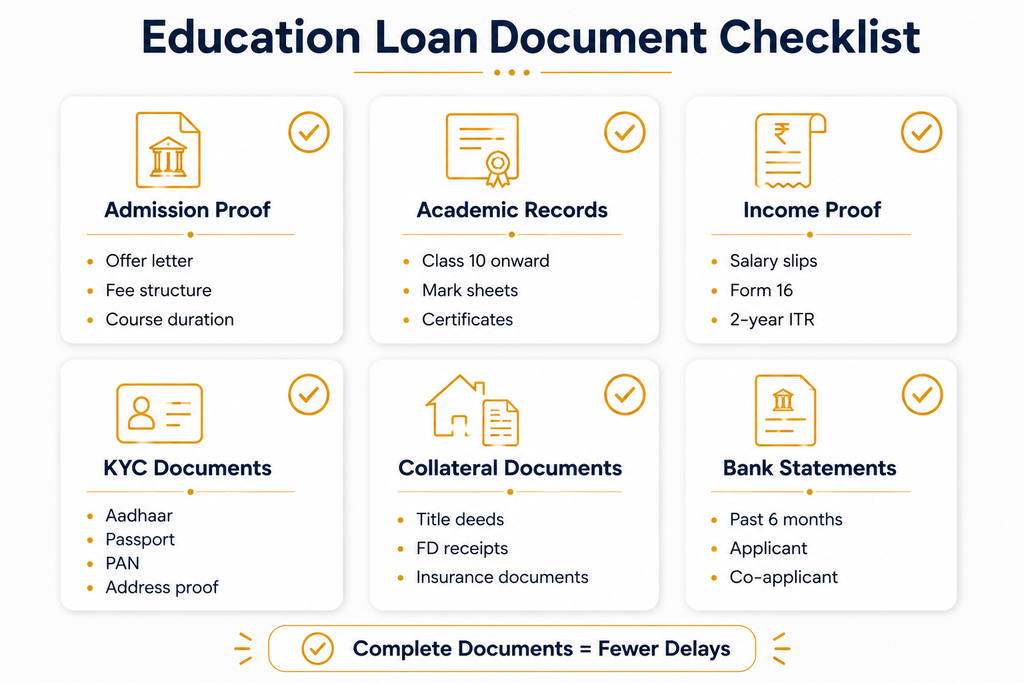
- Evidence of admission: Your university offer letter, university fee structure and duration of course.
- Academic: Your academic mark sheets and certificates of Class 10 to your latest qualification.
- Income evidence of co-applicant: Your salary slips, Form 16 or 2 years of income tax returns.
- KYC documents: Aadhaar, passport, PAN, address proof of both applicant and co-applicant.
- Collateral documentation: title deeds, FD receipts or insurance documents, as appropriate.
- Bank statements: Your past six months of both applicant and co-applicant accounts.
Mistakes to Avoid that affect your Eligibility criteria
These mistakes can be avoided to save your approval action against needless setbacks and delays.
- Applying for an education loan can be influenced by applying prior to obtaining a confirmed university offer.
- Selecting a co-applicant who is financially weak can decrease your education loan eligibility.
- Failure to submit complete documents may slow down the approval process and affect access to education loans.
- High debts or poor credit scores may adversely influence education loan eligibility.
- Postponing collateral valuation may cause issues with sanction and university deadlines.
- Submitting an application to a single lender can reduce superior loan opportunities and chances of approval.
- Selecting a university or course which is not supported may decrease the amount of your education loan.
- Providing the wrong financial information can result in a check-up problem or refusal of the loan.
- Lender-specific requirements are requirements that can be overlooked, which slows down the processing and jeopardises your education loan eligibility.
Scholarships and Loans: Reducing Your Loan Debt.
Scholarships do not eliminate the eligibility check but have a significant impact in decreasing the reliance on borrowed funds and may shorten your repayment process.
- Scholarships will save you the cost of borrowing money and enhance your education loan eligibility.
- Merit-based scholarships can enhance the financial picture and help in getting education loans.
- The use of a combination of both scholarships and loans can lower the period of repayment and the general interest charges.
- The amount of education loan that you require can be reduced with the help of government and university scholarships.
- Disclosure of scholarships can be beneficial in your application for education loans.
- Scholarships may lessen the financial burden on students and their co-applicants.
- The reduced education loan will be easy to repay once the graduation period is complete.
- Early scholarship research assists in knowing the real need for an education loan.
- There are several scholarships that can also lessen your total burden of education loans.
What Interest Rates are and how they affect Eligibility
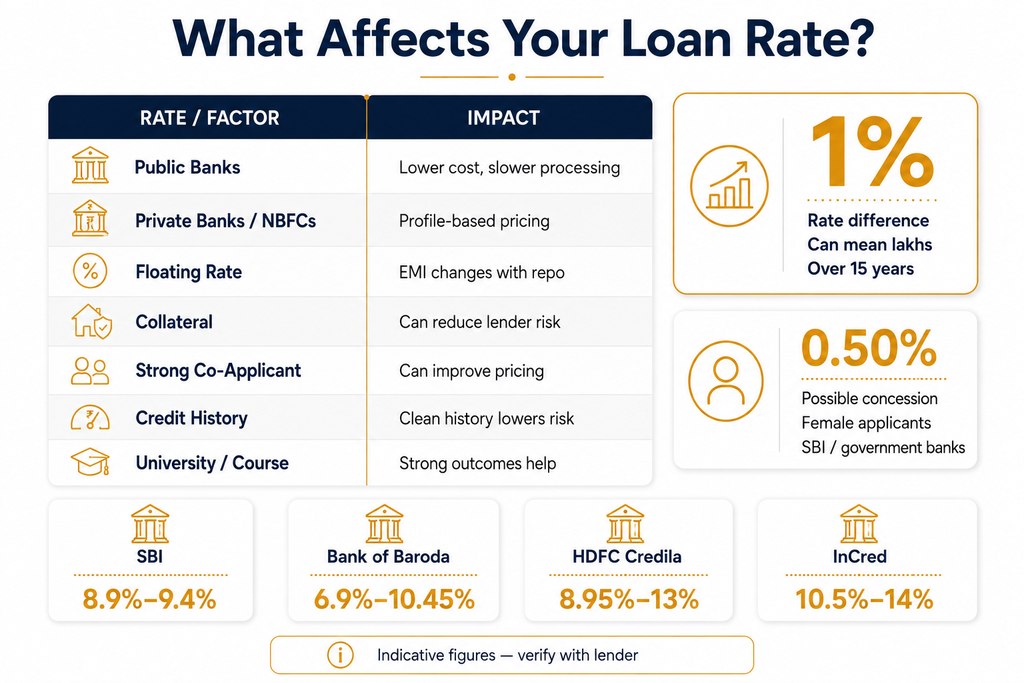
| Category | Key Information | Factor | Impact |
| Rate Structure | SBI 8.9 – 9.4 % /Bank of Baroda 6.9 – 10.45 %- tend to be slower. | Public banks | Less expensive, extended processing. |
| Rate Signal | Both lower perceived risk and higher rate imply more lender uncertainty. | Interest rate | Indicates strength of loan eligibility/profile. |
| Rate Structure | HDFC Credila 8.95 – 13 % /InCred: 10.5 – 14 % risk-based rate. | Private banks/NBFCs | Depends on the profile of the applicant. |
| Rate Structure | Typically associated with the RBI external benchmark. | Floating rate | EMI changes with repo rate. |
| Rate Drivers | Property/FD will open lower rates. | Collateral | Reduces lender risk. |
| Rate Structure | Provided by a few NBFCs; typically more expensive in the short term. | Fixed rate | Predictable throughout tenure. |
| Rate Drivers | Pricing can be enhanced by higher, reported income. | Co-applicant | Strengthens eligibility. |
| Cost Impact | Even on 25-30 lakh, 15 years’ interest can accrue several lakhs. | 1% difference | Minor variations in rates are important. |
| Rate Drivers | The 0.50% concession is normally provided by SBI and other banks that are run by the government. | Female applicant | Reduces borrowing cost. |
| Refinancing | RBI regulations prohibit foreclosure fees on floating rate loans since 2026. | Prepayment | Enables penalty-free refinancing. |
| Rate Drivers | Universities or courses with high outcomes which are ranked globally might receive better rates. | University/course | Improves risk assessment. |
| Strategy | Obtain a quicker NBFC loan, refinance with a sanctioned public bank. | Two-step loan | Blends speed and reduced rates. |
| Rate Drivers | Clean applicant/ co-applicant credit history reduces the risk premium. | Credit history | Can improve pricing. |
The way Gateway International can help you check eligibility.
When you partner with Gateway International, you will receive end-to-end assistance in education loan eligibility disbursement. Having 15+ years of experience and 23,000+ students tutored in the USA, the UK, Canada, Australia, Germany, France, Italy, Ireland, Dubai, New Zealand and Europe, the following is what we can offer.
- Compare two or more lenders to determine the options that suit your needs and education loan eligibility.
- Get professional advice to process quickly and have higher chances of getting education loans.
- Receive complete education loan assistance without additional service charges or hidden fees.
- Get end-to-end support with education loan eligibility evaluation and final loan disbursement.
- Compare banks in terms of interest rates, terms of repayment, academic profile and the funding requirements.
- Know about the education loan eligibility, documentation, collateral and the method of repayment with professional guidance.
- Compare education loan options to obtain competitive interest rates and terms of repayment.
- Request someone to help you with documentation to eliminate unwarranted delays in the process of obtaining an education loan.
- Get professional guidance in the process of obtaining an education loan, including application and ultimate disbursement.
- Get a free consultation with our advisory team on whether you qualify to obtain an education loan.
FAQs
Am I eligible for an education loan if I don’t have collateral?
Yes, even students without collateral can still qualify under collateral-free programs, as long as the income of the co-applicant is high.
Who qualifies for a study abroad education loan?
Education loan eligibility to finance study abroad are usually set with students who have a confirmed university offer, a co-applicant and the required documents.
Who will be able to take an education loan to study in a foreign country without a co-applicant?
There is almost no lender that does not require a co-applicant, as it comprises the essence of who can get approval for an education loan for studying abroad.
What banks offer education loans for studying abroad?
Some of the typical banking partners of overseas education loans include SBI, HDFC Bank, Bank of Baroda, Axis Bank, InCred, and IDBI Bank.
What is the time taken to approve loans?
The process takes one to six weeks to be approved based on the lender and whether the collateral is to be valued.
Will scholarships decrease my education loan?
Yes, a scholarship will decrease the overall loan principal required, and that can also facilitate your evaluation of an education loan.
Conclusion
Early verification of education loan eligibility eliminates the element of guessing in an already straining admissions calendar, and it places you in charge of the whole process. With or without collateral, great co-applicant or small, there is a lender profile that suits you once you compare; do it early. Secured loans would be best with families that have assets to pledge, whereas unsecured loans would be best with students who have good co-applicant income and a clear credit history. Check the rates of education loans in various banks, prepare your papers and account for any missing ones well in advance before your visa expires. Fancy funding your overseas education? Get a free personalised assessment of your education loan eligibility to get an education loan today, with a Gateway International expert.
Pingback: What Most Students Don't Know About an Education Loan for PhD