A practical guide for Indian students, parents and co-applicants to verify lenders, agents, sanction documents, fees and payment requests before sending money or sharing sensitive information.
A convincing WhatsApp message, polished sanction letter or confident “approval” call does not prove that an education loan is genuine. The safest response is to verify the lender, intermediary, document and payment channel independently before you act. These education loan fraud and scam alerts for students help Indian families recognise warning signs without wrongly assuming that every fee or unfamiliar agent is fraudulent.
RBI’s digital-lending rules cover credit assessment, borrower disclosures, digital-lending relationships and fund flows. RBI has also warned about impersonation, fake accreditation and attempts to obtain sensitive credentials. Read the RBI Digital Lending Directions, 2025
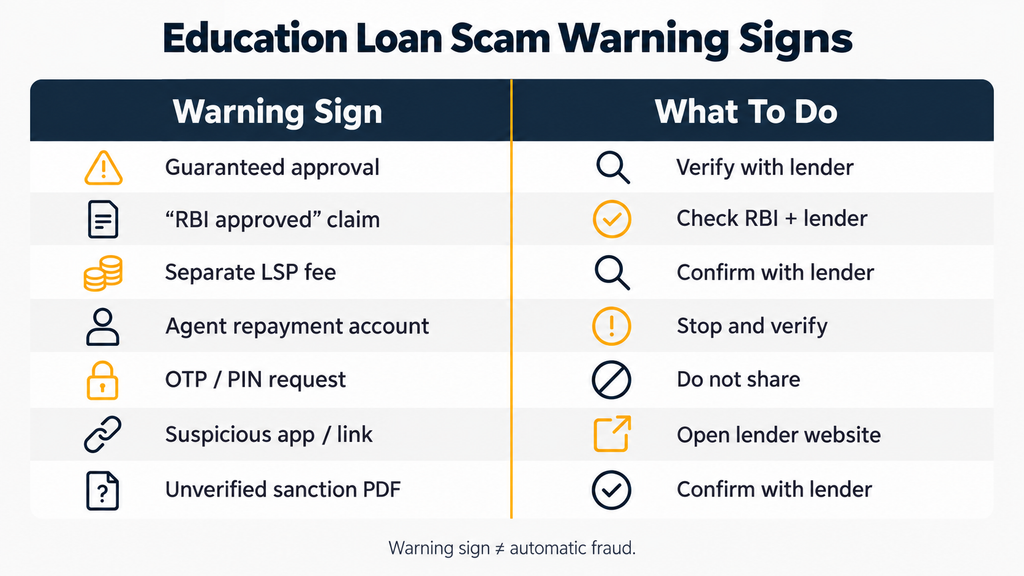
Education Loan Scam Warning Signs at a Glance
| Situation | Why it needs checking | What to do |
| “100% guaranteed approval” | An agent’s promise is not the lender’s underwriting decision | Verify directly with the lender. |
| “RBI approved agent/app” | RBI warns about fake accreditation claims | Check RBI and the lender. |
| Separate digital LSP fee | RBI says LSP fees are paid by the regulated entity | Confirm with the lender. |
| Repayment to an agent account | Digital-lending rules generally require direct fund flows | Stop and verify. |
| OTP, PIN or password requested | RBI warns against sharing these with unidentified persons | Do not share. |
| Suspicious app/link | The claimed relationship may be false | Find the lender website independently. |
| Unverifiable sanction PDF | Appearance is not proof | Ask the lender to verify it. |
These education loan fraud and scam alerts for students are verification triggers, not automatic proof of fraud.
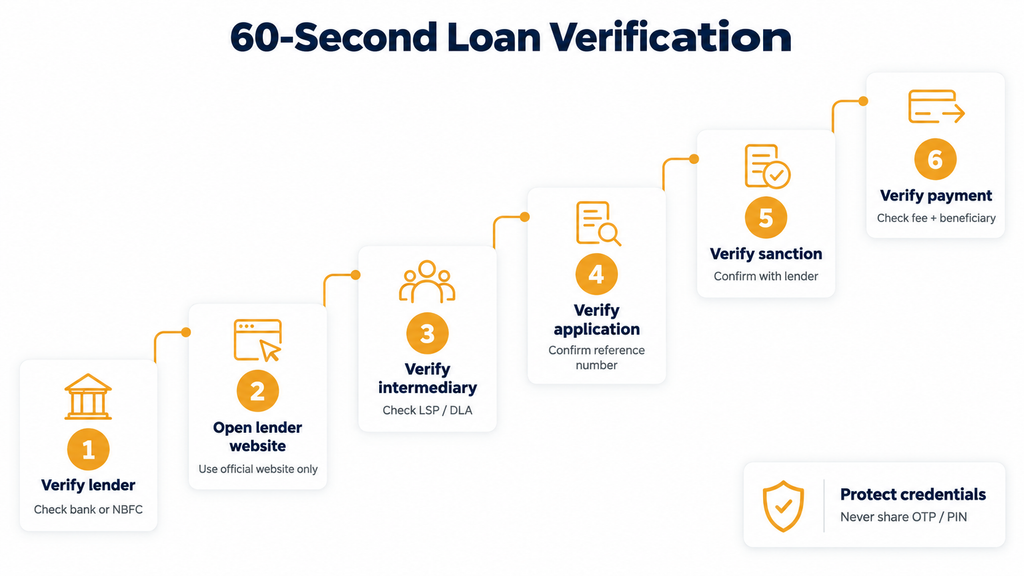
60-Second Verification Checklist Before You Pay
Before transferring money, signing or sharing sensitive data:
- Verify the lender. Check the claimed bank or NBFC through RBI resources.
- Open the lender’s website yourself. Do not rely only on the agent’s link.
- Verify the intermediary. For digital lending, check the lender’s disclosed LSP/DLA relationship.
- Verify the application. Confirm that your reference number exists.
- Verify the sanction document. Use contact details from the lender’s own website.
- Verify the fee. Check the applicable official loan documents.
- Verify the beneficiary. Confirm the payment account before transferring money.
- Protect credentials. Do not share your PINs, OTPs, banking logins or passwords with any unidentified person.
For education loan fraud prevention, verify first and pay second. These education loan fraud and scam alerts for students work best when followed in this order.
How to Verify the Lender and Loan Agent
Students searching how to verify loan agent India often start with the person. Start with the institution.
1. Confirm the bank or NBFC
If somebody claims a bank or NBFC is issuing your loan, check the institution through RBI’s official regulated-entity resources. Do not treat an agent’s visiting card, screenshot or certificate as proof.
Check RBI Regulated Entities
Check RBI’s registered NBFC information
2. Check the lender’s own digital-lending disclosures
Under RBI’s Digital Lending Directions, a regulated entity using a Lending Service Provider must have a contractual arrangement with it and publish relevant LSP/DLA information.
This is a key education loan fraud and scam alerts for students check because “authorised partner” remains only a claim until independently confirmed.
3. Contact the lender independently
Use customer-care details from the lender’s own website and ask:
- Does my application/reference number exist?
- Is this intermediary connected to you?
- Is this sanction communication genuine?
- Is this fee part of the loan process?
- Is this payment destination correct?
For anyone researching how to verify loan agent India, lender confirmation is stronger than an agent’s self-issued proof.
How Can You Check Whether a Loan Approval Is Genuine?
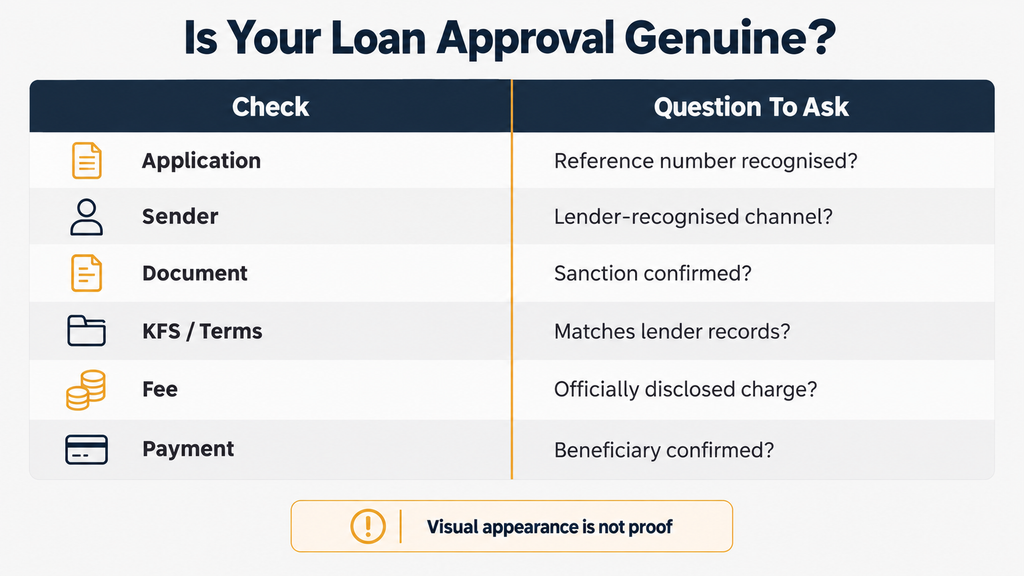
A professional PDF can still be fake. Do not judge authenticity by logo, colour, signature image or formatting.
For covered digital lending, documents including the KFS, sanction letter and terms are required to flow through registered and verified channels as applicable. RBI’s KFS framework also requires key loan facts and the annual percentage rate, or APR, for covered loans. Read RBI’s Key Facts Statement rules
| Check | Question to ask |
| Application | Does the lender recognise my application/reference number? |
| Sender | Is the communication through a lender-recognised channel? |
| Document | Does the lender confirm the sanction document? |
| KFS/terms | Do the terms match the lender’s records? |
| Fee | Is the charge disclosed and payable through an official route? |
| Payment | Is the beneficiary confirmed by the lender? |
For education loan fraud and scam alerts for students, independent lender confirmation is more useful than visual inspection.
Is Every Upfront Processing Fee a Scam?
No. That would be misleading.
A legitimate lender can have disclosed fees and charges. RBI’s KFS framework requires loan-cost disclosures and restricts undisclosed charges. Under RBI’s digital-lending framework, fees payable to an LSP must be paid by the regulated entity rather than separately collected from the borrower.
This distinction matters for education loan fraud and scam alerts for students. “Fee requested” does not automatically mean “fraud”.
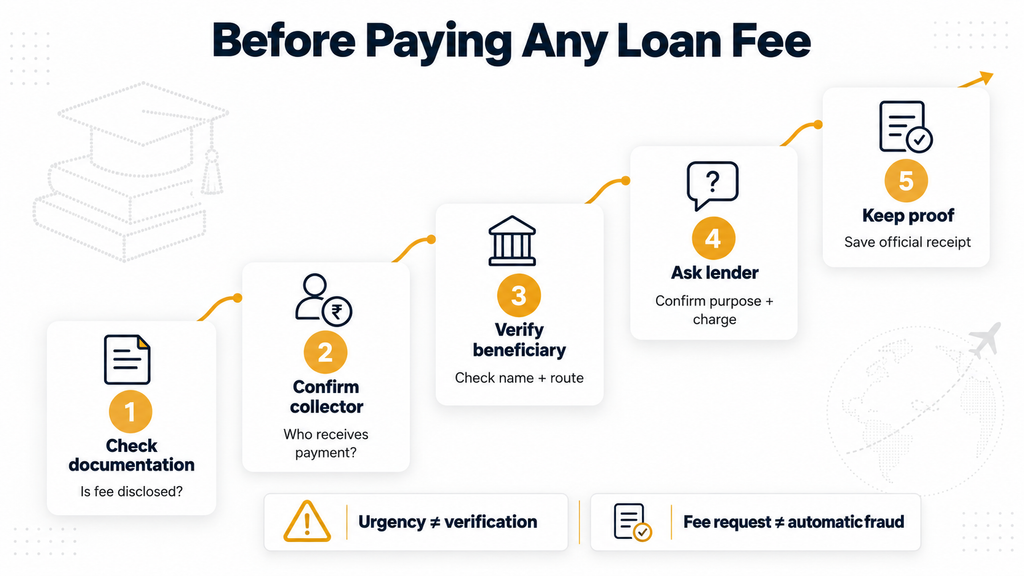
Before paying any fee
- Check whether it appears in official loan documentation.
- Confirm who is collecting it.
- Verify the beneficiary name and payment route.
- Ask the lender to confirm the purpose and charge.
- Keep the official receipt or transaction record.
A fake loan agent scam often uses urgency. “Pay now” is not a reason to skip verification.
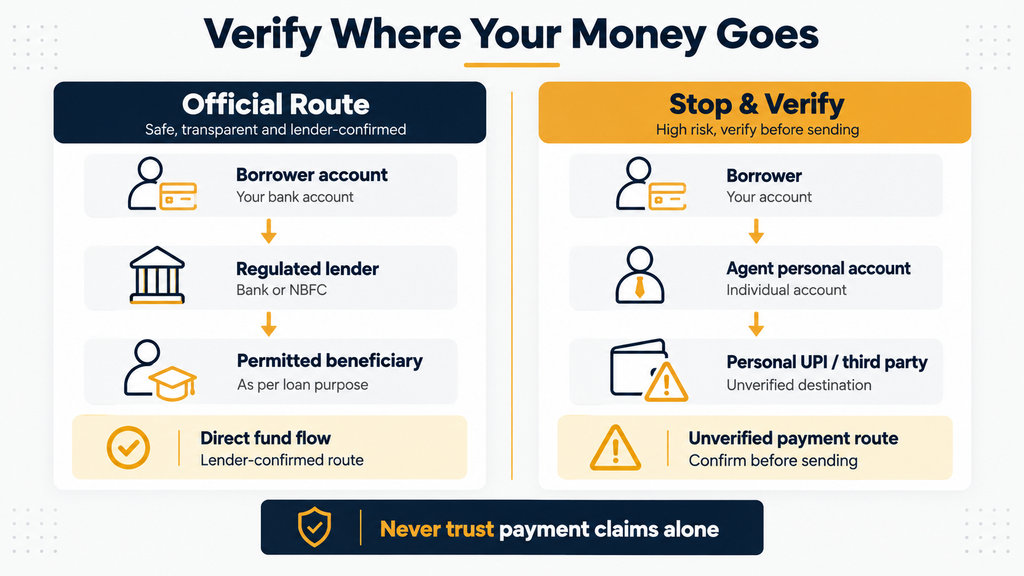
Should Money Go Through an Agent’s Personal Account?
For digital loans covered by RBI’s Directions, disbursal is generally required to go to the borrower’s bank account, subject to specified exceptions such as direct payment to an end-beneficiary for a specific end use. Repayment and servicing are also required to move directly between the borrower and regulated entity without a third-party pass-through account.
So a request to send repayment to an agent’s personal UPI or bank account is a serious verification trigger.
The safest education loan fraud and scam alerts for students rule is simple: never send money merely because the person contacting you says the account is “official”.
What Information do you need to preserve about yourself?
RBI warns individuals against sharing of login credentials, card numbers, PINs, passwords, OTPs or KYC with unknown individuals or via unverified websites/applications.
For digital lending, data collection must be need-based and consent-based. DLAs should not access contact lists, call logs, files/media or telephony functions, subject to limited permitted onboarding/KYC access with explicit consent.
A fake loan agent scam may use “urgent KYC” to demand unnecessary access. Good education loan fraud prevention means checking both who is asking and why.
If you are preparing a genuine application, use Foreign Edu Loans’ education loan document checklist to organise ordinary documentation requirements before sharing files.
Illustrative Example: A Suspicious Loan Offer
A student receives a WhatsApp message from someone claiming to represent a known NBFC. The person sends a sanction PDF, says the loan is “guaranteed”, requests a separate agent fee and provides a personal UPI ID.
The student should not use the sender to verify the sender.
Instead:
- check the NBFC through RBI resources;
- open the NBFC’s website independently;
- verify the intermediary relationship;
- confirm the application and sanction document;
- verify the fee and payment destination.
This education loan fraud and scam alerts for students example is illustrative, not a real borrower case.
What Should You Do If You Have Already Sent Money?
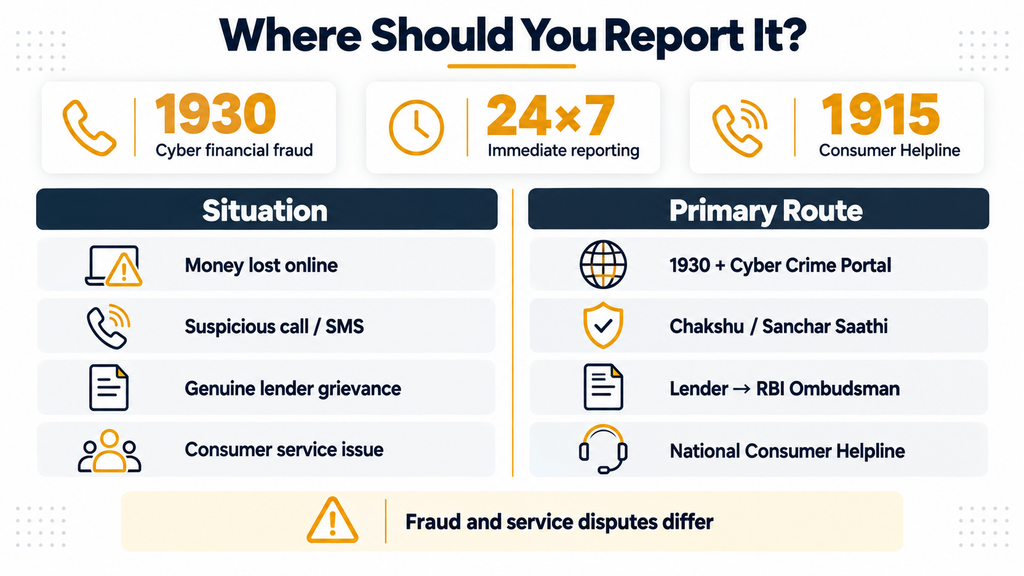
If you have suffered cyber financial fraud, the Government of India’s National Cyber Crime Reporting Portal says to call 1930 for immediate reporting. The portal states that the facility operates 24×7. Open the National Cyber Crime Reporting Portal
Do not spend hours arguing with the supposed agent before reporting the loss.
| Situation | Primary route |
| Money lost through cyber financial fraud | Call 1930 and use the National Cyber Crime Reporting Portal. |
| Suspicious call, SMS or WhatsApp but no loss yet | Use Chakshu on Sanchar Saathi. |
| Service grievance against a genuine covered regulated entity | Use the entity grievance process, then the applicable RBI Ombudsman route where eligible. |
| General consumer-service grievance | National Consumer Helpline may be relevant. |
DoT says Chakshu is for suspected fraudulent communications received through calls, SMS or WhatsApp. It separately directs victims of cybercrime or financial fraud to 1930 or the cybercrime portal. Open Sanchar Saathi
These education loan fraud and scam alerts for students should therefore separate prevention from post-loss action.
What If the Problem Is With a Genuine Lender?
Impersonation fraud and a service dispute with a real lender are different.
The Reserve Bank – Integrated Ombudsman Scheme, 2026 came into force on 1 July 2026 and provides a cost-free mechanism for eligible complaints involving covered regulated entities. Coverage and maintainability conditions apply. Read RBI’s Integrated Ombudsman Scheme 2026 FAQ
For general consumer grievances, the National Consumer Helpline offers 1915 and an online portal. For cyber financial fraud, use 1930/NCRP instead of waiting for an ordinary consumer grievance. Open the National Consumer Helpline
Some Mistakes That Increase Scam Risk
- Trusting the first link or phone number sent by the supposed agent.
- Treating “RBI approved” wording as proof of endorsement.
- Assuming a professional sanction PDF must be genuine.
- Sending money before verifying the beneficiary.
- Sharing OTPs, PINs or passwords for “verification”.
- Assuming every processing fee is fraudulent.
- Applying every digital-lending rule to every offline consultant without checking scope.
- Delaying cyber-fraud reporting while negotiating with the fraudster.
Avoiding these errors is practical education loan fraud prevention and strengthens education loan fraud and scam alerts for students.
Responsible Borrowing Still Matters
A genuine loan can still be unsuitable. After completing education loan fraud and scam alerts for students checks, compare the funding gap, repayment responsibility and co-applicant liability.
If a family member will join the loan, read Foreign Edu Loans’ co-applicant guide and review its Terms and Conditions.
Borrowing Rule: Compare the complete repayment commitment, not only the sanctioned amount.
How Foreign Edu Loans Can Help
Foreign Edu Loans is an education-loan facilitation and guidance platform for international education. It can help students explore options, compare eligible lenders and coordinate documentation and applications.
It does not make the lender’s final credit decision. Final approval depends on the respective lender’s assessment and current policies. This distinction is essential to education loan fraud and scam alerts for students.
FAQs
Can a loan agent guarantee approval?
Do not treat an agent’s guarantee as the lender’s decision. RBI’s digital-lending framework requires the regulated entity to assess borrower creditworthiness before extending a covered digital loan.
How do I verify a loan agent before paying?
For readers searching how to verify loan agent India, verify the lender first, check the lender’s website for the intermediary relationship where applicable, confirm your application and verify the payment destination before sending money.
Is every advance fee a fake loan agent scam?
No. Legitimate disclosed lender charges can exist. A fake loan agent scam concern arises when the charge, collector, beneficiary or purpose cannot be independently confirmed, or when the demand conflicts with applicable rules.
Is a sanction letter proof that a loan is genuine?
Not by appearance alone. Confirm the application and document directly with the lender through independently obtained official contact details.
Where should I report cyber financial fraud?
For cyber financial fraud in India, report immediately through 1930 and the National Cyber Crime Reporting Portal.
Conclusion
The best defence is not memorising one scam sign. It is following a verification process every time.
Use education loan fraud and scam alerts for students to check four things before acting: the lender, the intermediary relationship, the approval or fee, and the payment route. Protect OTPs, PINs, passwords and banking credentials, and never allow urgency to replace verification.
If money has already been lost through cyber financial fraud, report it through the official route immediately. If the loan is genuine, move on to affordability and repayment responsibility.
For safer decisions, education loan fraud and scam alerts for students should always come before payment.