Yes, an education loan without co-applicant income proof may be possible, but only in specific lender and product situations. Not having a salaried parent does not automatically make a student ineligible for overseas education finance.
The key question is why conventional income proof is unavailable. A self-employed parent may have ITRs and bank statements even without salary slips. An applicant with work experience may fit a lender-specific non-financial co-applicant route. Certain products recognise no-income or pensioner categories, while some international lenders offer eligible students loans without a cosigner.
There is no universal rule. The RBI Education Loan FAQ states that the Model Education Loan Scheme 2022 provides broad guidelines to Scheduled Commercial Banks, while implementing banks have discretion in operating their schemes.
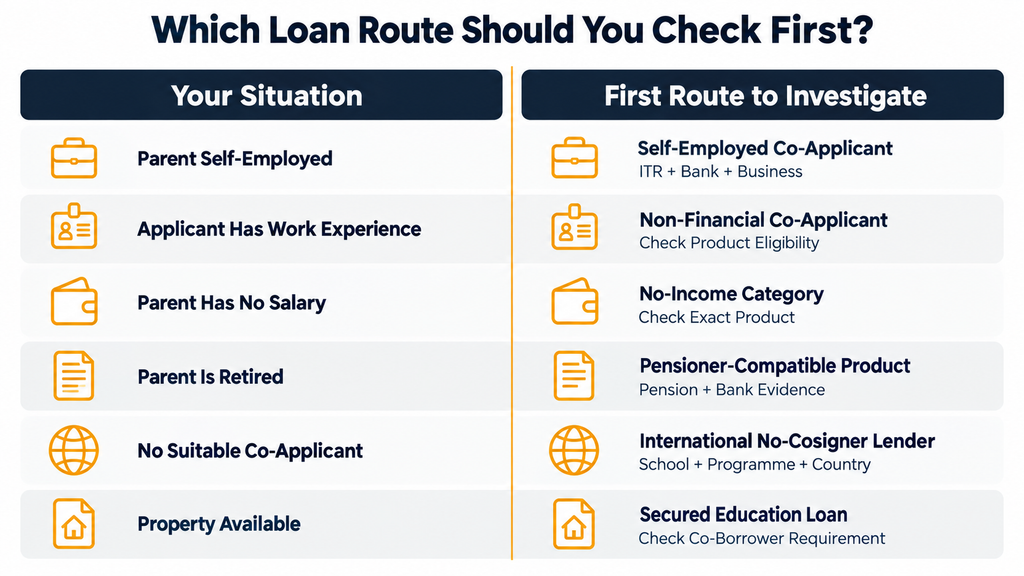
Which Route Should You Check First?
| Your situation | First route to investigate | What to verify |
| Parent is self-employed | Self-employed co-applicant | Accepted ITR, bank and business documents |
| Applicant has work experience | Non-financial co-applicant option | Whether your product permits it |
| Parent has no current salary | Product-specific no-income category | Whether that exact product accepts it |
| Parent is retired | Pensioner-compatible product | Pension and bank-statement requirements |
| No suitable family co-applicant | International no-cosigner lender | Supported school, programme and country |
| Property is available | Secured education loan | Whether a co-borrower is still required |
Bottom line: An education loan without co-applicant income proof is not one standard product. The right route depends on why salary-based evidence is unavailable.
For related background on co-applicant roles, see Foreign Edu Loans’ co-applicant in education loan guide.
What Does “No Co-Applicant Income Proof” Actually Mean?
Students often use education loan without co-applicant income proof for very different cases: a self-employed parent, a pensioner, a non-earning parent, or no suitable co-applicant.
These are different underwriting situations. Salary slips are only one type of financial evidence. Lenders may also examine ITRs, bank statements, business evidence and repayment capacity.
6 Education Loan Options When You Don’t Have a Salaried Co-Applicant
Option 1: Use a Self-Employed Co-Applicant
For many families, the most practical education loan without co-applicant income proof route is actually a loan using alternative income documentation.
SBI’s Global Ed-Vantage education-loan page separates salaried persons from “other than salaried” persons. For the latter, SBI lists business-address proof where applicable and latest ITRs where applicable, along with six months of bank statements.
The Axis Bank Education Loan guide similarly lists two years of ITRs and six months of bank statements for a self-employed co-applicant. Axis also states that documentation requirements can vary case by case.
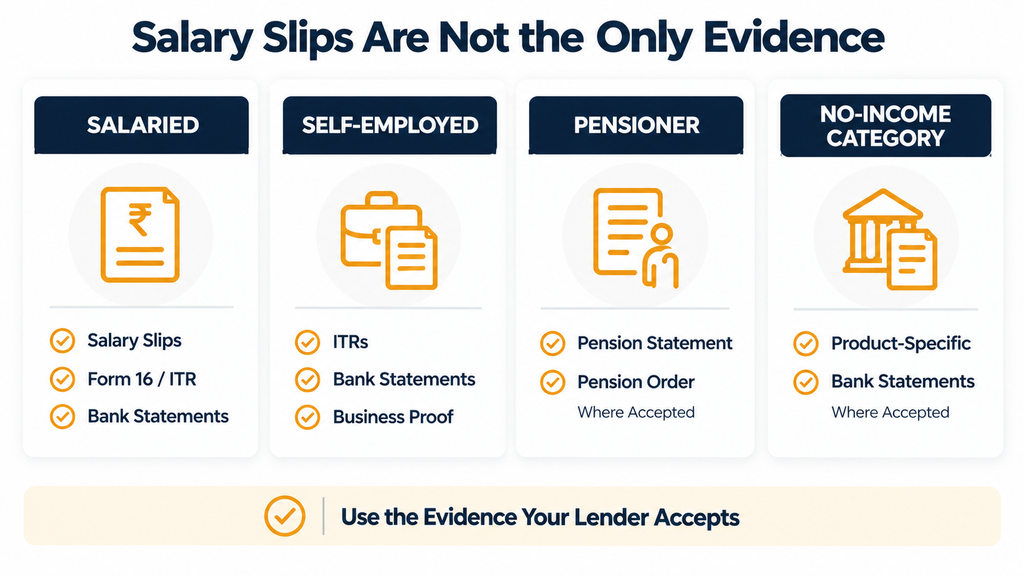
Salary Slips Are Not the Only Evidence
| Co-applicant profile | Examples of lender-published evidence |
| Salaried | Salary slips, Form 16 or ITR, bank statements |
| Self-employed | ITRs, bank statements, business-related proof |
| Pensioner, where accepted | Pension-credit statement or pension order |
| No-income category, where accepted | Product-specific bank statements |
Interpretation: An education loan without co-applicant income proof should not be confused with a loan without salary slips. If income exists, document it in the form the lender accepts.
Option 2: Check a Non-Financial Co-Applicant Route
A different possibility exists for some applicants with prior work experience.
The current ICICI Bank Education Loan FAQ states that applicants with work experience may apply with a non-financial co-applicant, subject to terms and conditions.
This is useful for students without an earning co-applicant, but it is not a universal banking rule. The work-experience condition matters, and the bank can still assess the student’s profile and other eligibility factors.
Before relying on this route, confirm:
- whether your exact product permits a non-financial co-applicant;
- which relationships are accepted;
- whether previous work experience is required; and
- what documentation the lender still requires.
Option 3: Check No-Income or Pensioner Categories
Some individual products publish separate documentation requirements for applicants whose co-applicant is not salaried.
Credila’s current B.Tech Education Loan page lists co-applicant financial categories including salaried, self-employed, proprietor, no income and pensioner. Its document table lists six months of savings-account statements for the no-income category and either pension-credit statements or a pension order for pensioners.
That makes this a legitimate example of an education loan without co-applicant income proof in a narrow, product-specific context.
The limitation matters. This evidence comes from Credila’s B.Tech page. It should not be rewritten as “Credila accepts non-earning co-applicants for every education loan”, and it should not be generalised across other banks or NBFCs.
Option 4: Consider a Genuine No-Cosigner International Loan
If there is no suitable family co-applicant, certain international lenders may offer a fundamentally different route.
MPOWER Financing’s official guidance states that MPOWER does not require or ask for cosigners or collateral. Its review considers factors including academic performance, credit standing and future earning potential based on the student’s school and degree programme.
Prodigy Finance’s eligibility guidance states that its assessment does not require collateral, co-signers or guarantors. Applicants must meet requirements including admission to a supported school and programme, studying abroad and residence in a supported country.
Prodigy’s update dated 18 September 2026 also confirms that India is currently supported for Fall 2026 and Spring 2027, while noting that funding availability and supported schools can change.
For an eligible student, this can be a genuine education loan without co-applicant income proof route. But no cosigner does not mean no assessment.
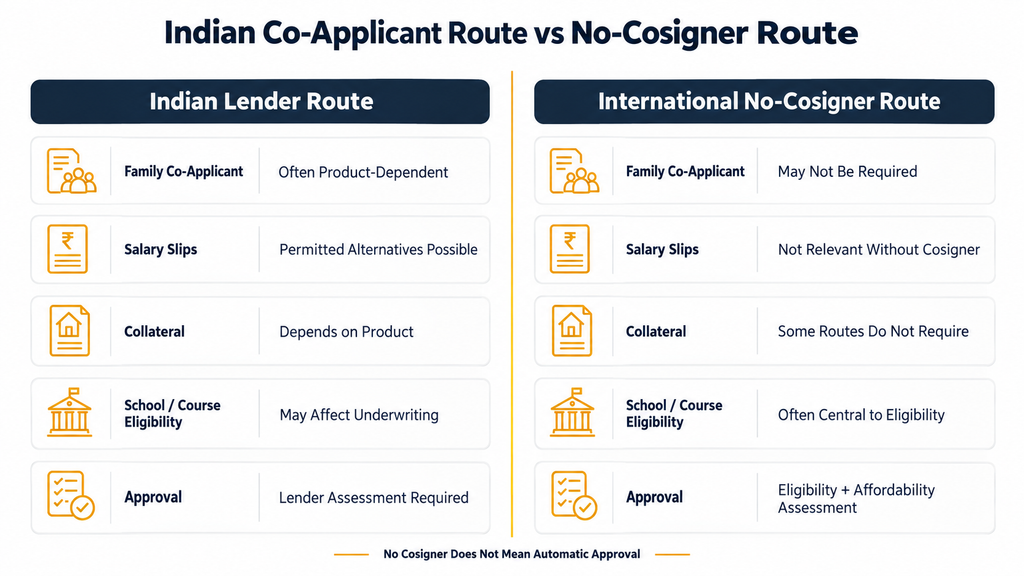
Indian Co-Applicant Route vs No-Cosigner Route
| Point | Indian lender route | Certain international routes |
| Family co-applicant | Often product-dependent | May not be required |
| Salary slips | May be replaced by permitted alternatives | Not relevant where no cosigner is required |
| Collateral | Depends on product | Some verified routes do not require it |
| School/course eligibility | May affect underwriting | Often central to eligibility |
| Approval | Subject to lender assessment | Subject to eligibility and affordability |
Option 5: Do Not Assume Collateral Replaces the Co-Applicant
Property does not automatically solve the co-applicant problem.
SBI’s Student Loan Scheme shows that a parent or guardian can remain a co-borrower while collateral requirements depend on the applicable loan structure.
So if your family owns property, ask two separate questions:
- Is the property acceptable as security?
- Does providing security change the co-borrower requirement?
A secured education loan may change the lender’s risk structure, but it does not automatically eliminate a co-applicant.
For a broader explanation of secured versus unsecured borrowing, see Foreign Edu Loans’ education loan without collateral guide.
Option 6: Do Not Treat a Guarantor as an Automatic Substitute
A co-applicant, co-borrower and guarantor are not automatically interchangeable. There is no verified universal rule saying that a guarantor can replace a required co-applicant.
Some lenders still explicitly require an earning co-borrower.
For example, the current Avanse study-abroad education-loan page states that applicants need a co-borrower who earns in India. It also states that co-borrower income details form part of the application.
That product would therefore not solve every education loan without co-applicant income proof case.
What Documents Should You Prepare?
Prepare documents that accurately describe the family’s actual financial profile.
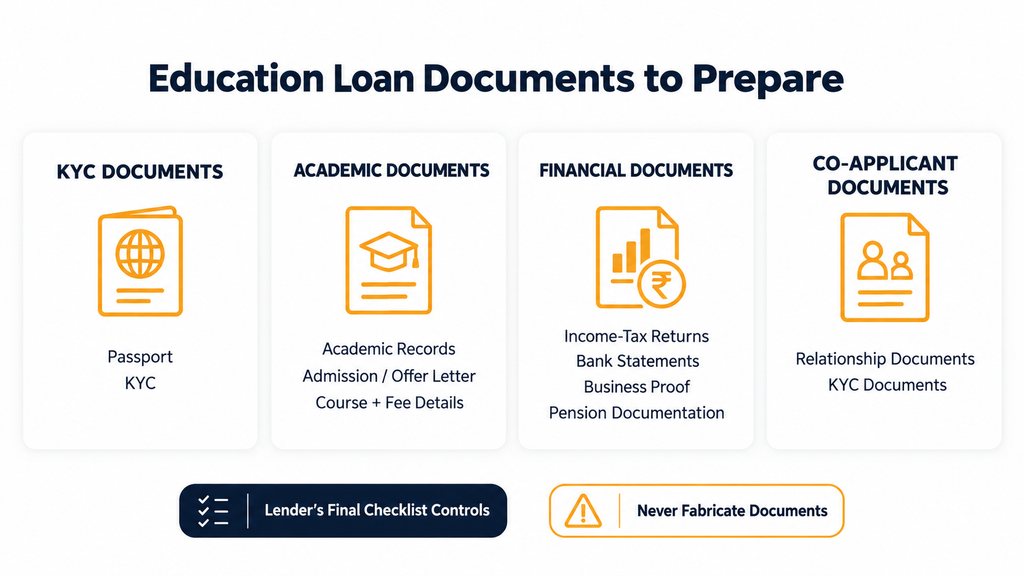
Student Documents
- Passport and KYC
- Academic records
- Admission or offer letter
- Course and fee details
Financial or Co-Applicant Documents
Depending on the lender and route:
- income-tax returns;
- bank statements;
- business proof;
- pension documentation;
- relationship and KYC documents.
Foreign Edu Loans’ education loan document checklist separates salaried and self-employed co-borrower documentation and can help organise a file before lender-specific verification.
The lender’s final checklist should still control.
Never fabricate salary slips, ITRs, bank statements or business evidence.
How to Apply Without Conventional Salary Proof
Step 1: Determine the Actual Problem.
Is parent self-employed, retired, non-earning or unavailable as a financial co-applicant?
For more context on co-applicant categories and responsibilities, see the Foreign Edu Loans co-applicant guide.
Step 2: Collect Genuine Evidence
Prepare the ITRs, bank statements, business records or pension documents that actually exist.
You can use the Foreign Edu Loans education loan document checklist to organise the required records.
Step 3: Check the Product, Not Just the Lender
Requirements can differ across products from the same institution.
In a case, SBI provides eligibility and document requirements, product-specific, as per its Global Ed-Vantage education loan
Step 4: Test Non-Financial options.
In the case of applicant work experience, authenticate the existence of a route where appropriate.
ICICI Bank currently states that applicants with work experience may apply with a non-financial co-applicant, subject to terms and conditions. Check ICICI Bank’s Education Loan FAQs.
Step 5: Compare Secured and Unsecured Structures Separately
Do not assume that providing collateral removes the co-borrower.
For a broader comparison, see the Foreign Edu Loans collateral vs non-collateral education loan guide.
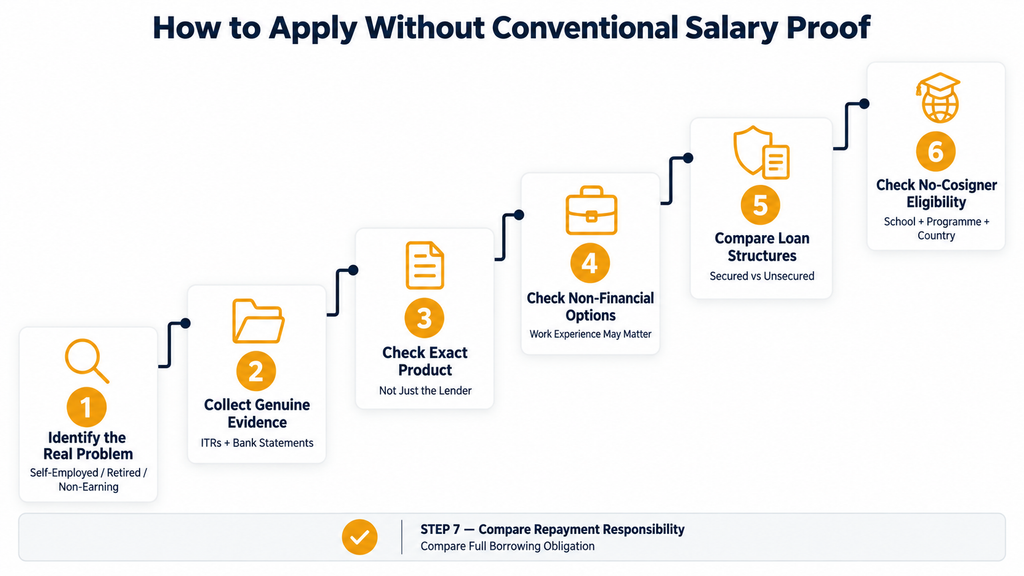
Step 6: Check International No-Cosigner Eligibility
Verify the school, programme, destination and current funding availability before relying on this option.
MPOWER publishes a no-cosigner and no-collateral structure for eligible Indian postgraduate students studying in the U.S. and Canada. Check MPOWER’s official no-cosigner loan information.
Step 7: Compare Repayment Responsibility
An education loan without co-applicant income proof should not be selected only because it is accessible. Compare the full borrowing obligation first.
Illustrative Example
Imagine that an Indian student gets an invitation to a foreign university, but the father of the student is a small business owner who does not have a monthly salary slip.
The wrong conclusion would be:
“I need a loan with no income proof.”
A better process is to shortlist lenders that accept self-employed co-applicants, prepare genuine ITRs and bank statements, verify course eligibility, and only then test a no-cosigner international route if needed.
SBI, for example, lists separate documentation for persons who are “other than salaried”. See SBI Global Ed-Vantage documentation requirements.
This is an illustrative example, not a real approval case or prediction of sanction.
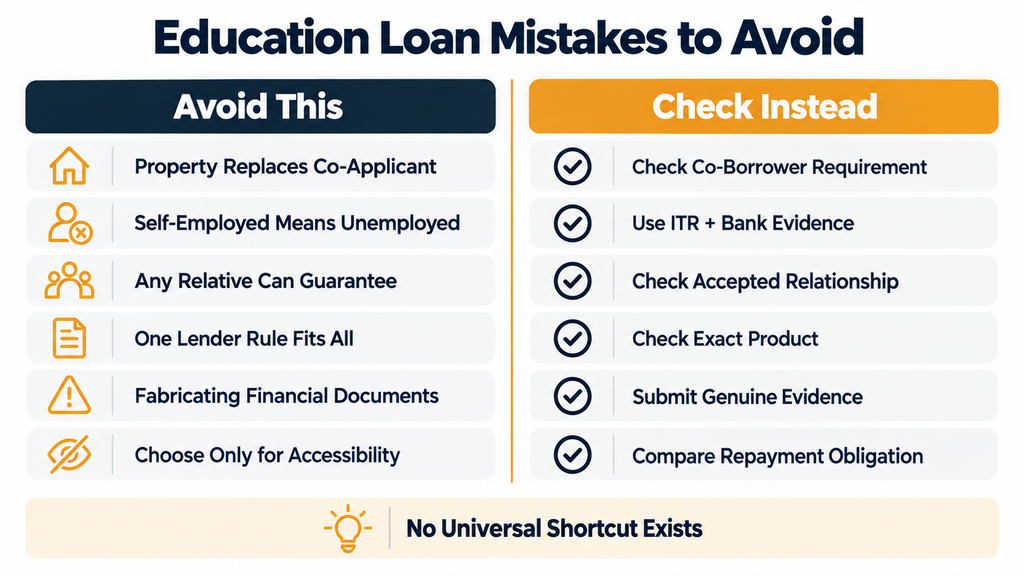
Some Mistakes to Avoid
- Assuming property automatically replaces the co-applicant
- Raising self-employed to unemployment.
- Assuming any relative can act as guarantor
- Generalising one lender’s exception across the market
- Fabricating income or banking documents
- Choosing a no-cosigner product without comparing repayment obligations
For more detail on co-applicant eligibility and guarantor differences, see the Foreign Edu Loans co-applicant guide.
Responsible Borrowing
Finding an education loan without co-applicant income proof solves only the eligibility question.
Students and families should still compare:
- the genuine funding gap after savings or scholarships;
- family contribution;
- total amount borrowed;
- repayment responsibility;
- collateral exposure, if any;
- foreign-currency risk; and
- post-study employment uncertainty.
For students comparing secured and unsecured borrowing, the Foreign Edu Loans collateral vs non-collateral education loan guide provides additional context.
Borrowing Rule: Compare the complete repayment obligation, not only whether a lender is willing to consider the application.
How Foreign Edu Loans Can Help
Foreign Edu Loans describes itself as a loan facilitation platform rather than a lender or credit provider.
Its current Terms and Conditions state that its services can include understanding loan requirements, providing indicative eligibility assessments, presenting loan-option comparisons, assisting with documentation and coordinating applications. The same terms state that final lending decisions, including approval, sanction amount, interest rate, tenure and collateral requirements, are made by the relevant lender.
That distinction matters when exploring an education loan without co-applicant income proof. Leadership may contribute to recognizing the right paths, yet no sanctions can be ensured.
FAQs
Am I Eligible to Take an Education Loan without Co-Applicant Income Proof?
Yes, in specific situations. An education loan without co-applicant income proof may involve self-employed documentation, a lender-specific non-financial co-applicant, a no-income or pensioner category, or an eligible international no-cosigner product. None of these routes is universally available.
Can a Self-Employed Parent Be My Co-Applicant?
Potentially yes. SBI and Axis Bank publish separate documentation routes for non-salaried or self-employed persons. The eligibility remains to be based on the lender, the profile of the product and the applicant.
Does it Benefit me Sometimes that I lack an Earning Co-Applicant?
For certain products. ICICI Bank currently states that applicants with work experience may apply with a non-financial co-applicant, subject to terms and conditions.
Can Property Replace Co-Applicant Income?
Not automatically. A secured education loan can still require a parent, guardian or another permitted person as co-borrower. Confirm the security requirement and co-borrower requirement separately.
Can I Get an Education Loan Without Any Cosigner?
Certain international lenders offer eligible students no-cosigner structures. MPOWER and Prodigy Finance are verified examples, but school, programme, destination, funding availability and other eligibility conditions apply.
Conclusion
An education loan without co-applicant income proof is possible in some situations, but there is no universal shortcut. A self-employed parent may use ITRs, bank statements and business evidence instead of salary slips. Some applicants may fit a lender-specific non-financial co-applicant structure, while selected products recognise no-income or pensioner categories. Eligible students may also consider international no-cosigner financing.
Classify the family profile correctly, verify the exact lender product, submit genuine documents and compare the complete repayment commitment before accepting a loan.