Making plans to study abroad is fun, yet the bureaucratic part of the whole process can be quite daunting to the majority of families. Throughout the years, we have been able to take thousands of students through the education loan process, and one thing we have realised to be true is that having the specific documents that you need to be approved to get an education loan saves us weeks of waiting back and forth with the bank. Late sanction letters are due to missing paperwork more than any other cause, and can be a surprise to families just ahead of a strict visa schedule. This guide will take you through the full list of documents required for education loan 2026, including KYC, academic, financial and collateral documents, and country-specific requirements, a comparison table with detailed instructions, a documentation schedule and tips on how to hasten your approval process, starting with your first application until your final loan is disbursed.
Why documents required for Education Loan?
When banks and NBFCs approve any loan, they consider two factors: your academic prowess and the repayment capacity of your family. The documents required for education loan are there to substantiate the two mentioned factors.
- The most common delay in processing in almost all lenders that we deal with is incomplete or inconsistent paperwork.
- A well-arranged education loan documents checklist will save you two to three weeks on the overall time of approval.
- Most students initially thought they were not eligible to get a loan until we enlightened them on their eligibility.
Education Loan Document List 2026: The Five Main Categories.
All the lenders in India, both in the government sector and the private NBFCs, will group the paperwork to be submitted to secure an education loan into five major categories. The whole education loan documents checklist will be much less daunting when one understands these categories.
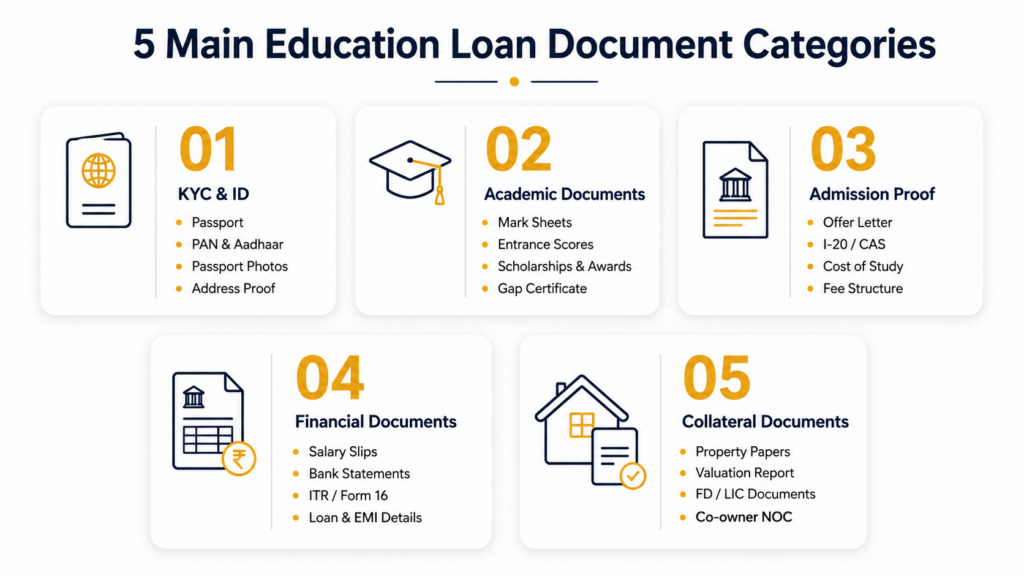
1. KYC and ID Docs.
These verify who you are and validate your address and are the backbone of any documents required for education loan.
- Authentic passport of the applicant, as it is essential both to be admitted and loaned to him overseas.
- PAN card and Aadhaar card of the student and the co-applicant to verify the identity.
- Two new passport-size photos set on a light background, as most banks mandate strict formatting.
- Up-to-date address evidence, e.g., an electricity bill or a rent contract, should it be dissimilar to KYC documents.
2. Academic Documents
There is a direct link between academic strength and interest rate and chances of approval; hence, this section is the centre of any education loan document list 2026. Academic records are considered one of the most scrutinised documents required for education loan by lenders.
- Class 10, Class 12 and undergraduate mark sheets and certificates, as you have gone through, depending on your course.
- Based on your selected destination, entrance exam scorecards include: GMAT, GRE, IELTS, PTE, Duolingo, TOEFL.
- Any academic scholarship, academic award or research publication certificates that enhance your overall academic profile.
- A gap certificate, which justifies career or study breaks, as gaps with no explanation can be a cause of further lender inquiry.
3. Evidence of Admission and Course Information.
This category attests that your funding application corresponds to a genuine, recognised educational chance overseas. No lender will handle the rest of the documents required for education loan without verified admission documents.
- Unconditional or conditional offer letter by the university, typed on official letterhead with all address details.
- I-20 form in the USA or CAS letter in the UK as they are country-specific admission forms.
- Institutional statement of the cost of study, including tuition, living costs and travel.
- Wherever the university includes a course prospectus or fee structure document with the offer letter.
4. Financial and Income Documents of Co-Applicant.
Lenders will evaluate the ability of the co-applicant to repay the loan meticulously; hence, these documents required when applying for a study abroad loan ought to be given special consideration. Financial paperwork, in our experience, takes more time in the documents required for education loan process than any other category.
- Past three months’ salary slip of salaried co-applicants or self-employed co-applicants, or income tax returns.
- The past half year’s bank statements, as anything over ninety days is normally considered to be stale.
- Last two or three financial years’ income tax returns (Form 16) with a steady earning capacity.
- Documents of any loans or EMIs that they have to be able to compute the total repayment that the co-applicant will need to pay.
5. Collateral Documents (If Applicable)
Public sector banks only require collateral on loans of over ₹7.5 lakh. This is generally the most paperwork-intensive section of the documents required for education loan journey.
- Paper of property ownership such as the sale deed, registration certificate, and encumbrance certificate of the real estate security.
- Recent report by a bank-approved valuer on the value of the property, indicating its market value at present.
- The document of a fixed deposit receipt or the LIC policy, in case you intend to pledge financial instruments other than property.
- No Objection Certificate of co-owners, when the property is jointly owned by more than one person in the family.
Documents required for education loan: Country Addition.
In addition to the standard education loan form checklist, a number of countries require additional documentation related to visa and remittance regulations. We are frequently told by parents how these country-specific requirements made the loan process a lot easier after a conversation with our experts.
- The loan file will typically require the I-20 form and proof of payment of the SEVIS fee by USA applicants.
- The CAS letter should be provided by the UK applicants, as it is considered official evidence of secured admission.
- Canada, Australia and Germany applicants usually require a GIC or blocked account confirmation in order to get a visa.
- All foreigners must have a valid passport, as it is not always required at the sanction stage when taking a domestic loan.
- Recently, one of our students managed to get funded by SBI after researching various lenders with the help of our platform and pre-planning country-specific paperwork.
Table of Education Loan Documents Checklists.
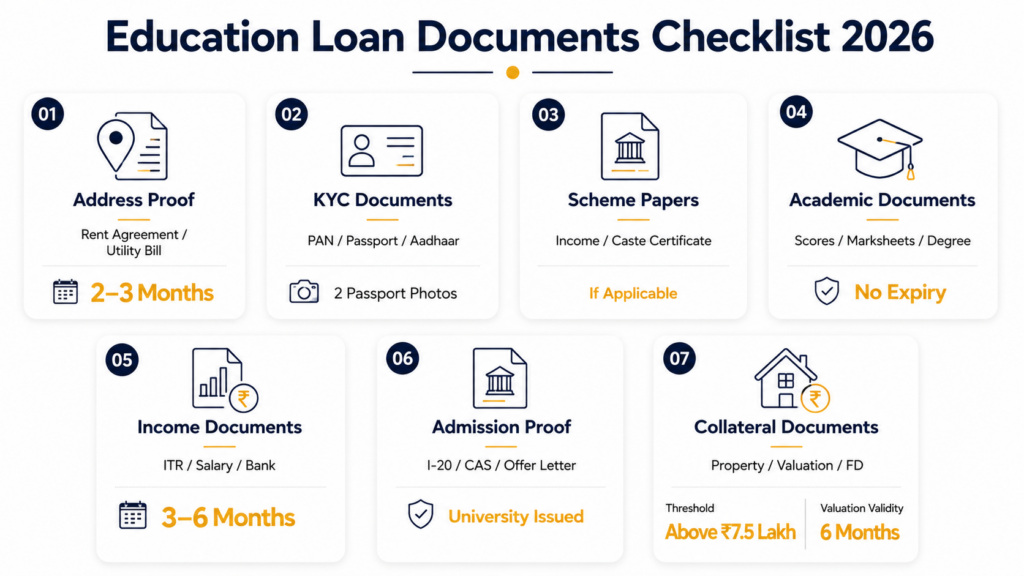
| Document Category | Mandatory For | Documents required for education loan | Validity / Notes |
| Address Proof | Only when the current address is not equal to the KYC address. | Rent agreement, utility bill, or Electricity bill | Should not be older than 2-3 months. |
| KYC Documents | Applicants and co-applicants: all. | PAN, Passport, Aadhaar, 2 passport-size photographs | Passport required for foreign countries, Valid indefinitely. |
| Government Scheme Papers | Only in the case of subsidy or interest-subvention schemes. | Income certificate, caste certificate (if applicable) | Published by local revenue authorities. |
| Academic Documents | All applicants | Entrance scores, Mark sheets, degree certificates | Indefinitely; expires not. |
| Income Documents | Co-applicant, which is obligatory in the majority of instances. | ITR, Salary slips, bank statements | Should not be more than 3-6 months old. |
| Admission Proof | All applicants | I-20/CAS, Offer letter, cost of study statement | Digital copy of the original or university-issued. |
| Collateral Documents | Secured loans above ₹7.5 lakh | Valuation report, Property papers, FD receipts | Valuation report normally valid for 6 months. |
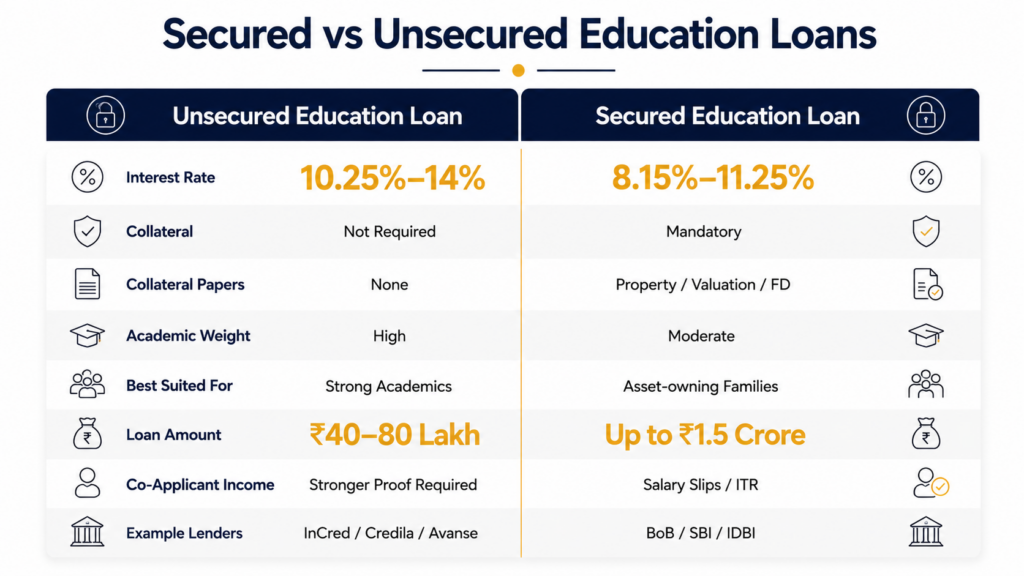
The Difference between Secured vs Unsecured Loans in terms of Documentation.
The paperwork involved in the application of the education loan varies significantly with the path you are taking; secured or unsecured. The documents required for education loan reduce significantly when there are no collators in the equation.
| Parameters | Unsecured Education Loan. | Secured Education Loan |
| Interest rate range | Generally higher, about 10.25% to 14% | Generally lower, about 8.15% to 11.25% |
| Collateral Documents | Not required at all. | Mandatory: property papers, valuation report, FD receipts |
| Academic Profile Weight | High, because approval is largely on merit. | Moderate, because collateral minimises lender risk |
| Best Suited For | Students with good academic grades and low assets. | Families that own property, gold or FDs |
| Limit on loan amount. | Typically limited between 40 and 80 lakh. | There is only a limit up to 1.5 crore based on collateral value. |
| Co-Applicant Income Demand | More powerful income documentation as a rule required. | Ordinary salary slips or ITR as a rule adequate |
| Examples Lenders | InCred, HDFC Credila, Avanse | Bank of Baroda, SBI, IDBI Bank |
Common Documentation Mistakes Students Make
Even well-qualified applicants sluggishly approve themselves by making unnecessary mistakes on paperwork. Any omission in the documents required for education loan will put your sanction date back by a few weeks, so we will make sure to go through the education loan documents checklist twice before we hand it in.
- Presentation of bank statements that are more than 90 days old, which is automatically declined by most lenders in the verification process.
- Leaving out the KYC of the co-applicant, as nearly all loans will have a co-applicant.
- A conditional offer letter is applied for without notifying the bank of impending admission conditions.
- Failing to provide property documents, e.g., lacking encumbrance certificates to obtain a loan against collateral.
How to Improve Your Loan Eligibility Before Applying?
Some planning enhances your approval rate and interest rate offers. Good eligibility also translates to fewer follow-up requests for the documents required for education loans in future.
- Have a good credit record on the co-applicant, as CIBIL score is a direct determinant of the approved interest rates.
- Minimise current EMIs to the extent possible since this enhances the debt-to-income ratio of the co-applicant considerably.
- Submit applications to a combination of banks and NBFCs as the criteria of approval and the papers that are required differ significantly.
- Scholarships may be used in conjunction with your loan request, which can help to decrease the total amount you borrow and interest.
Selecting an Appropriate Lender: Banks vs NBFCs.
Interest rates: the interest rates of 2026 are varied, with SBI offering a Scholar Loan with an approximate interest rate of 8.15% and some unsecured NBFC products with an approximate interest rate of 13-14%. Each lender has its education loan documentation checklist, which they publish, and the exact documents required for education loan may differ by a little margin between each lender. Lower rates with slower processing are provided by public banks such as SBI and Bank of Baroda. NBFCs such as HDFC Credila and InCred are quicker and tend to finance up to 100 per cent of costs.
- Compare the processing fees, as NBFCs usually charge 1-1.75% plus GST, as opposed to fixed fees charged by the public banks.
- Check the moratorium periods; the moratorium usually lasts between half a year and a year after taking the course.
- Check the prepayment policies, as some mortgage lenders limit early repayment in the first year to eighteen months.
- The lender should be a qualified owner of Section 80E tax benefits on the interest component paid.
The most significant relief was visiting several banks at the same time, without visiting each bank separately, as one of the recent applicants informed our team during their visit.
Timeline: When to Start Collecting Documents
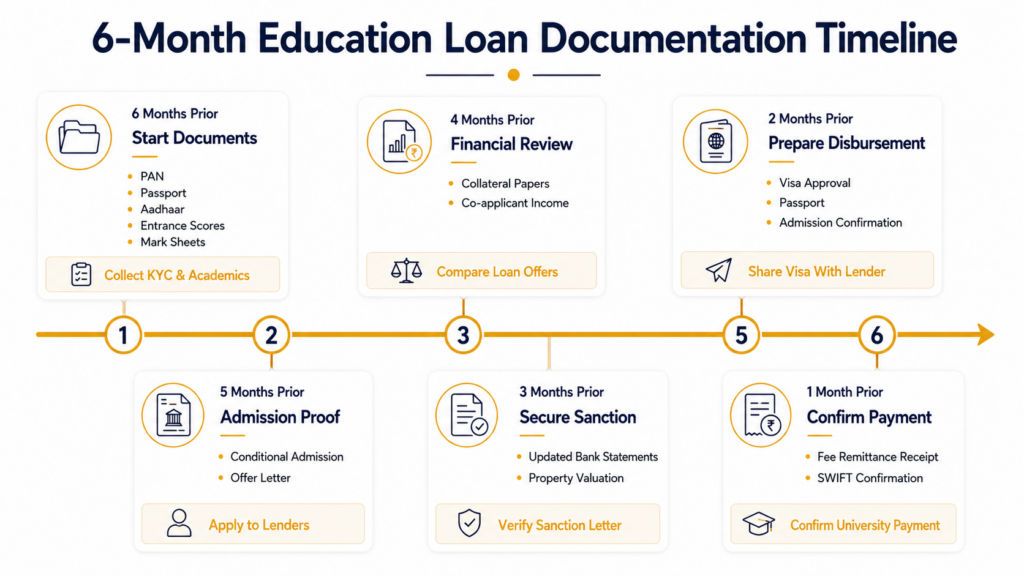
Ideally, you should begin to prepare your documents required for education loan about 6 months prior to your planned departure. Many students are often scrambling the night before their visa interview because they didn’t start working on a list of education loans to take out. This stage will help you avoid the last-minute rush.
| Pre-Departure Timeline | Important Documents involved. | What to be finished |
| 6 months prior | PAN, Passport, Aadhaar, entrance scores, mark sheets | Collect simple KYC documents and academic documents |
| 5 Months Before | Conditional admission or offer letter. | Appeal to various lenders, with preliminary admission evidence |
| 4 Months Before | Collateral documents, income documentation of co-applicant. | Compare offers and select the lender of your choice. |
| 3 months | Updated bank statements, Property valuation report | Prior to this, have your sanction letter fully verified and secure your letter, |
| 2 Months Before | Copy of visa approval, passport, confirmation of admission. | Share visa with the lender to be disbursed |
| 1 Month Prior | Fee remittance receipt, SWIFT transfer confirmation. | Confirm that the university has been paid the money |
FAQs
Who can get a study abroad education loan?
Any Indian student between the ages of 18 and 35 years who has been confirmed to have been admitted to a recognised university outside the country, and an eligible co-applicant.
Is it possible to obtain a loan without any collateral?
Yes, there are a number of NBFCs and banks that provide unsecured loans to a maximum of ₹40-50 lakh depending on the academic merit and the strength of co-applicant income.
What are the education loans offered by banks to study abroad?
The most active lenders of overseas study financing are SBI, HDFC Credila, Bank of Baroda, Axis Bank, InCred and IDBI Bank.
What is the turnaround time of loans?
It normally takes four to eight weeks by the public sector banks and seven to fifteen working days by the NBFCs to sanction loans.
Will scholarships decrease my loan value towards education?
Yes, scholarships will decrease the overall financing gap, which will decrease your loan principal and interest outlay (over time) significantly.
What are the documents to apply for an education loan?
The basic documents required for education loan approval are KYC documents, education records, admission documentation, co-applicant income documentation and collateral documentation (where applicable).
Conclusion
The best way to fast-track your loan sanction and visa is to ensure that you get your paperwork right. It is a list of education loan documents 2026 that includes all the KYC and academic documents, country-specific visa documents required for education loan, collateral requirements and a definite month-by-month schedule. When you have the entire paperwork that is needed to obtain an education loan, the process of a loan is much more predictable, and the lenders reduce their file processing time and the number of follow-up questions. As a partner, Gateway International can take care of documentation preparation, free of charge, in all major banks and NBFCs for thousands of study abroad aspirants. Calculate your education loan eligibility now, shop and compare various lenders on a single site and talk to our specialists to make your study abroad a fully funded, worry-free reality.
Pingback: Education loan for Singapore university India options, costs, eligibility
Pingback: Education loan for Singapore university India
Pingback: Straight Out of School: Can You Get an Education Loan for undergraduate Abroad?