The CIBIL score impact on education loan approval is important, but often oversimplified. A stronger credit profile can support a lender’s assessment, while missed payments or adverse account statuses can weaken a file. However, no established RBI or TransUnion CIBIL guideline requires all applicants of education loans to possess a minimum score of 700, 750 or any other single digit. According to CIBIL, the lenders look at the CIBIL Score and Report, but the lending decision is in the hands of the lender.
For study-abroad finance, that distinction matters because lenders may also assess academics, course, university, co-applicant, existing obligations and other underwriting factors. The useful question is not “What score guarantees approval?” but “What does the complete credit profile show before I apply?”
CIBIL and education loans at a glance
| Situation | What it may mean | What to do |
| Higher score | Can support credit assessment | Maintain clean repayments |
| Lower score | May weaken the application | Identify the cause |
| NA/NH | Not automatically bad credit | Check lender policy |
| Co-applicant involved | Their credit may be assessed | Review their report |
The CIBIL score impact on education loan approval is therefore one part of underwriting, not an automatic pass-or-fail switch.
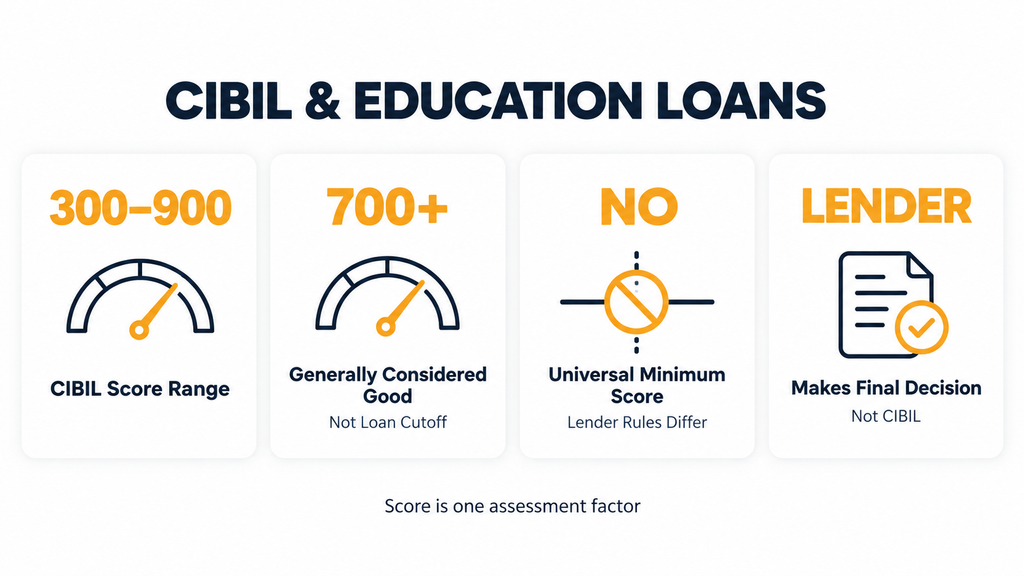
What is a CIBIL Score, and what does a lender see?
A CIBIL Score is a three digit brief of credit history. TransUnion CIBIL indicates that its range is between 300 and 900 and a score above 700 is usually considered to be good. That will not form an absolute education-loan ceiling.
The score is not the only information in CIBIL Report. It may contain account information, just payment amounts, balances, ownership and lender inquiries. It is a measure of creditworthiness by lenders. CIBIL does not approve or disapprove a loan per se.
For the official explanation, see CIBIL’s Credit Score and Loan Basics.
That is the first key point about the CIBIL score impact on education loan approval: the number matters, but the underlying report matters too.
Is there a minimum CIBIL score for an education loan in India?
No universal minimum was verified from RBI or TransUnion CIBIL for all education loans.
A search for credit score requirement India may produce 650, 700 or 750, but those numbers should not be presented as an industry-wide rule unless a specific lender publishes that requirement for a specific product.
Official CIBIL guidance leaves the final lending decision with the lender. InCred’s education-loan FAQ also shows why one score cannot explain the whole decision: it says its assessment considers academic and career record, potential income trajectory, co-borrower creditworthiness, credit histories and other factors.
You can review the lender-specific approach in InCred’s official Education Loan FAQs.
Therefore, the CIBIL score impact on education loan approval can differ by lender, loan structure and applicant profile.
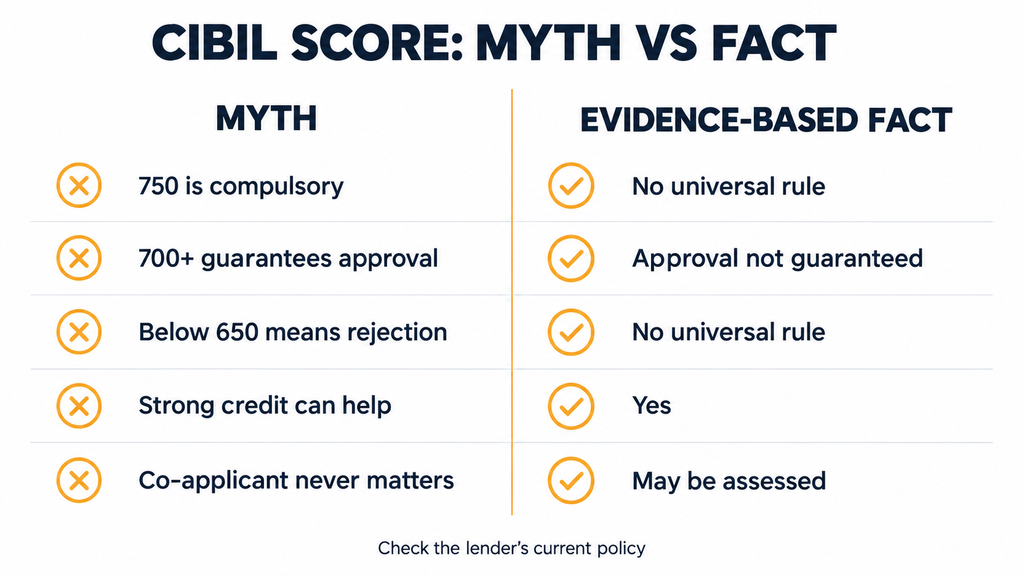
Myth vs fact
| Claim | Evidence-based answer |
| “750 is compulsory for every education loan” | No universal rule verified |
| “Above 700 guarantees approval” | No |
| “Below 650 means automatic rejection” | No universal rule verified |
| “A stronger credit profile can help” | Yes |
| “The co-applicant may be assessed” | Yes, depending on lender/product |
Treat a credit score requirement India search as a prompt to check the lender’s current policy, not as proof of one market-wide cutoff.
Why can the co-applicant’s CIBIL profile matter?
The co-applicant CIBIL score importance is easy to underestimate. InCred states that it evaluates co-borrower creditworthiness and analyses the credit histories of parties to the loan.
So the CIBIL score impact on education loan approval may come from the co-applicant even when the student has limited credit experience.
Before applying, review the co-applicant’s repayment history, overdue amounts, existing obligations, settled or written-off accounts, recent enquiries and inaccurate information. The co-applicant CIBIL score importance is about the whole profile, not simply whether one number looks high.
What if the student has no CIBIL Score?
A student who has never used much formal credit may have insufficient activity to generate a conventional score. CIBIL refers to inadequate credit activity as “No Hit”.
This is not the same as having a poor repayment record. For the CIBIL score impact on education loan approval, that distinction matters because young students may have little personal borrowing history.
Which credit behaviours can weaken an application?
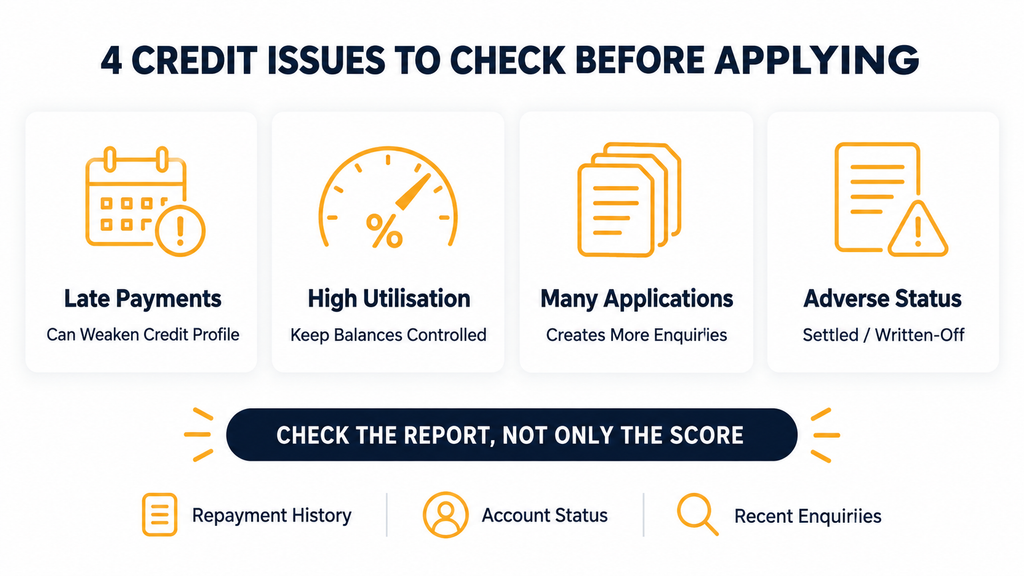
CIBIL’s guidance points to four common areas:
- Late or missed payments: late payments are viewed negatively by lenders.
- High credit utilisation: CIBIL advises keeping balances controlled.
- Too many new applications: frequent applications may negatively affect the score.
- Adverse account status: written-off, settled and suit-filed cases are not viewed favourably.
These factors show why the CIBIL score impact on education loan approval cannot be judged from the headline number alone.
How to improve CIBIL for loan preparation
If you are searching how to improve CIBIL for loan approval, ignore promises of a fixed score jump in 30, 60 or 90 days. The official sources used here do not support such guarantees.
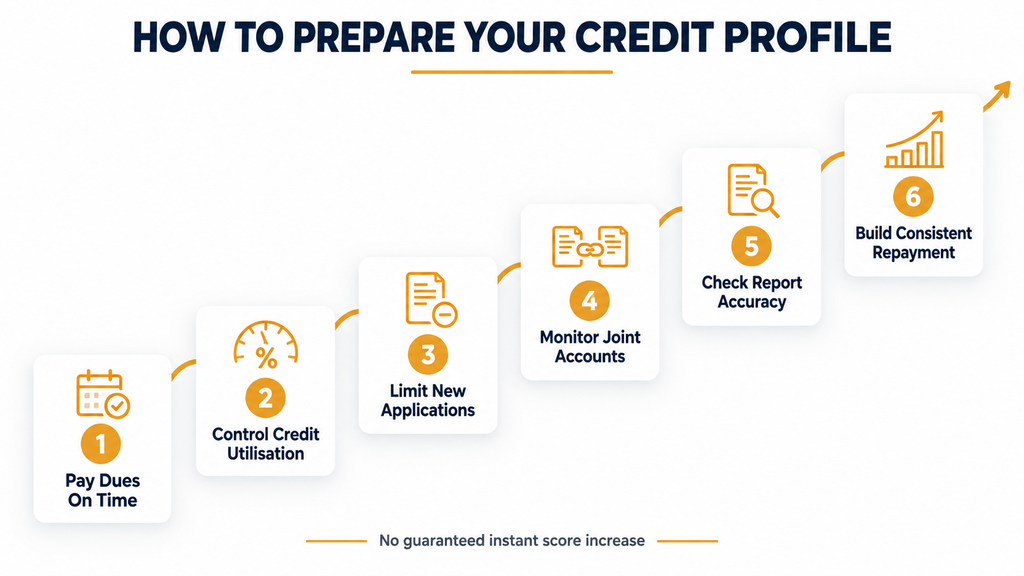
CIBIL’s guidance is practical:
- Pay EMIs and credit-card dues on time.
- Keep credit utilisation controlled.
- Apply for new credit cautiously.
- Monitor co-signed, guaranteed and joint accounts.
- Review the CIBIL Report for inaccuracies.
- Maintain responsible credit behaviour over time.
That is the responsible answer to how to improve CIBIL for loan preparation.
The CIBIL score impact on education loan approval is more meaningful when the report shows consistent financial discipline.
Should you check your CIBIL Report before applying?
Yes. CIBIL currently offers one Free CIBIL Score and Report per calendar year.
Before applying, review identity details, unfamiliar accounts, overdues, repayment history, recent enquiries and adverse account statuses. Review the co-applicant too where relevant.
Use the official Free CIBIL Score and Report service rather than an unknown third-party score website.
This is one of the simplest ways to manage the CIBIL score impact on education loan approval before a lender evaluates the file.
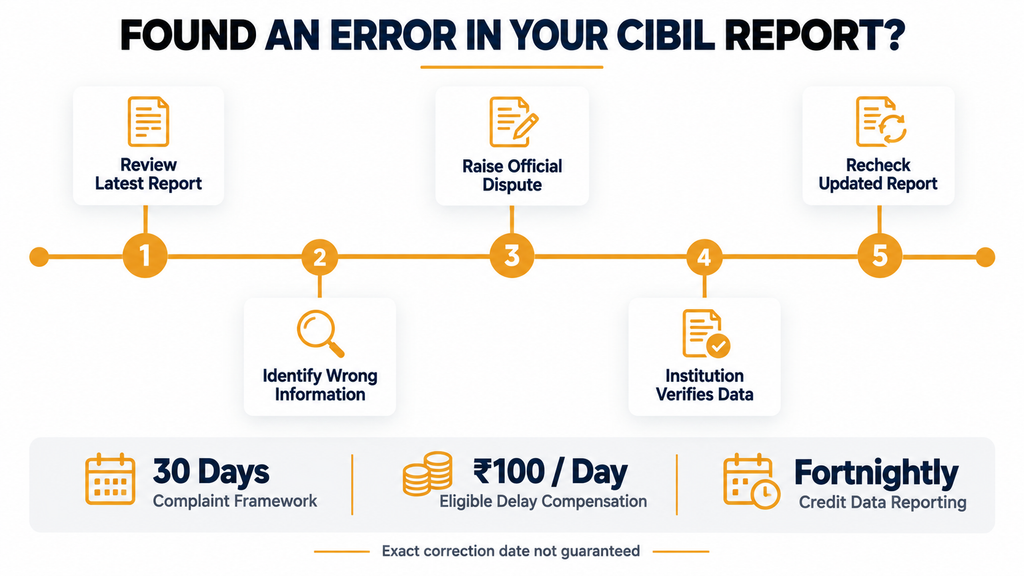
What should you do if the CIBIL Report contains an error?
Do not ignore an inaccurate account, enquiry, balance or personal detail.
CIBIL provides an official dispute process and states that it cannot change lender-reported records on its own. The relevant credit institution may need to verify and update the information.
The RBI compensation framework provides an overall 30-calendar-day period for covered credit-information complaints. CIBIL states that eligible delay beyond that period can attract ₹100 per calendar day, subject to the framework.
See CIBIL’s official compensation framework for the conditions and process.
RBI’s current directions also require credit information to be updated on a fortnightly basis, as at the 15th and last day of the month, or at shorter agreed intervals, effective from 1 January 2025. That does not guarantee that a particular correction will appear on an exact date.
Correcting genuine inaccuracies can reduce avoidable problems connected with the CIBIL score impact on education loan approval.
Does a high CIBIL Score guarantee a lower education-loan rate?
No.
A stronger credit profile may support more favourable assessment, but education-loan pricing remains lender-specific and applicant-specific. InCred says its education-loan interest rate can be influenced by credit histories, employment records, security and other factors.
That does not justify saying “750 gives you a 0.5% cheaper loan” unless a named lender’s current official pricing document says exactly that.
The CIBIL score impact on education loan approval and pricing should be read alongside the complete offer, including secured versus unsecured structure, fees, repayment tenure, moratorium-interest treatment and actual borrowing requirement.
Students comparing loan structures can also read Foreign Edu Loans’ collateral vs non-collateral education loan guide.
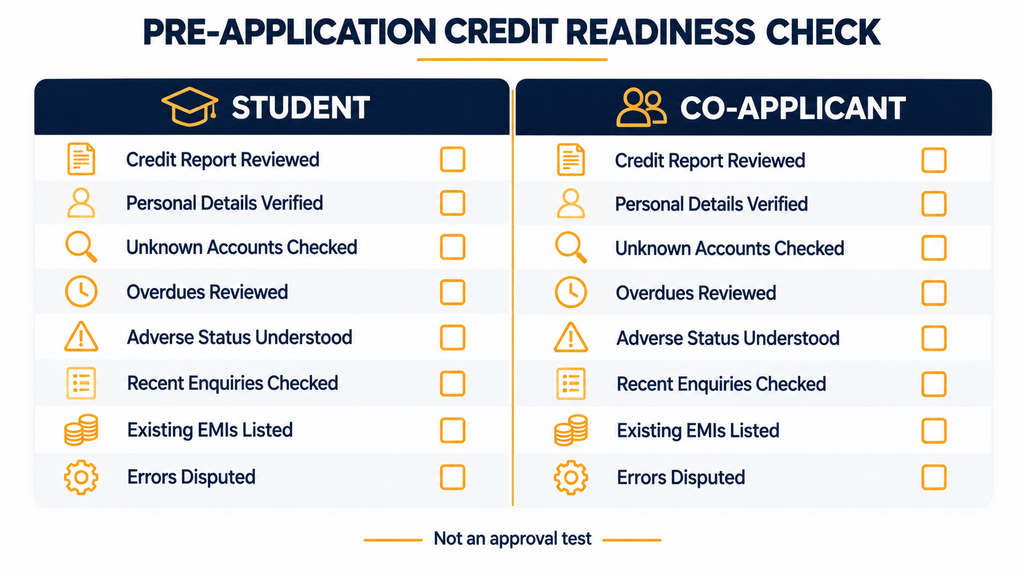
Foreign Edu Loans Pre-Application Credit Readiness Check
Use this checklist for both the student and co-applicant where relevant.
| Check | Student | Co-applicant |
| Latest credit report reviewed | □ | □ |
| Personal details verified | □ | □ |
| Unknown accounts checked | □ | □ |
| Overdues reviewed | □ | □ |
| Settled/written-off status understood | □ | □ |
| Recent enquiries checked | □ | □ |
| Existing EMIs listed | □ | □ |
| Genuine inaccuracies disputed | □ | □ |
This checklist is not an approval test. It is a practical pre-application framework designed to reduce preventable credit-file problems before underwriting.
Some Common mistakes to avoid
- Treating 700 or 750 as a universal cutoff. No industry-wide minimum was verified.
- Applying to many lenders blindly. Repeated formal enquiries can weaken the credit profile.
- Ignoring the co-applicant. The co-applicant CIBIL score importance can be substantial where that person is assessed.
- Treating “settled” as “closed”. CIBIL distinguishes these statuses.
- Buying an instant score-increase promise. No official source used here guarantees a fixed improvement within a fixed time.
Avoiding these mistakes gives a more realistic understanding of the CIBIL score impact on education loan approval.
Responsible borrowing: approval is not affordability
A strong credit profile does not mean you should borrow the maximum amount offered.
Start with the actual funding gap after family contribution, scholarships and other confirmed resources. Then compare expected borrowing cost, moratorium interest, repayment tenure, EMI, co-applicant liability, collateral exposure where applicable, currency risk and uncertainty around post-study income.
Borrowing Rule: Compare the complete repayment commitment, not only the sanctioned amount or advertised interest rate.
The CIBIL score impact on education loan approval tells you something about credit risk. It does not tell you whether the loan is affordable.
For repayment planning, Foreign Edu Loans has a detailed education loan moratorium and EMI guide and an education loan EMI calculator guide.
How Foreign Edu Loans can help
Foreign Edu Loans is not a bank, NBFC or a lender, it is an education-loan facilitation and guidance platform. Its present conditions are that it does not itself approve sanction, disburse credit decisions. Lender decisions and terms are at last left with the appropriate lender.
Foreign Edu Loans may help students gain knowledge of funding requirements, existence of appropriate and viable loan facilities, document organisation and coordination.
Visitors to choose fund configurations may visit the Foreign Edu Loans loan products section and the study abroad education loan guide
If you are worried about the difference in CIBIL score impact on education loan approval, you can avoid unnecessary surprises by checking the student and co-applicant profiles before completed applications are made.
FAQs
Is 750 CIBIL mandatory for an education loan?
No universal 750 rule was verified from RBI or TransUnion CIBIL. There is no single credit score requirement India-wide that applies to every education-loan lender. A lender may use its own underwriting criteria.
Can a student with no CIBIL history get an education loan?
No credit history is not automatically bad credit. A No Hit means there is insufficient credit activity to generate a score and report. Lender-specific rules still apply.
Does the co-applicant’s CIBIL Score matter?
It can. InCred explicitly considers co-borrower creditworthiness and credit histories in education-loan evaluation.
How to improve CIBIL for loan preparation?
For how to improve CIBIL for loan preparation, focus on timely repayment, controlled utilisation, cautious credit applications, monitoring joint obligations and correcting genuine report errors.
Will checking my own CIBIL Score reduce it?
CIBIL supports consumers in monitoring their own CIBIL Score and Report. Formal lender enquiries created when you apply for new credit are different.
Conclusion
The CIBIL score impact on education loan approval is significant, but it is not a universal pass-or-fail formula. A stronger credit profile can support an application, while adverse repayment history can weaken it. No verified RBI or CIBIL rule sets one minimum score for every education-loan lender or product.
Check both the score and underlying report before applying. Review the co-applicant where relevant, correct genuine inaccuracies, avoid unnecessary formal applications and compare the full loan structure rather than chasing a mythical “guaranteed approval” score.
Isolate the eligibility and affordability. Only borrow when the size, the price and settlement obligation to the student and family is viable.