A practical guide to getting additional funding for tuition, living costs and other eligible study expenses
Your education loan may look sufficient when you apply, but the actual cost of studying abroad can change. A revised university fee, higher accommodation costs, insurance, travel or other eligible expenses can leave you with a funding gap.
A top-up loan is not a universal service and is not an automatic loan that can be used by every borrower; however, in certain instances, an education loan top-up of extra costs can be provided. Your lender, your loan product, residual eligibility, documentation and cause of the additional funding all determine whether or not you can increase your current loan.
Find out precisely what you are falling short of (before you ask to borrow some more) whether such expenses can be charged and inquire your current lender to know whether you can have an enhancement or a top-up.
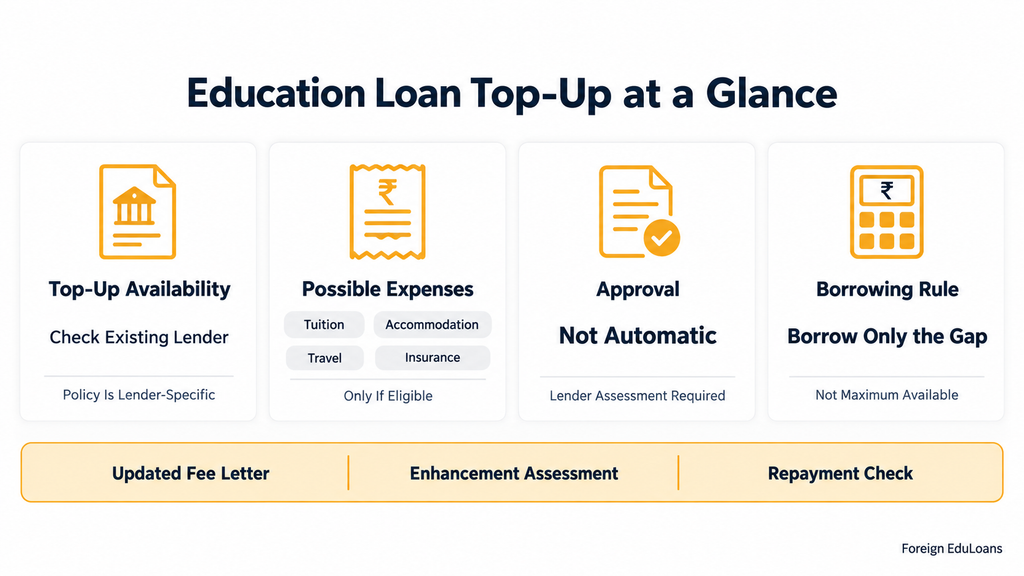
Education loan top-up at a glance
| Question | What you should check |
| Is a top-up available? | Your existing lender’s current policy |
| Why do you need more money? | Tuition, accommodation, travel, insurance or another eligible expense |
| Has your course cost changed? | Get an updated fee letter or official cost document |
| Can your existing loan be enhanced? | Ask the lender for an enhancement or top-up assessment |
| Is approval automatic? | No. Additional funding remains subject to lender assessment |
| What if your lender does not offer a top-up? | Compare a fresh education loan or another suitable financing route |
| Should you borrow the maximum available? | No. Borrow only what you actually need and can repay |
What is an education loan top-up?
An education loan top-up is additional borrowing requested after an existing education loan has already been sanctioned or disbursed.
However, “top-up” is not a universal product structure. One lender may call it an enhancement, another may offer additional funding with a balance transfer, while another may require a fresh application.
For example, Avanse’s official education loan balance-transfer and enhancement information currently describes enhancement funding for eligible applicants and states that eligible applicants may also avail top-up funding for education-related expenses.
That is a lender-specific example. It should not be treated as proof that every bank or NBFC offers the same facility.
The practical question is:
Can your current lender increase your approved funding under your existing loan or through another eligible facility?
Why does an education loan fall short?
A funding gap can appear for several reasons.
1. Your university revises the fee
If your original loan assessment was based on an earlier fee schedule, a later university demand may be higher.
An updated fee letter is therefore useful when discussing an enhancement with your lender.
2. Your living costs are higher than expected
Accommodation, food, insurance and travel can make the original budget insufficient.
However, do not assume that every living expense automatically qualifies for additional education-loan funding. The lender’s loan terms determine what can be financed.
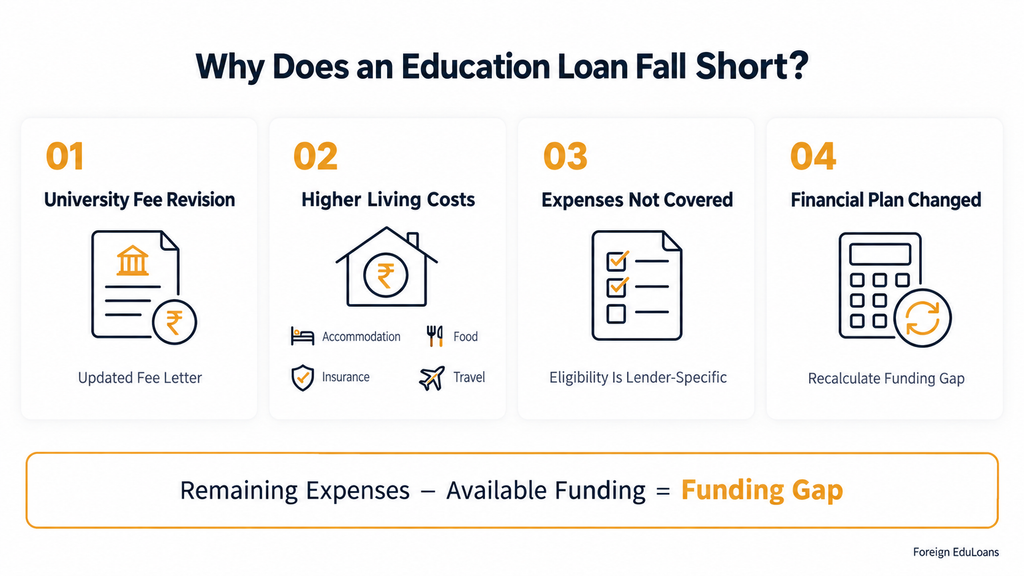
3. Your original loan did not cover every expense
Education-loan products can define which study-related expenses are eligible.
For example, SBI’s current Global Ed-Vantage information lists expenses such as college, school or hostel fees, examination, library and laboratory fees, travel for studies abroad, books and equipment, and certain other course-completion expenses.
Its November 2024 official MITC also lists expenses such as fees, travel, books and equipment, certain deposits and insurance among the expenses considered under the scheme.
The important point is that eligible expenses are lender-specific.
4. Your original financial plan has changed
Your course cost, available savings or other funding sources may no longer match the original plan.
That is why your first step should be to calculate the remaining funding gap rather than immediately applying for the maximum additional amount.
Can your existing lender increase your education loan?
Possibly, but it depends on the lender and your circumstances.
There is no single rule requiring every lender to provide an education-loan top-up.
Avanse’s current education loan information states that the education-loan amount can often be increased through a top-up after fresh assessment and revised fee letters, with approval depending on eligibility at that time.
This gives you a useful framework:
Existing loan + documented additional requirement + lender assessment = possible enhancement
But it is not a guarantee of approval.
Your lender may reassess factors such as:
- remaining course cost
- university and course
- existing outstanding loan
- borrower and co-applicant profile
- repayment capacity
- collateral or security, where applicable
- updated fee or expense documentation
- current lender policy
Top-up, fresh loan or balance transfer: which route should you check?
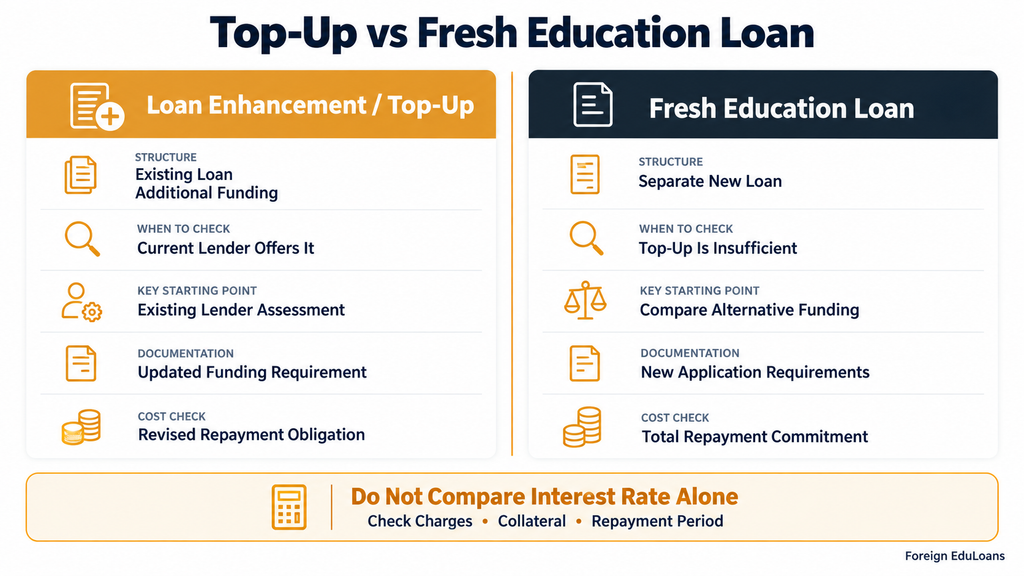
| Route | What it means | When to investigate |
| Loan enhancement/top-up | Additional funding connected to an existing loan | Your current lender offers this facility |
| Fresh education loan | A separate new loan | Your current lender cannot provide enough additional funding |
| Balance transfer | Moving an existing loan to another lender | Another lender may offer a suitable structure |
| Balance transfer + top-up | Transferring existing borrowing and seeking additional funding | The new lender specifically permits this combination |
Avanse’s current student-loan refinance information provides an example of a lender offering enhancement funding alongside balance-transfer options for eligible applicants.
If you are comparing a fresh loan or balance transfer, don’t look only at the advertised interest rate. Compare the complete borrowing structure, including repayment period, charges, collateral requirements and total repayment commitment.
If you need help understanding the main loan structures available for overseas study, you can also compare education loan products for studying abroad before deciding which route to investigate.
How to request an education loan enhancement
If your existing loan is falling short, follow these steps.
Step 1: Calculate the exact shortfall
Do not start by requesting an arbitrary additional amount.
Use:
Remaining eligible expenses − available loan/disbursement = funding gap
As an illustration 30 lakh left of your eligible costs and 24 lakh of funds available:
₹30 lakh − ₹24 lakh = ₹6 lakh funding gap
The ₹6 lakh is your calculated requirement. It is not a guaranteed sanction amount.
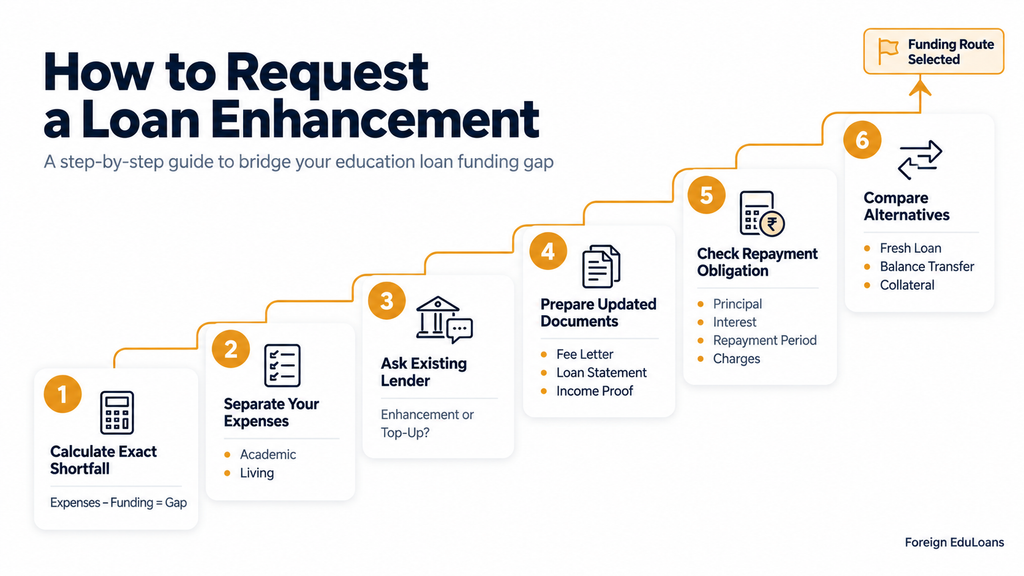
Step 2: Separate academic and living expenses
Create two lists.
Academic expenses
- tuition
- examination or academic fees
- books and equipment
- project or thesis costs
- other documented course expenses
Living and related expenses
- accommodation
- food
- insurance
- travel
- other expenses permitted by your lender
This distinction matters because lenders can apply different eligibility rules to different expense categories.
Step 3: Ask your existing lender about enhancement
Use precise language.
Ask:
“Does my current education-loan product permit an enhancement or top-up for my remaining course expenses?”
Also ask whether your request will be treated as:
- an enhancement
- a top-up
- a fresh sanction
- a balance-transfer facility with additional funding
- or another financing structure
Do not assume that two lenders use these terms in exactly the same way.
Step 4: Prepare updated documents
Your lender may require evidence showing why additional funding is needed.
Depending on your case, useful documents may include:
- revised university fee letter
- university demand letter
- accommodation documents
- invoices or receipts
- updated course-cost statement
- current loan statement
- income documents
- bank statements
- other documents requested during reassessment
Avanse’s current education-loan page lists documents such as proof of admission, fee structure, academic records, income proof and bank statements among education-loan documentation requirements.
You can also review the education loan document checklist when preparing your application.
Step 5: Check the revised repayment obligation
Before accepting additional funding, ask for the revised repayment structure.
You should understand:
- additional principal borrowed
- applicable interest rate
- repayment period
- whether interest accrues during the study or moratorium period
- applicable charges
- resulting repayment obligation
The objective is not simply to obtain more money. It is to close the funding gap without creating an unaffordable repayment burden.
Step 6: Compare alternatives if the top-up is unavailable
If your lender cannot provide additional funding, do not assume another loan is automatically better.
Compare:
- additional amount available
- interest rate and how it is calculated
- processing and other charges
- collateral requirements
- repayment period
- co-applicant requirements
- timing of disbursement
- total repayment commitment
If you do not have collateral, you can separately review education loan without collateral options. If you do have suitable collateral, compare the requirements for an education loan with collateral as well.
The objective is not to choose the loan with the biggest sanction. It is to find a structure that meets the genuine funding requirement without creating an excessive repayment burden.
Worked example: calculate the funding gap first
Suppose your remaining education costs are:
| Requirement | Amount |
| Remaining tuition and eligible academic costs | ₹30 lakh |
| Existing loan available for remaining requirements | ₹24 lakh |
| Funding gap | ₹6 lakh |
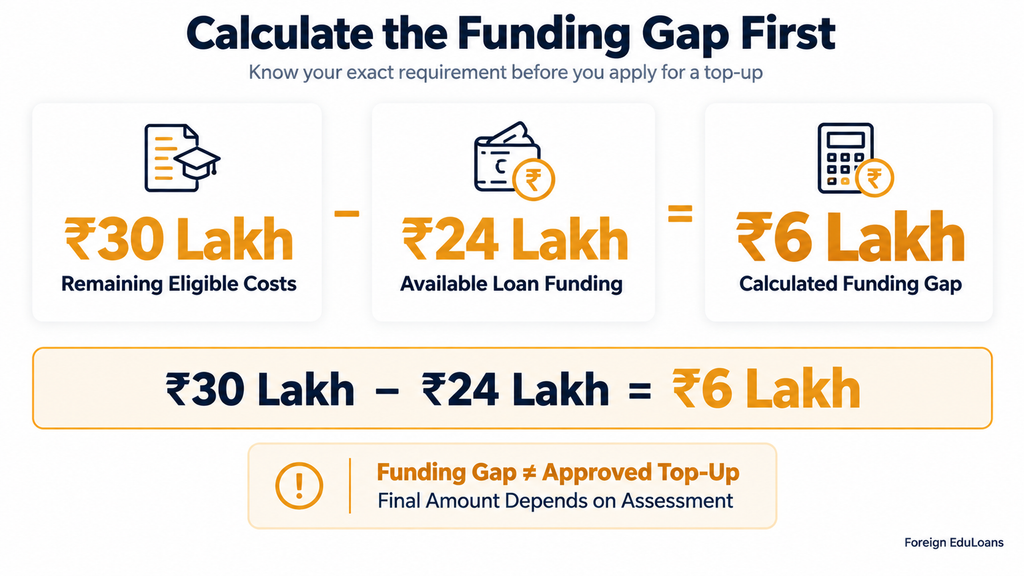
The calculation is:
₹30 lakh − ₹24 lakh = ₹6 lakh
The student should therefore investigate additional funding of approximately ₹6 lakh, subject to the lender confirming which expenses are eligible.
This does not mean the lender will sanction ₹6 lakh.
The actual amount can depend on the lender’s assessment, documentation, eligibility and loan structure.
That distinction is important:
A calculated funding gap is not the same as an approved top-up amount.
What should you ask the lender before accepting additional funding?
Use this checklist:
| Question | Why it matters |
| Is enhancement/top-up available under my existing loan? | Establishes whether the facility exists |
| What expenses can the additional amount cover? | Prevents funding assumptions |
| Do I need a revised fee letter? | Helps prepare documents |
| Will my loan be reassessed? | Determines whether eligibility changes |
| Will collateral or co-applicant requirements change? | Important for secured and unsecured structures |
| What will the revised repayment obligation be? | Measures affordability |
| Are there additional charges? | Helps calculate total cost |
| How will the additional amount be disbursed? | Helps with university payment planning |
Get important terms in writing before relying on them.
Mistakes to avoid when seeking a top-up
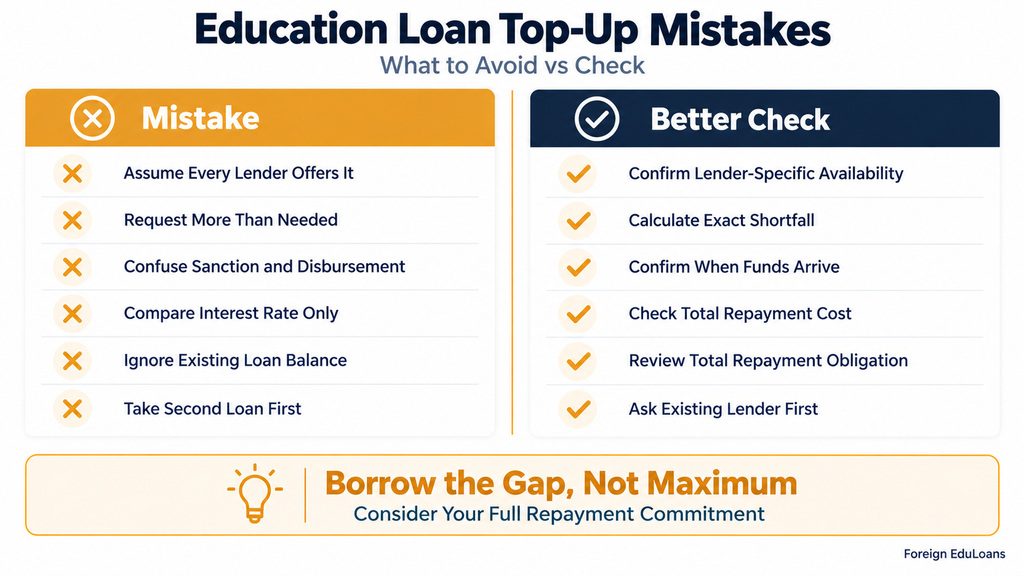
Mistake 1: Assuming every lender offers top-ups
Lenders do not necessarily offer the same facility or use the same terminology.
Mistake 2: Asking for more than your documented requirement
A larger request does not automatically mean a better financial outcome.
Mistake 3: Confusing sanction with disbursement
A sanctioned amount is not the same as money already received.
Always confirm how and when the additional amount will actually be disbursed.
Mistake 4: Looking only at the interest rate
A lower advertised rate does not by itself establish the cheaper borrowing option.
Consider the complete repayment commitment and applicable charges.
Mistake 5: Ignoring the existing loan balance
If you already have a substantial outstanding balance, evaluate additional borrowing alongside the existing repayment obligation.
Mistake 6: Taking a second loan before speaking to your existing lender
A top-up or enhancement may be a suitable route in some cases, but you need to confirm availability rather than assume it.
Responsible borrowing: borrow the gap, not the maximum
An additional education loan can solve an immediate funding problem, but it also increases your future repayment obligation.
Before accepting a top-up, ask:
How much do I actually need?
Then ask:
What will be the cost of this extra borrowing after the period of repayment?
Finally:
What happens if my post-study income is lower or employment takes longer than expected?
Responsible borrowing means considering the full repayment commitment, not just the additional amount sanctioned.
If your calculated gap is ₹6 lakh, for example, do not automatically request ₹10 lakh simply because a lender may permit a higher amount.
Where Foreign EduLoans fits in
Foreign EduLoans is not a bank or NBFC but a study-abroad education-loan management and advice platform.
Its Lender & Partner Disclosure stipulates that with Foreign EduLoans, students can compare and facilitate education-loan programs, whereas loan grant, interest rates and other loan conditions are chosen by the staff of the appropriate lender.
If your existing loan is falling short, the useful question is not simply:
“Which lender gives the biggest loan?”
Instead, you can explore:
- whether your existing lender offers an enhancement
- whether your additional expenses may be eligible
- whether another lender should be considered
- what documentation may be required
- how different financing structures compare
Foreign EduLoans can help you explore these options through its education loan products and lender-matching process. The final sanction, interest rate, charges, eligibility and disbursement remain matters for the respective lender.
FAQs
1. Can I increase my education loan after it has been sanctioned?
Possibly. Some lenders provide enhancement or top-up facilities for eligible borrowers, but availability and approval are lender-specific. Avanse, for example, currently describes enhancement funding and additional top-up funding for eligible applicants.
2. Can an education loan top-up be used for living expenses?
It is subject to the lender, as well as the loan terms. Do not think a top-up is going to spend all matching charges that cover living cost. Ensure you confirm your sanction terms, and confirm with the lender.
3. What documents are useful for an enhancement request?
Updated evidence of the additional requirement is important. Depending on the lender and expense, this may include revised university fee documents, invoices, receipts, accommodation documents and updated financial information.
4. Is a top-up better than taking a new education loan?
Not automatically. Compare the additional borrowing cost, repayment structure, charges, eligibility and documentation requirements before choosing between an enhancement, fresh loan or another financing route.
5. What if my current lender does not offer a top-up?
You can investigate whether a fresh education loan or balance-transfer structure is available and suitable. Your existing loan, remaining requirement, collateral position and lender eligibility can all affect the appropriate route.
Conclusion
A funding shortfall does not necessarily mean you need to start your education-loan journey again. An education loan top-up for additional expenses may be available in some lender-specific situations, but approval is never something you should assume in advance.
Start with the exact funding gap. Then confirm which expenses are eligible, ask your existing lender about enhancement or top-up options, prepare updated documents and compare the revised repayment commitment. If your current lender cannot meet the requirement, evaluate other financing structures carefully rather than borrowing more than you need.
If you want to compare your options before taking additional borrowing, check your education loan eligibility and review the funding route that best fits your requirement.