An Indian student/parent practical guide on how to compare an education loan for medical studies abroad before deciding on the choice of university to join, a lending institution or a repayment plan.
An education loan for medical studies abroad normally requires a course of 6 years of tuition and hostel accommodation, a compulsory period of internship and living allowances in a foreign currency of ₹35 lakh to ₹70 lakh and above, depending on the destination country and university. The banks, NBFCs and international lenders charge this loan differently depending on the collateral, the income of the co-applicant and the reputation of the university. The comparison points are similar whether you are exploring an option of taking an MBBS loan in India or you have a postgraduate medical seat you are looking into with an application for an MD study loan in India. This is a step-by-step explanation of how you can figure out the actual price of an MBBS in a foreign country, the difference between secured and unsecured, the current values of lenders, and what paperwork and NMC authorisation understandings you should be aware of before finding yourself with a loan agreement in your hands.
The interest rates of education loans, collateral regulations, processing fees, university rates and NMC regulations vary quite often. The figures below should be confirmed as at August 2026 and re-checked with the corresponding lender or authority prior to your application.
What does MBBS overseas cost?
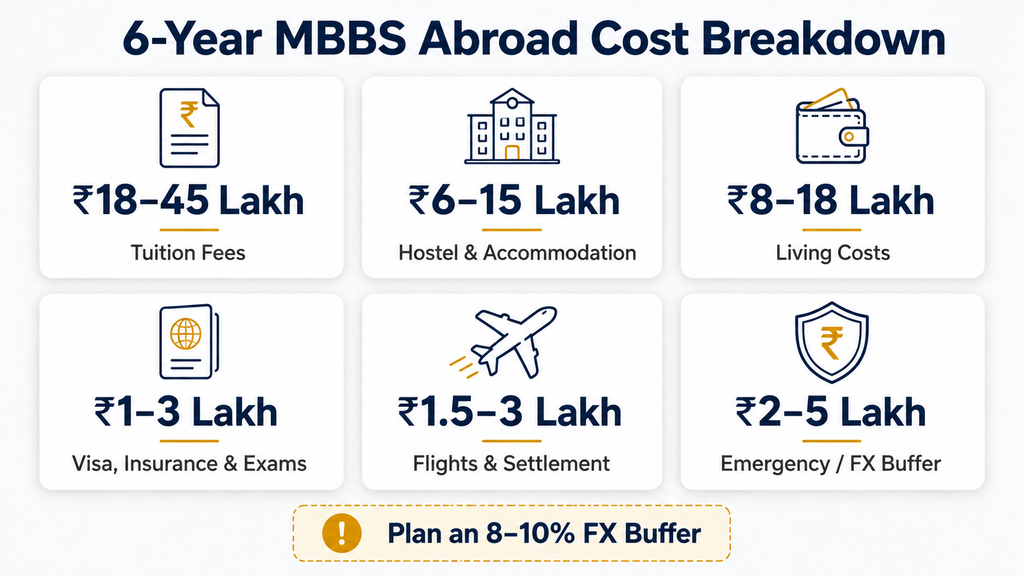
You must know the total cost of the study before shortlisting a lender; not tuition only. The actual education loan for medical studies abroad should be calculated considering the full six years of the process, including the mandatory year of internship.
| Cost head | Typical range (6-year MBBS) | Notes |
| Tuition fees | ₹18–45 lakh | Differentiates radically by country and university. |
| Hostel/accommodation | ₹6–15 lakh | Usually compulsory during the first 1- 2 years. |
| Cost of living | ₹8–18 lakh | Food, utilities, local transport |
| Visa, insurance, examination | ₹1–3 lakh | NEET, IELTS/TOEFL as necessary. |
| Flights & settlement | ₹1.5–3 lakh | Round trips across the course |
| Emergency / FX buffer | ₹2–5 lakh | Suggested, not necessarily paid. |
Budgeting Rule
The price which has to be paid by the parents and students should be the investment in the whole six-year programme rather than the annual tuition amount they have to pay as quoted by a university agent. The same thing can be said about an education loan for medical studies abroad request to get a postgraduate seat, when the costs associated with clinical rotation and thesis are not always included in the initial estimates.
What this Means to You.
Build in a currency-fluctuation buffer of 8–10% points, and then the loan amount was requested, as MBBS programmes are much longer than most other courses; depreciation of rupees in six years can appreciably increase the real-world burden of repayment.
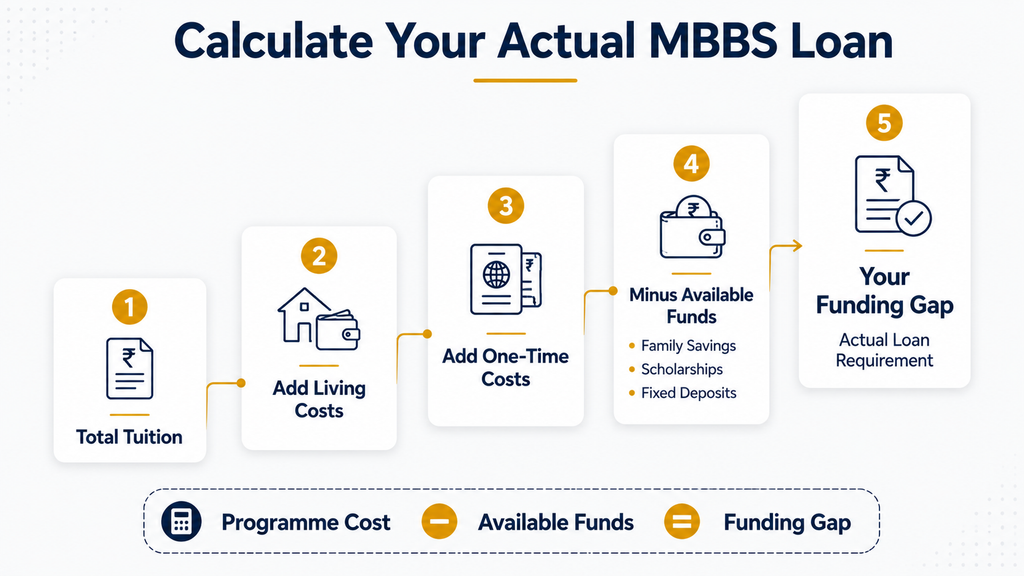
Work Out Your Actual Loan Requirement
Calculate the total programme cost (tuition + living + one-time costs) in local currency and then divide it by INR at a current rate – approximately, around mid-August 2026: ₹95.7 per US dollar; this is not calculated, just an indication and will vary before disbursement.
Minus family savings, scholarships and other fixed deposits set aside to finance education.
Your funding gap is the balance– this is what you take to the lenders to take out less than the entire amount, under an education loan for medical studies abroad.
Secured vs Unsecured: Which is best to be used in an Education loan to attend medical studies abroad?
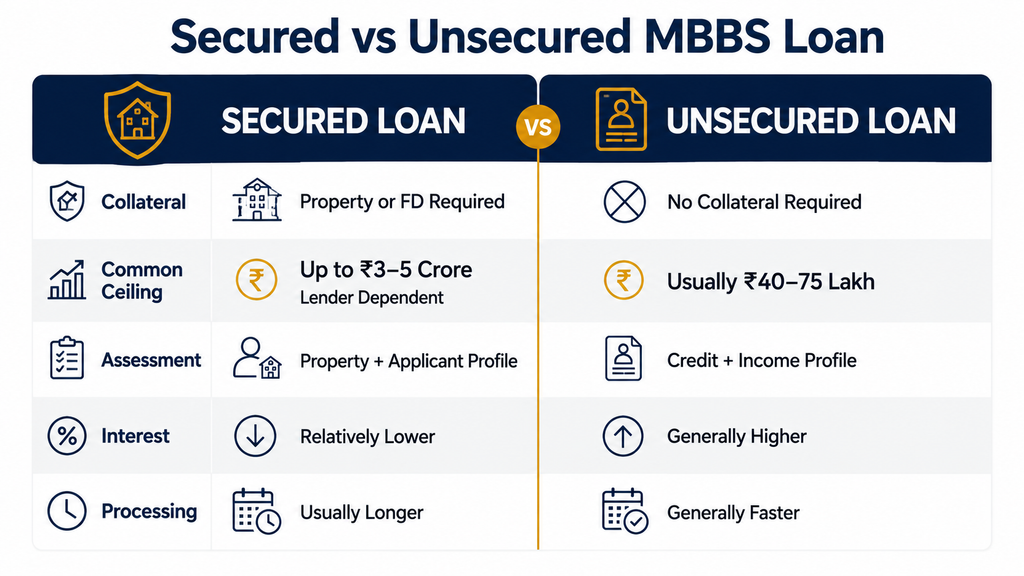
Due to the size of the loan taken up by MBBS overseas and the duration of the loan moratorium of 6 years, the majority of lenders are willing to offer collateral for this type of course, although in unsecured cases the loan moratorium limit is also up to a certain limit.
| Factor | Secured Loan | Unsecured Loan |
| Collateral | Required Property or FD | Not required. |
| Common ceiling | As high as 3-5 crore (lender dependent) | Usually not more than 40-75 lakh. |
| Basis of assessment | Value of property + applicant profile | Credit profile + applicant income + co-applicant income + credit profile |
| Interest rate | Tend to be relatively lower | Tend to be larger. |
| Processing time | Longer, due to legal and valuation checks | Generally faster. |
What that Means to You.
Since MBBS in foreign countries may require bank fees ranging from 35 lakh or higher, most families find themselves comparing the offered products of Baroda Scholar-, SBI Global Ed-Vantage-, or Credila-type as opposed to using unsecured limits. Avoid removing collateral by confirming with the lender prior to disqualifying education loan for medical studies abroad under the unsecured ceiling.
Collateral, Co-Applicant and Medical Education Loan Eligibility
There is no universal rule regarding the eligibility of education loan for medical studies abroad which is unrelated to any single student, co-applicant, university or lender.
- Collateral: Lenders can take residential property, and in selected instances fixed deposits, as long as its title is cleared, valued and verified legally. Real estate that is disputed or has a current mortgage usually cannot be accessed until resolved.
- Co-applicant: Co-applicant is a parent, spouse or sibling with a stable income. Lenders will evaluate income, present EMI payments and credit record – this is crucial for medical education loan eligibility since the co-applicant is obliged to serve a six-year moratorium long-term even though only the student is the beneficiary.
- Credit profile: An excellent CIBIL score enhances the possibility of receiving education loan for medical studies abroad, yet there is no particular credit profile to specify that will certainly be approved; personally ensure lender parity.
Common Mistake
One of the most common reasons behind delayed applications or declined applications at underwriting is not verifying the co-applicant credit report of the applicant.
Comparing Lenders for an Education Loan for Medical Studies Abroad
Rates lower than these are representative initial rates with official lending sites and lender-approved associate exposures in August 2026. The real rates are determined by the profile of the applicant, security and the university, as well as the internal policy of the lender when the application was made.
| Lender | Loan value (outside country) | Indicative initial rate | Collateral-free limit. |
| SBI – Global Ed-Vantage | ₹7.5 lakh – ₹3 crore | Out of an estimated 8.9% (floating) | Up to ₹50 lakh in some institutions. |
| Bank of Baroda -Baroda Scholar | Up to ₹1.5 crore (premier) | Between circa 8.7 and 9.5% (floating) | Restricted; mostly premier listed institutions. |
| Credila (NBFC) | Not more than ₹75 lakh+ unsecured; more so with collateral | Between 9.5-10% | Up to ₹75 lakh (profile-dependent) |
| Avanse Financial Services | Lender specialty | Check existing rate | Offer on unsecured particulars. |
| MPOWER Financing / Prodigy Finance | Programme-specific, usually USD-denominated | Verify present rate & currency | As a rule, no Indian collateral is required. |
Rates looked at on: August 2026. Interest rates are not binding, and they may increase or decrease based on the profile of the applicant, type of loan product and policies of the lender- always make sure that the current one applies before submitting.
Read out: Public Bank vs Private Bank vs NBFC Education Loan
What This Means to You
The best education loan for medical studies abroad is not necessarily the one with the lowest rate that is advertised. Compare eligibility, total borrowing cost, collateral, fees, length of moratorium and its terms of disbursement, as a six-year MBBS abroad India commitment cannot possibly earn the same amount of money in moratorium interest as a one- or two-year master’s degree. An MD study loan India shortlist is in the same category of comparison.
NMC and NEET Compliance: A Step Before You Borrow
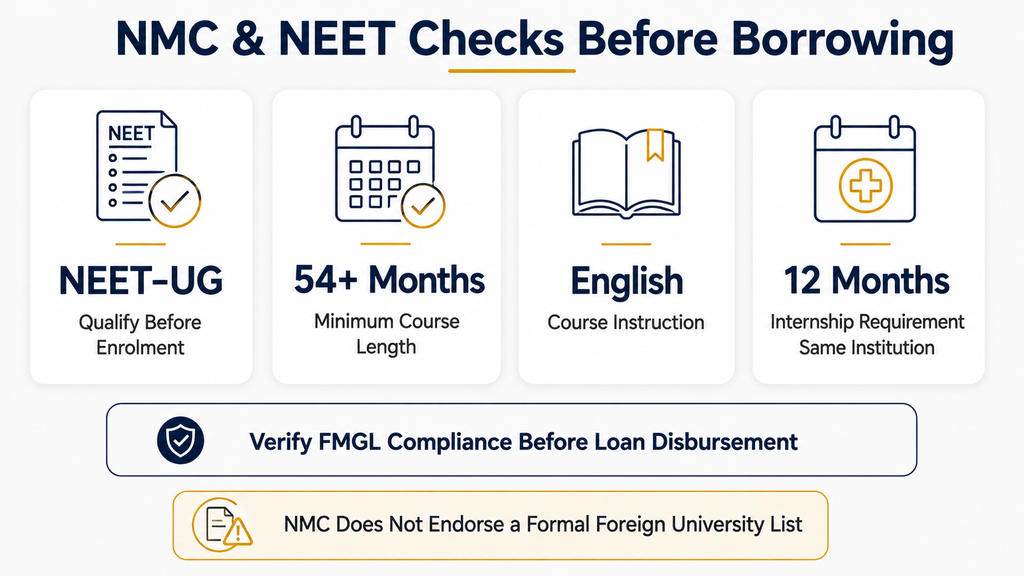
Since an education loan for medical studies abroad is not processed until your application is accepted, make sure that NMC is already in place; the first mistake you make with the incorrect degree cannot be rectified through refinancing. According to the Foreign Medical Graduate Licentiate Regulations of NMC, Indian students need to pass NEET-UG prior to enrolling in an MBBS course abroad; the course needs to be at least 54 months long in English with a 12-month internship at the same institution, and the graduate must pass FMGE or an equivalent test to be registered as a doctor in India. Ask the university and NMC to verify these details with their own advice before drawing the funds of the loan; even college banks offer higher education, based on the course you want; they do not provide Indian recognition for it.
Important Note
NMC has affirmed that it does not produce or support a formal list of foreign medical institutions it deems to be approved. The student and the family have the responsibility of verifying the compliance of a university, and not the lender.
The Requirement of Documents in education loan for medical studies abroad
| Category | Typical documents |
| Student identity | PAN, Aadhaar, passport, photographs. |
| Academic | 10th/12th/ NEET marksheets, admission/offer letter, fee structure. |
| Co-applicant | PAN, address proof, income proof (salary slips/ITR), bank statements |
| Security interests (supplied on security) | Title, property tax receipts, owner records. |
Precise list of documents depends on the type of lender and profile of an applicant; get an individual checklist with the shortlisted lender.
Check out: How to Apply for Education Loan for Abroad
Loan Process, Sanction and Disbursement
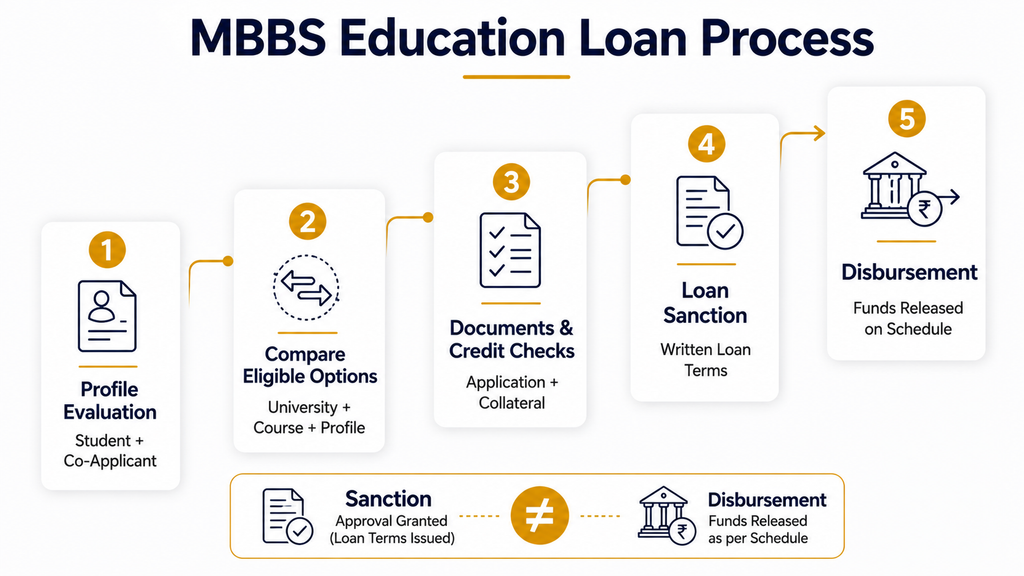
Loan sanction refers to the lender giving an approval to the loan under certain stipulated terms. Loan disbursement implies the allocation of sums of money- more often than not in instalments based on the academic years and the yearly payments made by the university. The two are not synonymous, and a letter of sanction does not imply that money is received at the university.
| Stage | What happens | What can influence timing. |
| Profile evaluation | Review of student and co-applicant by Lender | Document completeness. |
| Comparison of eligible options | University, course, profile | Lender shortlisting |
| Documentation/credit checks | Application and collateral checks | Missing documents, appraisals. |
| Sanction | Written terms | In-house approval process. |
| Disbursement | Money issued on schedule | University and visa schedules. |
Tax Benefit Under Section 80E
The interest charged on an education loan for medical studies abroad, such as MBBS, MD or similar courses of medicine, is deductible under Section 80E of the Income Tax Act, 1961, where there is neither a limit to the number of eligible loans nor a limit to the size of the loan. The deduction would only be applicable to the interest component, but not to principal, and to a maximum of eight yearly assessments, like where the repayment of interest has commenced, and the deduction remains until interest is completely repaid- whichever is earlier. The loan should be obtained with a recognised financial institution or approved charitable institution; loans between friends are ineligible. This is broad general information and not personalised tax advice; consult a tax professional with your particular circumstances.
Repayment and Moratorium and the Six-Year Reality.
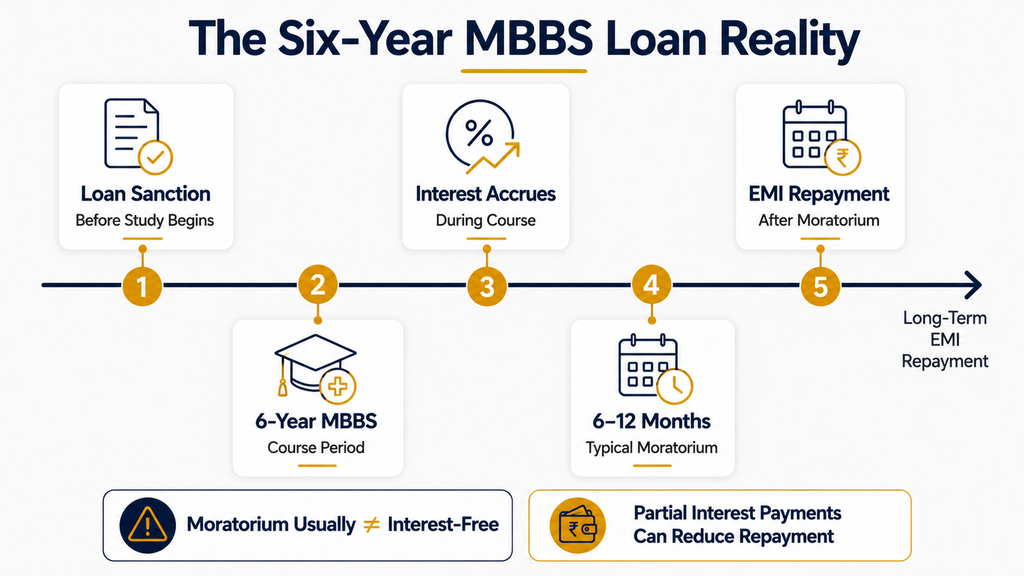
Moratorium on MBBS overseas applies generally to the 6-year curriculum plus 6-12, but the interest will most likely run on until that time unless the loan specifically indicates otherwise – do not think that it is no interest. Due to the length of the MBBS course (as compared to most other courses), unpaid interest in the moratorium can grow significantly to the principal by the time EMIs start. In case it is affordable, even partial payment of simple interest in the course years will cut down the overall repayment significantly. The longer the period in years the repayment term is, the lower the EMI and vice versa.
Common Mistakes Families Make
- Considering MBBS and postgraduate medical financing the same without examining programme-specific conditions of tenure and moratorium.
- Using the interest rate that is advertised rather than the overall interest to repay.
- Making an application to one lender rather than shortlisting two or three options that are eligible.
- Disregarding six years of accruing interest in the moratorium in budgeting the EMI.
- Undervaluing living expenses and monetary change borders in a prolonged programme.
- Failure to check the compliance of the university with NMC/FMGL prior to signing the loan agreement.
- Providing high-value collateral without insight into valuation and release terms.
- Calculating the minimum advertised price as a given profile.
- Selecting the maximum tenure to reduce total interest without considering the total interest.
- Including misleading loan sanction with really disbursed funds to the university.
Responsible Borrowing for a Six-Year Commitment
The things to look into before signing include the gap in funding after scholarships and family contribution, the actual repayment schedule in the future after FMGE/NExT, and the possibility of making half-payments throughout his course. It is impossible to ensure that any lender offers a certain rate, a certain approval date, or a certain date of its disbursement; each application is individually underwritten by the lender.
The help of Foreign Edu Loans.
Foreign Edu Loans operates within public-sector banks, privately based banks and NBFCs and foreign education lenders, and assists students in finding an appropriate credit to finance medical studies overseas: Grouping them according to their university, the amount required, the collateral and co-applicant profile available. Loans are not approved by Foreign Edu Loans itself; sanction and final terms are given by the applicable lender according to their own credit policy.
Eligibility: Check Your Education Loan.
It takes just a minute to assist you in the comparative process of their eligible lenders on behalf of your MBBS abroad loan India need, and you can quickly obtain the Study Abroad Education Loan Guide 2026-27 before you enter the applications.
FAQs
What is the maximum limit to an MBBS abroad loan India needs?
Lenders, collateral, and university have varying amounts of loans to give to students, with unsecured schemes ranging between ₹7.5 lakh and ₹3 crore. The real balance to be charged actually is a function of total cost, family contribution, as well as co-applicant profile, and therefore consider the published maximums merely as upper limits, rather than as guarantees.
Do I need any collateral in the education loan for medical studies abroad to travel?
Not in all cases; however, due to the fact that MBBS abroad often requires a large loan over the course of six years, most students tend to seek secured products, as unsecured limits tend to generally be smaller and are often dependent on profile.
How much should my co-applicant earn in order to be eligible to receive education loan for medical studies abroad?
It is not a one-size-fits-all situation, with every lender developing its own income and credit requirements, depending on the loan amount, collateral and its internal policy – this is just as true of an MD study loan India application as it is of an MBBS one. Arrange the exact need with your shortlisted lender.
Is the moratorium interest-free?
No, in general. Simple interest generally keeps building up throughout the course and moratorium, except under the exception of a particular loan product; confirm this expressly with your loan provider.
Might I deduct on an education loan for medical studies abroad?
Yes, paid interest is subject to Section 80E, up to eight consecutive assessment years beyond which the amount deducted is limited, provided the loan is not between the familiar institution.
What is the fate in case my NEET or compliance with NMC is not finished?
NMC recognition is not checked when you are accepting the loan. Check NEET qualification and FMGL conformity with the university and Non-Medical Central guidance on its own, as an unrecognised degree cannot be corrected by refinance in the future.
When is the right time to seek funding?
Make sure that you start the process of shortlisting loans immediately upon securing an offer letter, as the sanction process can sometimes take several weeks and a significant number of lenders can execute a sanction letter prior to your visa interview.
Conclusion
It is a continuing commitment of six years, not a one-time purchase, which is why an education loan for medical studies abroad is not as simple as it seems on the surface; however, the best composite cost, collateral, moratorium, interest, and repayment of two to three eligible lenders is what counts. Check the NMC and NEET requirements, check all the rates and qualification numbers with the lender before you borrow, and find the published numbers as a guide, not an ultimate proposal.
Confirm your eligibility to get an Education Loan. Compare possible suggestions to your university, co-applicant requirements and the loan required.